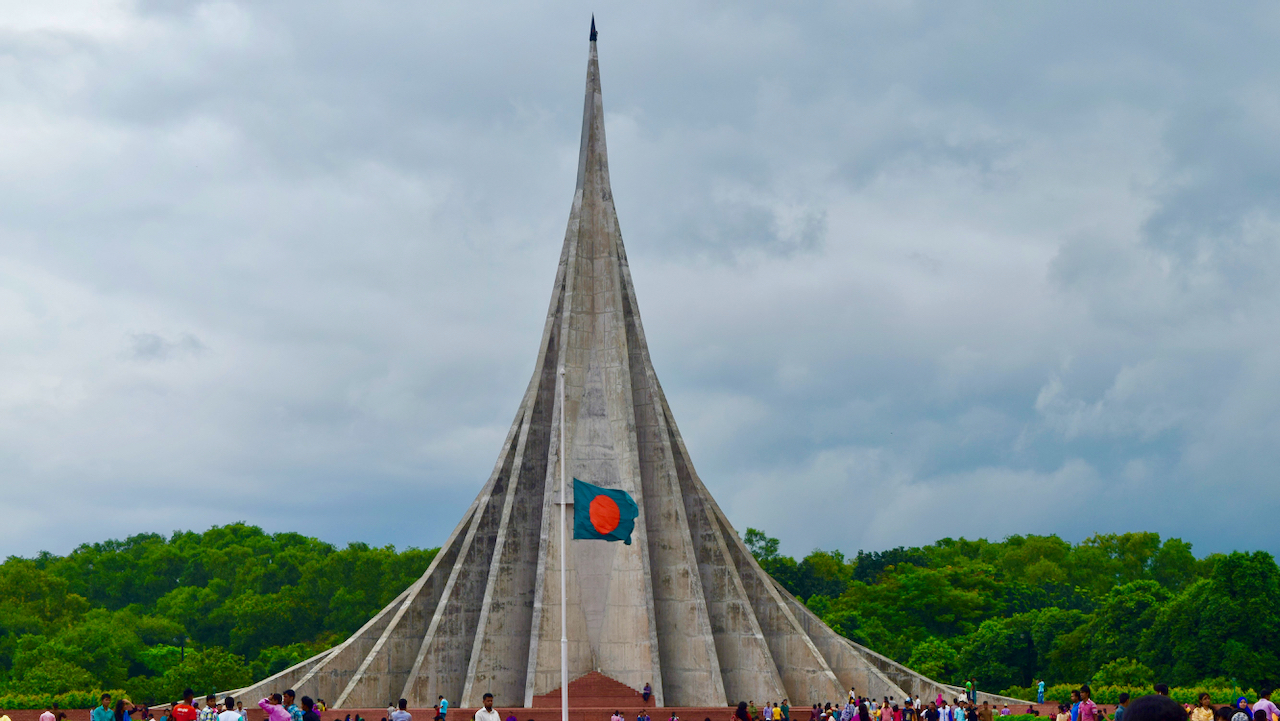
National monument of Bangladesh also known as the National Martyrs’ Memorial is a fascinating piece of architecture. It is located in Savar which is about 35 Kilometers and 90 minutes ride from the capital Dhaka. You can visit this place as a day trip from Dhaka. In this writeup, you will know about the history behind the national monument of Bangladesh and how a nation was born despite all the odds.
The National Monument of Bangladesh, Jatiyo Smriti Soudho, is the National Martyrs’ Memorial in Savar, about 35 km north-west of Dhaka. It honours the people who died in the 1971 Liberation War. Its seven triangular concrete walls, rising to 150 feet (46 m), stand for the seven key movements on the road to independence, from the 1952 Language Movement to the 1971 war. Entry is free, and it is an easy half-day trip from Dhaka.
Where
Savar, Dhaka district
Nabinagar, on the Dhaka to Aricha highway
From Dhaka
1 to 2 hours by road
Depends heavily on traffic
Entry
Free
No ticket or booking
Hours
Daytime, every day
Closed for days before 26 March and 16 December
Height
150 feet (46 m)
Designed by Syed Mainul Hossain
Why This Monument Matters to Me
Before I tell you about the monument, let me share a conversation I have had many times while travelling.
“Where are you from?”
“Bangladesh.”
A moment of silence.
“Do you recognise where it is?”
The answers vary:
“Pardon?”
“Not actually.”
“Sorry, I don’t know.”
“Is it in Oceania?”
“Of course! It’s in India.”
Those replies used to annoy me. Now I accept them, and before I answer, I open Google Maps on my phone and point to Bangladesh.
It still amuses me that so many well-travelled people do not know one of the most populous countries on earth. But travellers are supposed to have big hearts, so I let it go. To understand why the National Monument means so much to Bangladeshis, you need a little history.
The Story Behind the Monument: 1947 to 1971
The story begins in 1947, when the British left the Indian subcontinent and split it into two countries, India and Pakistan. Pakistan itself had two parts: West Pakistan (today’s Pakistan), where the central government sat, and East Pakistan (today’s Bangladesh), separated from the west by about 1,600 km of Indian territory.

The two halves shared a country and a religion, Islam, and little else. East Pakistan had the larger population and spoke Bengali, with its own food, music and centuries-old literature. West Pakistan spoke Urdu, Punjabi, Sindhi and other languages.
In 1948, the government declared that Urdu alone would be the national language, even though most people in the east spoke Bengali. The protests grew, and on 21 February 1952, police opened fire on demonstrators in Dhaka, killing several people who were asking to use their own language.
That date, 21 February, is now marked around the world as International Mother Language Day, recognised by UNESCO.
Two Decades of Inequality
Through the 1950s and 1960s, East Pakistan earned much of the country’s export income, mainly from jute, but most of the spending on education, health, infrastructure and the army went to the west.
By the late 1960s, a mass movement had formed around the Awami League and its leader, Sheikh Mujibur Rahman. Its central demand was autonomy: the right of East Pakistan to govern itself within a federal Pakistan.
The 1970 Election
In December 1970, Pakistan held its first general election based on one person, one vote. The Awami League won 160 of the 300 general seats in the National Assembly, an outright majority.
The military government of President Yahya Khan, with Zulfikar Ali Bhutto’s Pakistan Peoples Party, refused to hand over power, and the National Assembly session was postponed indefinitely. East Pakistan erupted in protest.
Operation Searchlight and the Liberation War
On the night of 25 March 1971, the Pakistani army launched Operation Searchlight, a military crackdown on the people of East Pakistan meant to crush the independence movement.
Soldiers attacked Dhaka University’s halls of residence, killing students and teachers, and set fire to parts of Old Dhaka. Over the following months, the violence spread across the country: villages were burned, civilians were killed, and sexual violence was used as a weapon of war.
Yahya Khan is reported to have said before the crackdown, “Kill three million of them and the rest will eat out of our hands.”
Nine months of war followed. Against a professional army stood farmers, students, teachers, writers and fishermen, many of whom joined the freedom fighters, the Mukti Bahini.
India entered the war in December 1971 in support of the Mukti Bahini, and the Pakistani army surrendered in Dhaka on 16 December 1971, now celebrated as Victory Day. Bangladesh was born.
Estimates of the number of people killed range from several hundred thousand to three million, the figure Bangladesh officially uses. The National Monument is dedicated to all of them.
The Architecture of the National Monument

Knowing what the design means makes the monument far more powerful in person.
The monument is made of seven triangular concrete walls, set one behind the other. The outer walls are the widest and lowest; each one behind is narrower and taller, and the innermost rises to the peak at 150 feet (46 m).

The seven walls stand for seven key movements in the struggle for independence:
- The Language Movement of 1952
- The 1954 provincial election, won by the United Front
- The constitution movement of 1956
- The education movement of 1962
- The Six-Point Movement of 1966
- The mass uprising of 1969
- The Liberation War of 1971
The concrete has a rough, textured finish rather than a smooth, polished one. To me, it speaks of struggle and sacrifice more than triumph.

The architect, Syed Mainul Hossain, was only 26 when his design won a national competition in 1978, chosen from 57 entries. The monument was inaugurated on 16 December 1982. He received the Ekushey Padak, one of Bangladesh’s highest civilian honours, in 1988, and died in 2014.

Stand directly in front of the monument and it looks like a single, symmetrical peak. Move to either side and it changes into a rising wave, a row of blades. Every angle shows a different shape, so walk all the way round before you pick your favourite view.

The artificial lake in front of the monument catches its reflection, and on a still morning, the effect is beautiful.

The landscaped complex covers about 84 acres, with a further green belt around it. Along the paths, you will find ten mass graves of unknown martyrs from the war. Take your time here; this is a place for quiet reflection.
Visiting heads of state usually lay a wreath here, and many have planted a tree in the grounds. Small plaques next to the trees record who planted them.
The National Monument of Bangladesh is one of the most marvellous structures I have ever seen. Maybe I am biased, maybe not; I will leave that for you to decide.
And the next time someone asks me where I am from, I will not hesitate. I hope you know where it is now.
I will smile and say, “I am from Bangladesh.”
How to Visit the National Monument
Opening Hours and Closures

The complex is open every day during daylight hours. There is no official published timetable; visitor guides give roughly 8am to 6pm, so plan to arrive in the morning and leave by sunset.
Best Time to Visit

- Early morning: soft light, cooler air and the fewest people, especially on weekdays.
- Late afternoon: low sun throws long shadows across the concrete walls, and you can stay for the sunset.
- Season: November to February is the most comfortable time, with dry, cooler weather.
- Avoid: Fridays, public holidays, and the days around 26 March and 16 December, when crowds are huge or the gates are closed.
Entry Fee
Free. There is no ticket and no booking, and you do not need a guide.
How to Get There from Dhaka
The National Monument is at Nabinagar in Savar, about 35 km north-west of central Dhaka on the Dhaka to Aricha highway. Traffic decides everything: the drive can take under an hour early in the morning and well over two hours at busy times.
By ride-hailing app (easiest for visitors): book an Uber or Pathao car from your hotel. Check the fare in the app before you book, and for the return trip, either book again from the gate or agree a waiting charge with your driver.
By car with driver: your hotel can arrange a car for a half day. This is the most comfortable option, especially if you want to add Jahangirnagar University or other stops in Savar.
By local bus (cheapest): buses towards Savar and Nabinagar leave from Gabtoli and other points in Dhaka; operators include Welcome, Thikana, D-Link and Mou Mita. Ask for “Smriti Soudho” or Nabinagar, and the conductor will tell you where to get off; the main gate is a short walk away. Buses are crowded and staff rarely speak English, but the fare is very low.
Google Maps: National Martyrs’ Monument, Savar
A Half-Day Trip from Dhaka
- Leave Dhaka by about 7:30am to beat the traffic and the heat.
- Spend 1.5 to 2 hours at the memorial: walk all the way round the monument, find the reflection in the lake, and visit the mass graves.
- Add Jahangirnagar University next door for a stroll through its green campus, its lakes and, in winter, migratory birds.
- Have lunch nearby (see below), then head back to Dhaka before the afternoon traffic builds.
Where to Eat Near the National Monument
Near the Gate
There is a cafeteria inside the complex, and small restaurants line the highway around Nabinagar, including Joy Restaurant, across the road from the entrance. Expect simple Bangladeshi meals of rice, fish or chicken curry, and dal at local prices.
Bhorta at Jahangirnagar University
The Batatola area of Jahangirnagar University, next to the memorial, is known for cheap rice meals served with dozens of kinds of bhorta (mashed vegetables, fish and lentils with mustard oil and chilli). It is a fun, local way to finish the trip.
Other Famous Monuments in Bangladesh
The National Monument is the best-known memorial in Bangladesh, but it is far from the only one. These are the other landmarks and monuments I would put on a first trip:
- Central Shaheed Minar, Dhaka: the memorial to the martyrs of the 1952 Language Movement, the focus of every 21 February.
- Martyred Intellectuals Memorial, Rayer Bazar, Dhaka: marks the killing of teachers, doctors, writers and journalists in December 1971.
- Liberation War Museum, Dhaka: the best place to understand the history before you visit Savar.
- National Parliament House, Dhaka: Louis Kahn’s modernist masterpiece.
- Lalbagh Fort and Ahsan Manzil, Old Dhaka: a 17th-century Mughal fort and the pink palace of the Dhaka Nawabs.
- Sixty Dome Mosque, Bagerhat, and Somapura Mahavihara, Paharpur: two UNESCO World Heritage Sites.
Most of the Dhaka sights are in my guide to the best places to visit in Dhaka, and you can see the old city in my Old Dhaka photo story.
National Monument of Bangladesh FAQs
What is the National Monument of Bangladesh called in Bangla?
Jatiyo Smriti Soudho (also spelled Jatiyo Sriti Shoudho). Jatiyo means national, smriti means memory and soudho means monument. Its official English name is the National Martyrs’ Memorial.
Where is the National Monument of Bangladesh?
At Nabinagar in Savar, about 35 km north-west of central Dhaka, on the Dhaka to Aricha highway.
What do the seven walls of the National Monument represent?
Seven key movements on the road to independence: the Language Movement (1952), the United Front election (1954), the constitution movement (1956), the education movement (1962), the Six-Point Movement (1966), the mass uprising (1969) and the Liberation War (1971).
Who designed the National Monument of Bangladesh?
Architect Syed Mainul Hossain, who won the national design competition in 1978 at the age of 26, from 57 entries. He received the Ekushey Padak in 1988 and died in 2014.
When was the National Monument built?
Work on the main structure followed the 1978 design competition, and the monument was inaugurated on 16 December 1982, the 11th anniversary of Victory Day.
How tall is the National Monument of Bangladesh?
The highest point is 150 feet, or about 46 metres.
Is there an entry fee?
No. Entry is free, with no ticket or booking needed.
What are the opening hours?
It is open daily in daylight, roughly 8am to 6pm according to visitor guides. It closes to the public for several days before 26 March and 16 December.
How long should I spend at the National Monument?
Allow 1.5 to 2 hours to walk round the monument, see the lake and the mass graves, and take photos. With travel from Dhaka, it makes a half-day trip.
Is photography allowed?
Yes, in the public areas of the complex. Drones need permission and are likely to be stopped.
Explore More of Bangladesh
The National Monument tells the story of Bangladesh in concrete. The rest of the country shows you its rivers, hills and coast:
- 🏙️ Places to visit in Dhaka: the capital’s highlights, many linked to the Liberation War
- 🏖️ Cox’s Bazar: one of the longest natural sea beaches in the world
- 🏝️ Saint Martin’s Island: the only coral island in Bangladesh
- 🌿 Birishiri: a remote village near the Garo Hills that most visitors miss
A Final Word
The National Monument is not a comfortable place in the way a beach or a market is. It asks you to stand with a painful history and remember the people who died so that Bangladesh could exist.
It is also a place of deep pride. Visit early, walk slowly, and give it the time it deserves.
Found this guide useful? Leave a comment below, and pin it to help other travellers find this remarkable corner of Bangladesh.

Leave a reply