
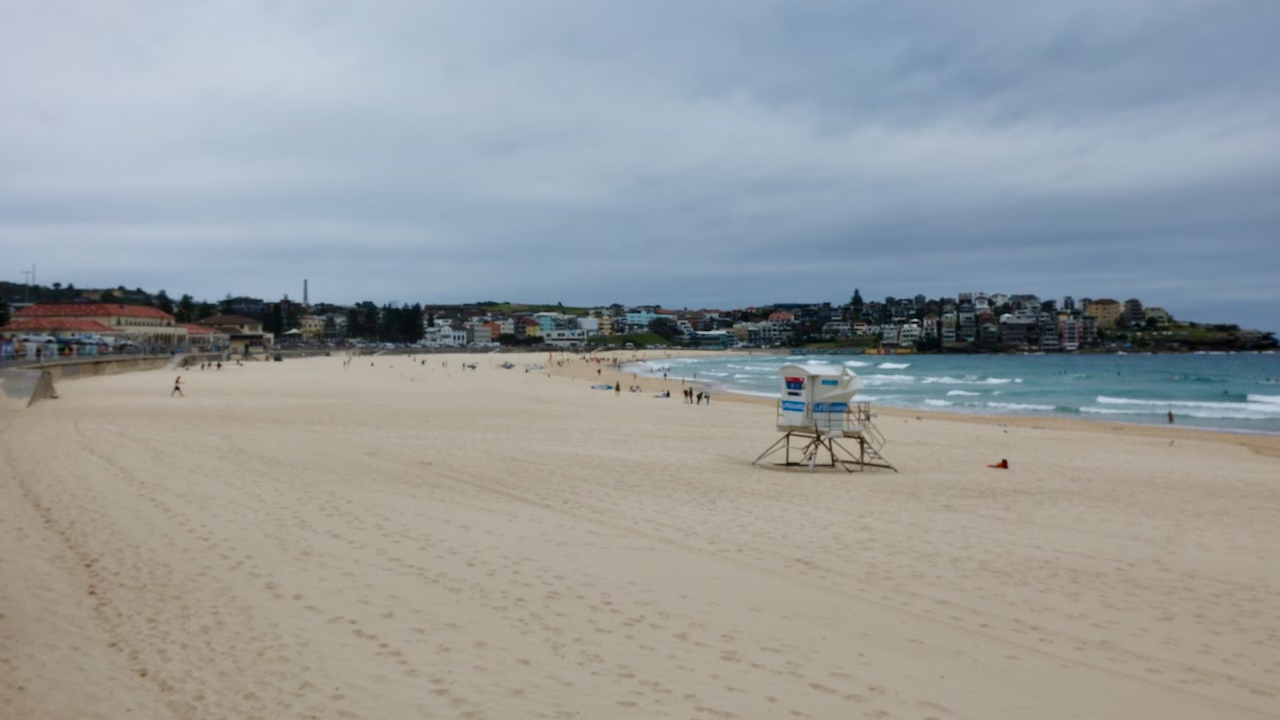
Bondi is Sydney’s most famous beach, and of all the things to do in Bondi Beach, the one I’d start with is the one I did first: almost nothing. I sat on the grass in Bondi Park, then on the sand, and watched the ocean. I went back a few more times, at different times of day, and mostly did the same again.
That’s the first thing to know about Bondi: you don’t need a plan. The beach is free and the bus drops you a few steps from the sand. But if you want more than a towel and a view, there’s plenty here: an ocean pool where waves break over the lanes, a 1929 pavilion with free exhibitions, Aboriginal rock engravings on the northern headland, a surf school on almost every corner and one of Australia’s best coastal walks starting at the south end.
This guide splits Bondi into two parts. The first five things are what I did myself. The rest come from research, official sources and other guides, and I’ve marked them clearly so you know which is which.
In short: the best things to do in Bondi Beach are watching the beach from Bondi Park, swimming between the flags or at Bondi Icebergs, walking the first stretch of the Bondi to Coogee coastal walk, exploring the Bondi Pavilion, dipping in the free North Bondi rock pools and finding the Aboriginal rock engravings on the northern headland. The beach is about 7 km from the city centre, and half a day is enough for the highlights.
Bondi is on the Country of the Gadigal and Birrabirragal people. I acknowledge them as its Traditional Custodians.
This post contains affiliate links. If you book through them, I may earn a small commission at no extra cost to you.
Cost
Free
Icebergs pool $10
Getting there
Bus 333 from Circular Quay · or T4 train to Bondi Junction, then bus 333 or 380
No train station at the beach · tap on with Opal or a contactless card
Time needed
Half a day
A full day with the coastal walk
Best time
Early morning or late afternoon
November to April for swimming
Swimming
Between the red and yellow flags
Avoid the south end rip
Facilities
Toilets and showers in the Pavilion
Free things to do in Bondi Beach
Bondi Beach Map
Bondi Beach runs for about a kilometre between Bondi Icebergs at the south end and the North Bondi rock pools and Ben Buckler headland at the north end.
The layout is simple, and it’s the order this guide mostly follows:
Things I Did at Bondi Beach
1. Sit on the grass in Bondi Park and watch the beach
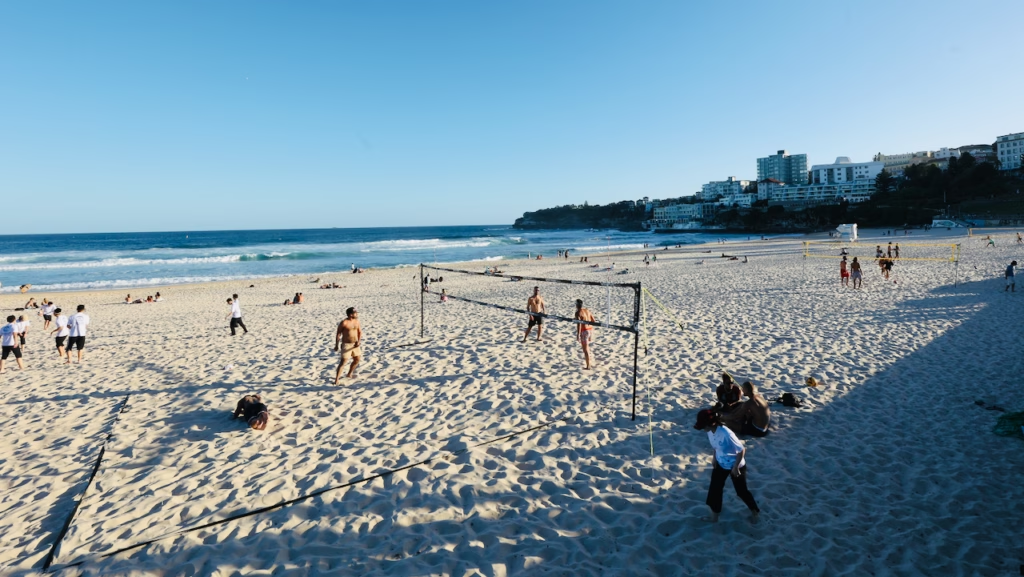
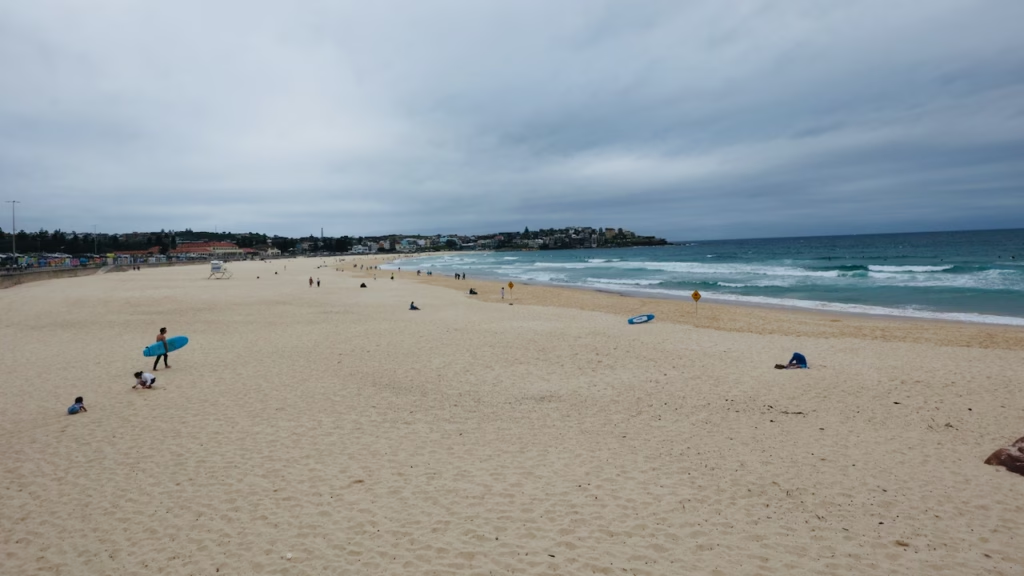
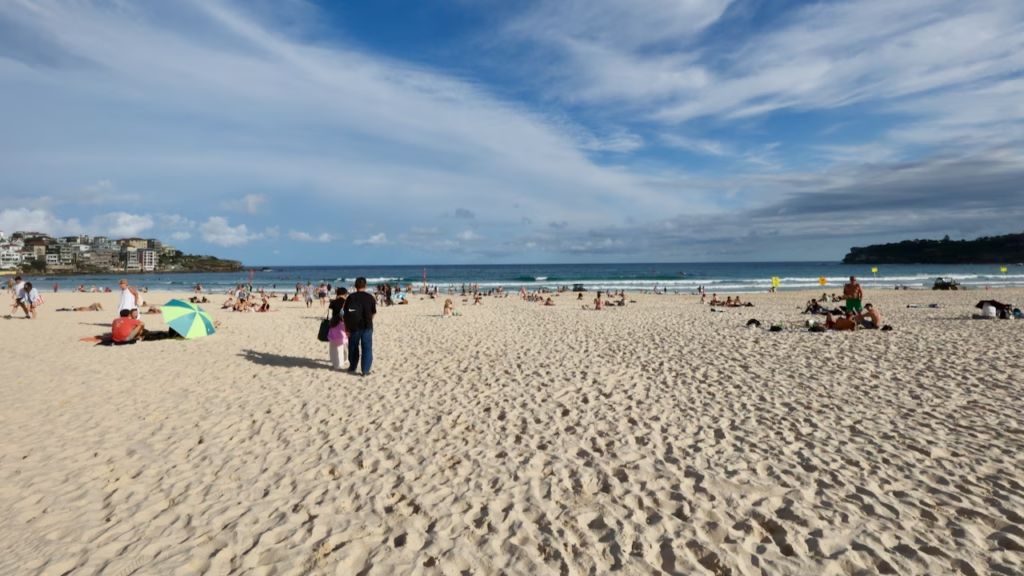
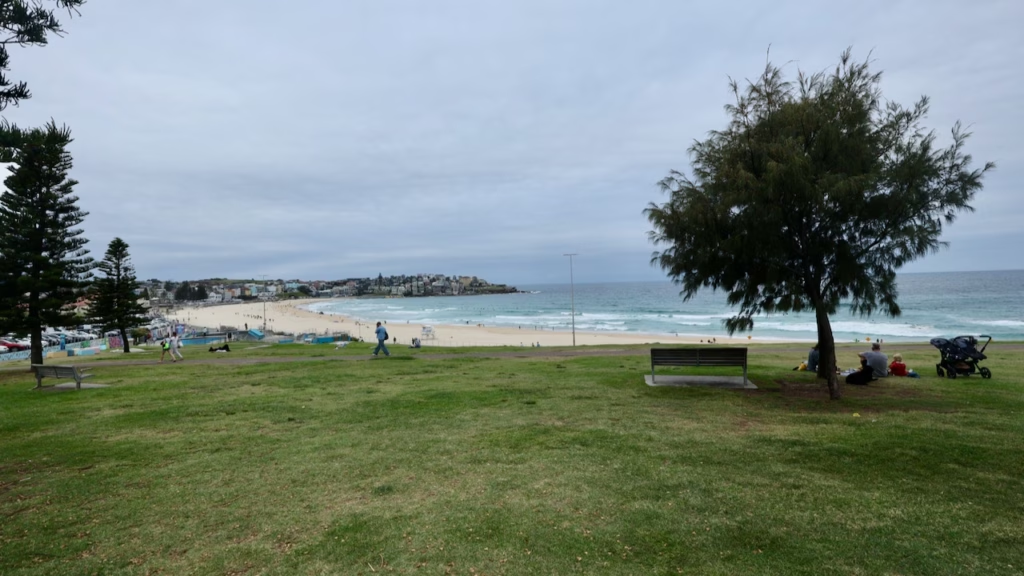
This is what I did most at Bondi, and it’s what I’d tell anyone to do first. Bondi Park is the sloping lawn behind the promenade, and from there you see the whole beach at once. On my visits, volleyball games ran along the southern end, surfers carried boards down to the water, families dug in the sand and the lifeguard towers kept watch over all of it.
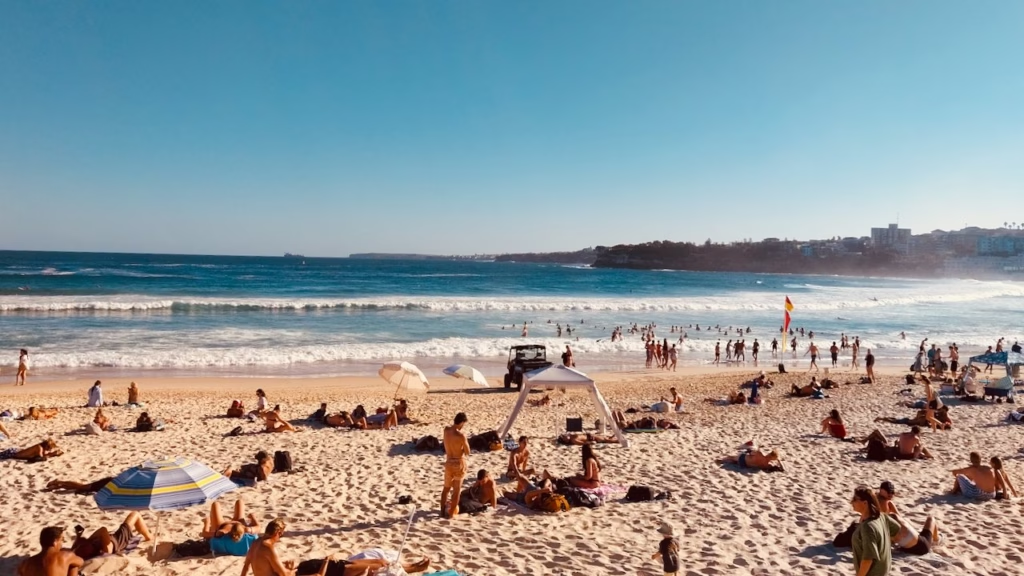
I sat on the grass a couple of times, and on the sand a couple more. On some visits, that was all I did. If you only have an hour in Bondi, buy a coffee or fish and chips on Campbell Parade and do the same.
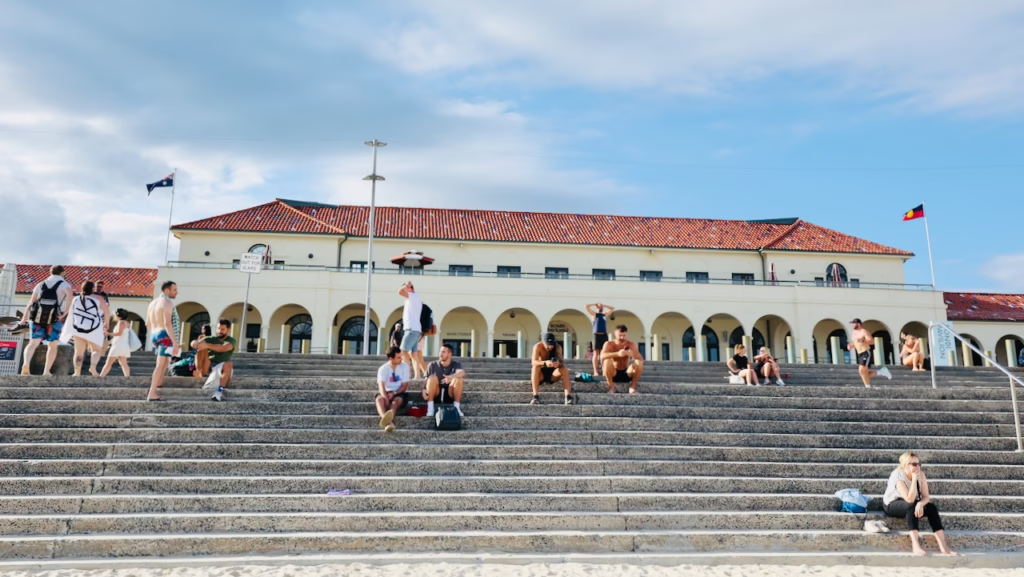
The sandstone steps in front of the Bondi Pavilion work just as well, and they’re where you’ll find half of Sydney on a warm afternoon. One thing to know before you open a drink: Bondi Beach is an alcohol-free zone.
2. See Bondi from the top
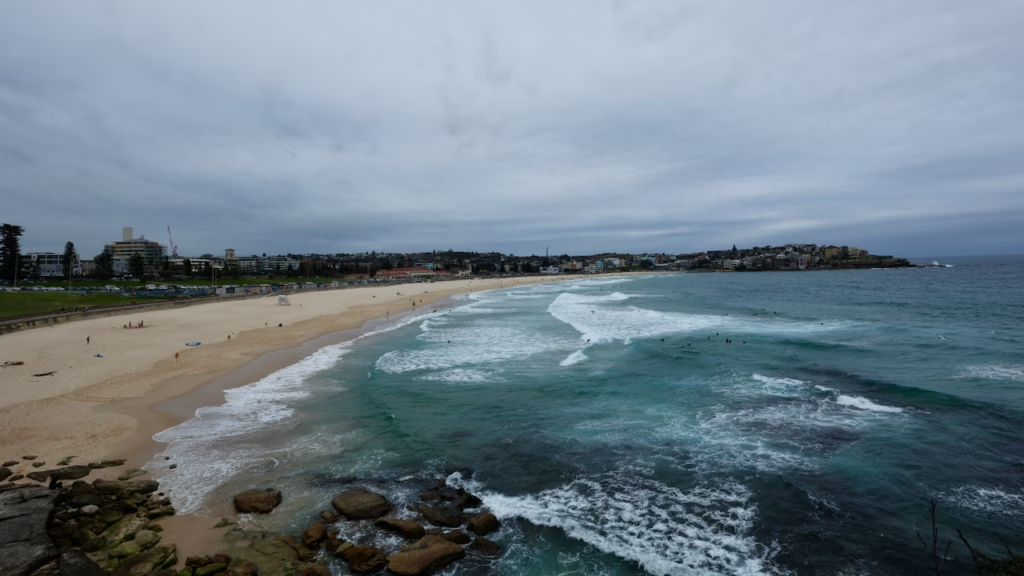
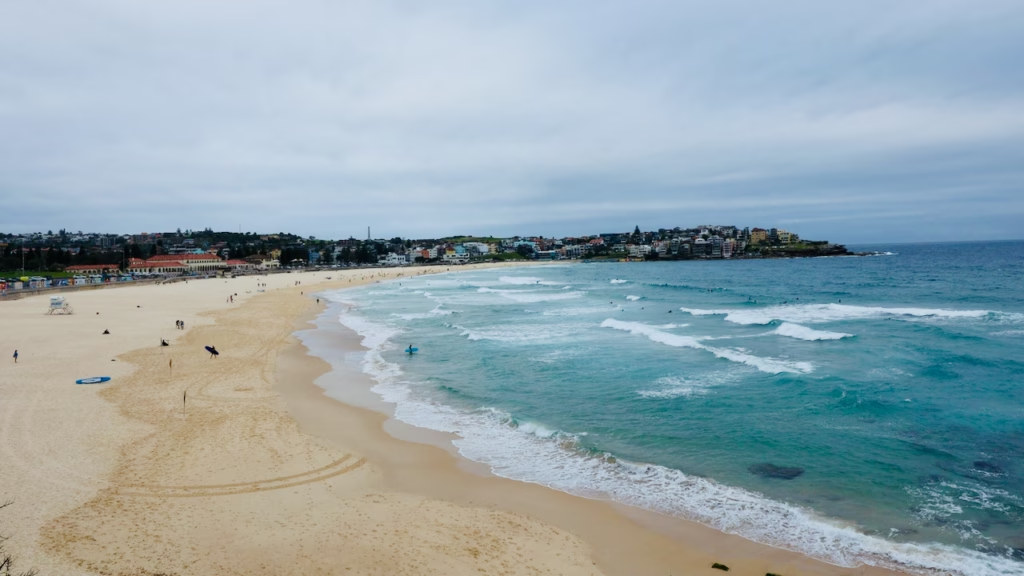
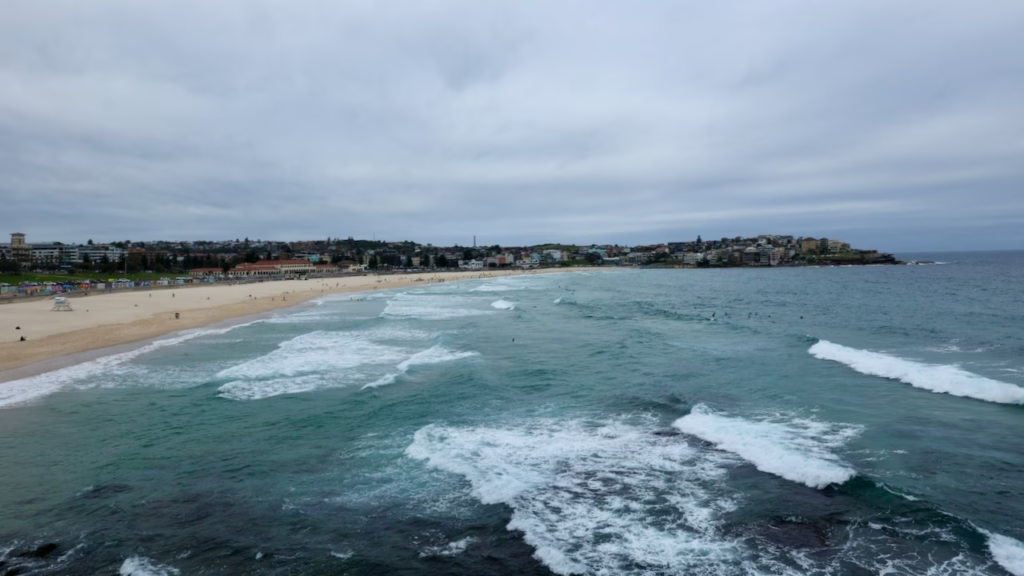
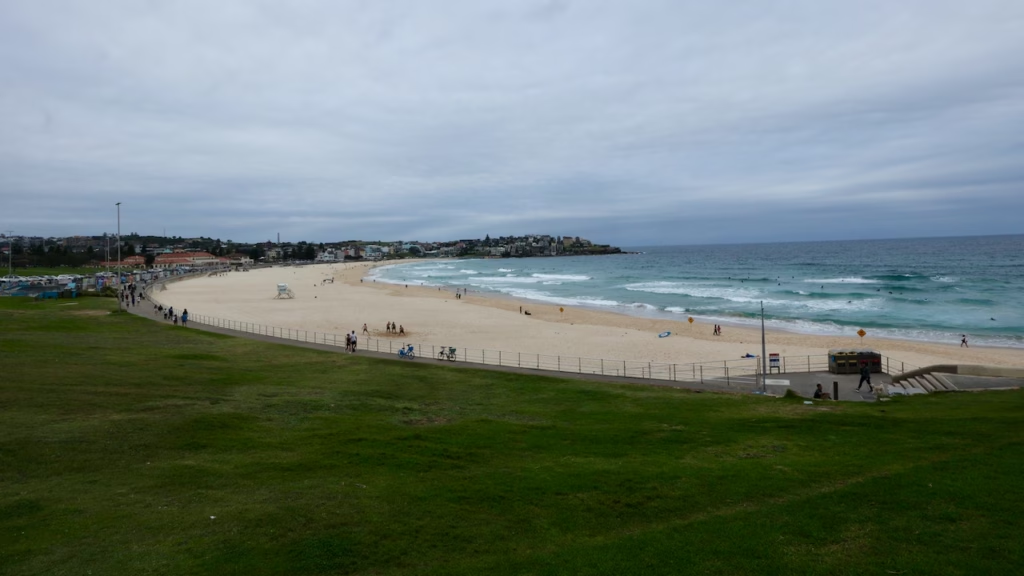
Bondi looks big from the sand. From the top, it looks huge. My favourite view of the beach was from the cliffs at the start of the coastal walk, a few minutes past the Icebergs pool, where the path climbs above the ocean. Turn around there and you see the whole curve of sand, the red roofs of the Pavilion in the middle and the houses stacked up on the North Bondi headland at the far end.
You don’t have to do the full walk to see it. Walk up Notts Avenue past Icebergs and follow the path south for about ten minutes, then turn round and come back. On one grey day I did just that, walking a short way along the path and back, and watched the view widen with every few steps up.
3. Watch the waves crash into Bondi Icebergs
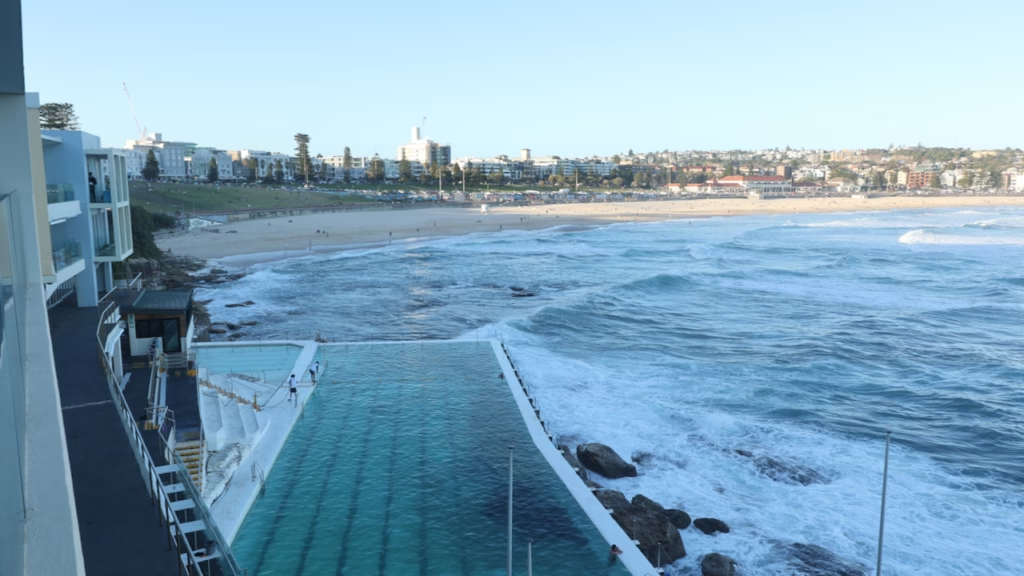
The Bondi Icebergs pool is the most photographed spot at Bondi. The 50-metre saltwater pool sits right on the edge of the ocean at the south end of the beach, and when the swell is up, waves break straight over the outer wall into the lanes while people carry on swimming.
I didn’t swim, but I’d be lying if I said I wasn’t tempted. It looked like the best pool in Sydney. You can swim here yourself, and you don’t need to be a member: entry is $10 for adults, $7 for children and $30 for a family, and includes the sauna. The pool usually closes on Thursdays for cleaning (in summer it sometimes opens when the tides allow), so check the Icebergs pool conditions page before you go.
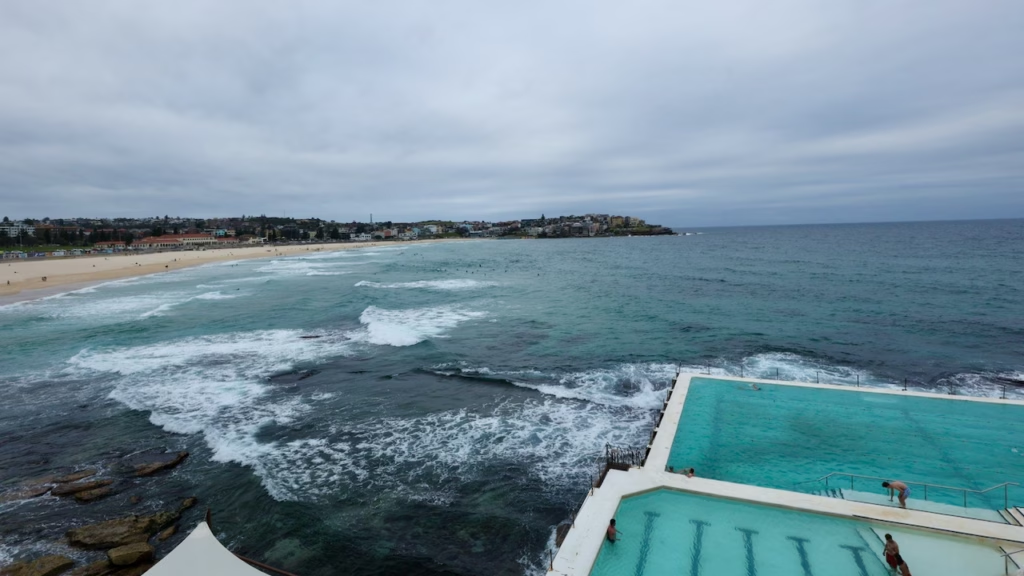
The ocean baths here were built in 1888 and 1889. The Icebergs club that runs them was founded in 1929 by local lifesavers who wanted to keep fit through winter, and the winter season still opens with blocks of ice tipped into the pool. The membership rule is just as tough: to earn lifetime swimming membership, members must race on three Sundays out of four for five winters. For the view without the swim, look down from Notts Avenue, or go up to the Icebergs bistro and bar above the pool.
4. Walk through the Bondi Pavilion
The Bondi Pavilion is the long red-roofed building behind the beach. It was built in 1929 and reopened in September 2022 after a major restoration. I first walked through it to use the toilets, and ended up liking it more than I expected: the cool courtyards and arches are a nice break from the sun, and there was an exhibition on when I passed through.
Inside there’s the Bondi Pavilion Gallery and the Bondi Story Room, a digital exhibition about Bondi’s history, including its Aboriginal history, the beginnings of surf lifesaving and the early settlers. There’s also a theatre, a café, and public toilets, showers and change rooms. Check the Bondi Pavilion website to see what’s on during your visit.
5. Start the Bondi to Coogee walk
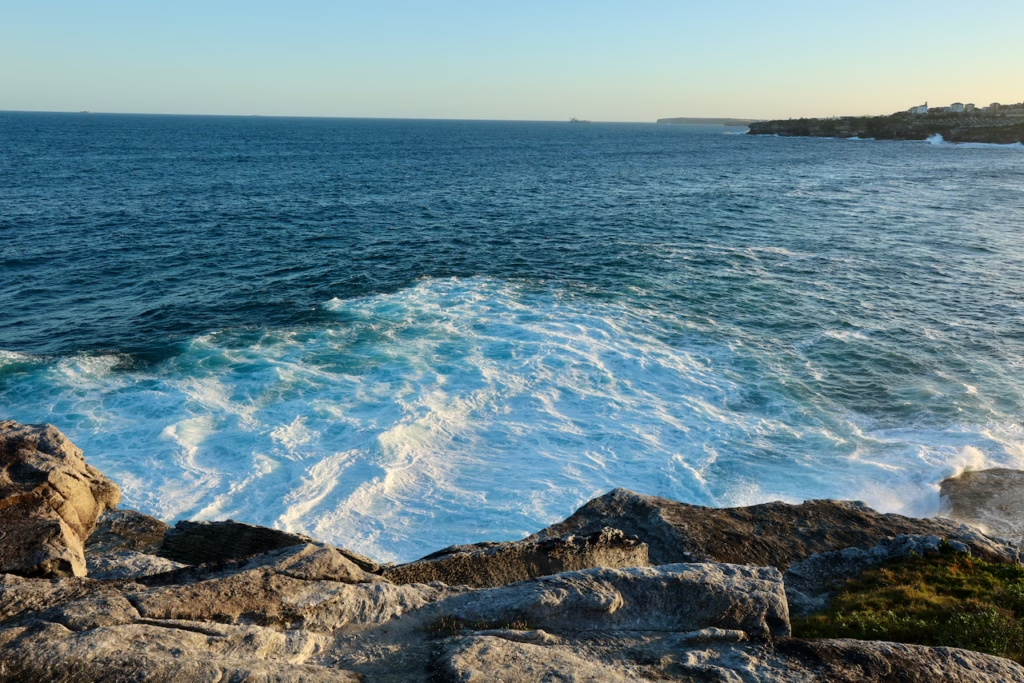
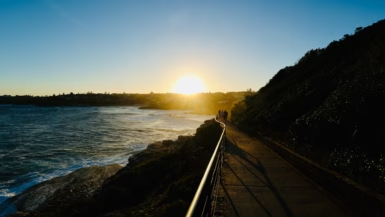
The Bondi to Coogee walk is the best thing to do in Bondi if you’ve got legs and a couple of hours. It starts beside the Icebergs pool and runs 6 km along the cliffs past Tamarama, Bronte, Waverley Cemetery, Clovelly and Gordons Bay to Coogee Beach. I walked it twice, from opposite ends, once on a windy grey afternoon and once into the sunset.
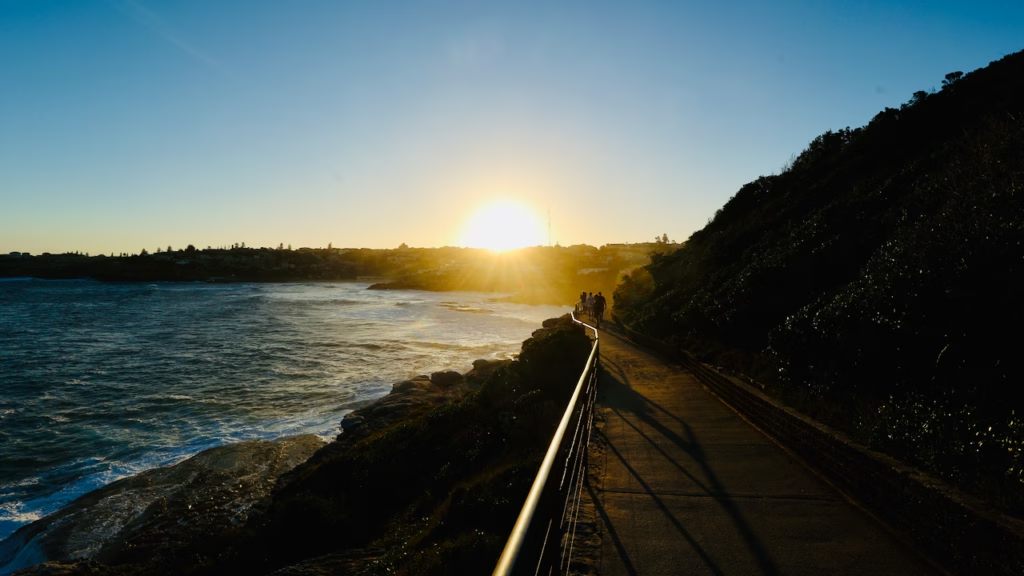
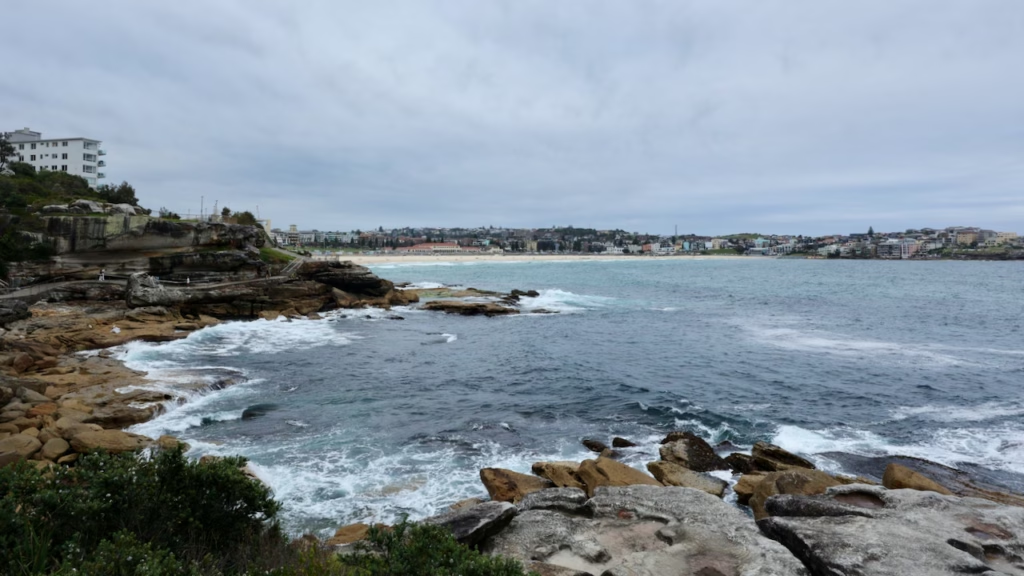
The path is paved and rated Grade 2, but it has plenty of stairs, so it isn’t suitable for prams or wheelchairs. A few minutes past Icebergs, look down into Mackenzies Bay, a rocky cove that every few years fills with sand and becomes a temporary beach, then disappears again. If you don’t want the full walk, Bondi to Bronte is about 3 km and takes under an hour, with a bus back from Bronte.
More Things to Do in Bondi Beach
I didn’t do the things in this section myself. They come from Waverley Council, the Bondi Pavilion, Destination NSW and other guides. I’ve checked the facts against official sources where I could, but times and prices change, so check before you go.
6. Take a surf lesson
Bondi is where a lot of people stand up on a board for the first time. Several surf schools run lessons on the sand every day, in zones kept apart from the swimming flags. A two-hour group lesson is the usual format, with a board and wetsuit included. Surf conditions change from day to day, so if you’re new to it, learn with a qualified instructor rather than hiring a board and heading out alone.
7. Swim between the flags
Waverley Council’s lifeguards, the ones you may know from the TV series Bondi Rescue, patrol Bondi all year, and volunteer surf lifesavers join them on weekends and public holidays in the warmer months. No beach is risk-free, but the flags mark the safest water, chosen by people who watch it all day.
The flags exist for a reason. On 6 February 1938, a hot Sunday that drew around 35,000 people to the beach, three large waves swept hundreds of swimmers out to sea. Lifesavers from the Bondi Surf Bathers’ Life Saving Club pulled around 250 people from the water in one of the largest mass rescues in Australian history, but five people drowned. It’s remembered as Black Sunday.
Swim between the red and yellow flags. The flags move during the day to wherever the water is safest, so check where they are each time you go in. Don’t swim at the south end near Icebergs: a strong, near-permanent rip known as the Backpackers’ Express runs out against the southern headland. Rips often look like the calmest patch of water on the beach, which is exactly why visitors get caught in them. If the surf looks rough, use one of the ocean pools instead. Check conditions on Beachsafe before you swim.
8. Swim in the free North Bondi rock pools
If Icebergs is Bondi’s famous pool, the north end has the free ones. On the rock shelf off Ramsgate Avenue there’s the North Bondi Children’s Pool, a shallow, free paddling pool that’s popular with families, and beyond it the Wally Weekes Pool, a tidal rock pool that fills and empties with the sea. Depth depends on the tide: too shallow at low tide, too full at high tide. About an hour after high tide is usually best; check the Bureau of Meteorology tide predictions for Sydney before you go. At low tide, the rock shelf around the pools is good for rock-pooling with kids.
Bondi Icebergs
- South end of the beach
- 50-metre saltwater pool, plus a children’s pool
- $10 for adults, sauna included
- Usually closed Thursdays
- Waves break over the wall
North Bondi rock pools
- North end, off Ramsgate Avenue
- Children’s paddling pool and a tidal rock pool
- Free
- Open at all times, depth depends on the tide
- Quieter, more local
For a proper swim and the famous view, go to Icebergs. With small children, or if you just want a free dip, head to the north end.
9. See the Aboriginal rock engravings at North Bondi
Long before the surf clubs, the Gadigal and Birrabirragal people carved figures into the sandstone here. There are two sites at the north end of Bondi:
The larger site, on a rock platform near the cliff edge inside the public golf course. Enter from Military Road, near Blair Street, and head towards the ventilation tower. The engravings show a fishing scene with sharks, whales, fish and a turtle. According to the Dictionary of Sydney, the oldest may be up to 2,000 years old, and one panel shows an eight-metre shark that appears to be attacking a man, which may be the first record of a shark attack at Bondi. The carvings were re-grooved in 1964, so many are still clear, though some have weathered away.
At the end of Ramsgate Avenue, beside the stairs down to the boat ramp. Only a turtle is still easy to make out here.
Aboriginal sites like these are protected under NSW law, and they’re still important to Aboriginal people today. Treat them as you would any other heritage site.
To see them with someone who can explain them, Destination NSW suggests Walangari’s Bondi Aboriginal Walking Tours, an Aboriginal-owned tour that covers the rock carvings and the bush foods growing along the coast.
Visiting the engravings? Neither site is fenced and signage is minimal. Don’t walk on the carvings, and keep an eye out for golf balls on the golf course. If you’re doing the Bondi to Coogee walk, there’s another engraving site at Marks Park, a few minutes south of Icebergs.
10. See the Bondi sea wall murals
The low wall that runs along the promenade between the sand and Bondi Park is an outdoor gallery. People have painted on it since the 1960s. Today artists apply to Waverley Council for a permit, and each mural usually stays up for around six months before it’s painted over, so you’ll see something different on each visit. Walk the length of the promenade from the Pavilion towards the north end to see most of it.
11. Shop the Bondi Markets
Bondi has two weekend markets, both in the grounds of Bondi Beach Public School on Campbell Parade, at the north end of the beach:
Bondi Markets (Sunday)
- Every Sunday, 10am to 4pm
- Local designers, vintage clothes, jewellery and art
- Vintage and pre-loved pop-up on the first Sunday of each month
Bondi Farmers Market (Saturday)
- Every Saturday morning
- Fresh produce, coffee and breakfast stalls
- Check times before you go
Come on Sunday for browsing and shopping, Saturday for breakfast and groceries. Times are on the Bondi Markets website.
12. Eat and drink near Bondi Beach
You won’t go hungry at Bondi. Campbell Parade is lined with takeaways, cafés and bars, and fish and chips on the grass is a Bondi classic. A few well-known places:
The splurge: Italian food and cocktails above the Icebergs pool, with the whole beach in front of you. Book ahead.
Seafood and drinks at the north end of the beach, close to the rock pools.
A busy Italian restaurant on Bondi Road, a short walk up from the beach, known for its wood-fired bread.
A second-hand bookshop and café on Hall Street, a block back from the beach. Good for a quiet coffee away from the crowds.
A North Bondi brunch spot on Ramsgate Avenue, famous for colourful, very photogenic breakfasts and its view over the beach.
13. Look for whales from Ben Buckler
From May to November, humpback whales pass Sydney on their migration, and you can sometimes spot them from the Bondi headlands. Ben Buckler, the headland at the north end of the beach, is the best lookout at Bondi itself. It’s exposed and windy, so bring a layer. Look for spouts and splashes on the horizon, ideally on a calm day. The peak of the northern migration is usually in June and July.
14. Check the Bondi Beach events calendar
Bondi hosts some of Sydney’s biggest free events. They’re a great time to visit, but expect crowds, road closures and packed buses.
In 2026, Sculpture by the Sea runs from 16 October to 2 November. Details are on the official Sculpture by the Sea website. Festival of the Winds is free and run by Waverley Council; in 2026 it was held on 13 September. Dates change every year, so check each event’s official page before you plan around it.
A Short History of Bondi Beach
The name is older than the city. Bondi is thought to come from boondi, an Aboriginal word usually translated as “water tumbling over rocks”. Waverley Council gives it as the “noise made by the sea waves breaking on the beach”.
The rock engravings at North Bondi are among the oldest marks of human life here, alongside shell middens on both headlands. Around 1900, a storm stripped sand from the dunes and uncovered thousands of small stone spear barbs. Archaeologists still call this type of tool a “Bondi point”.
The beach’s public status was hard-won. After local campaigning, the NSW Government dedicated it as a public reserve in 1882, and Bondi went on to become one of the places where Australian beach culture began. The Bondi Surf Bathers’ Life Saving Club was formed in 1907. The NSW Government’s Blue Plaque on its clubhouse pillar calls it the world’s oldest surf lifesaving club, though nearby Bronte has long argued it got there first.
Early beachgoers changed in rows of council surf sheds, built in 1911. The Bondi Pavilion replaced them in December 1929, complete with Turkish and hot sea-water baths. Many of those beachgoers came by tram. Until 1960, trams ran from the city to the beach, and the Bondi line was so fast that it gave Australians a phrase still used today: to “shoot through like a Bondi tram” means to leave in a hurry.
Forty years later, the world came to Bondi: the beach volleyball at the Sydney 2000 Olympics was played in a temporary stadium on the sand. In 2008, Bondi Beach was added to the National Heritage List for its role in Australian beach culture and the surf lifesaving movement.
Things to Do in Bondi Beach With Kids
Bondi works well with children, as long as you stay close to the flags. The best spots for families:
Free, shallow and sheltered, at the north end off Ramsgate Avenue.
At low tide, the rock shelf around the north end pools is full of small sea creatures.
A children’s pool alongside the main lap pool (paid entry).
Shade, grass and space to run, with toilets and showers in the Pavilion.
Many Bondi surf schools run lessons for children. Check the minimum age when you book.
Bondi Beach Accessibility
Much of Bondi is accessible without the sand. The promenade, Bondi Park, the Bondi Pavilion and the view from Notts Avenue above Icebergs are all step-free or close to it. The coastal walk, the rock pools and the rock engravings aren’t, because of stairs and uneven rock.
On the sand itself, Waverley Council provides:
Rolled out at the northern ramp near the Wally Weekes Pool on set days each week, weather and surf permitting.
Kept in lockers beside the North Bondi amenities. Advance booking is essential.
At North Bondi and in the Bondi Pavilion. The Pavilion’s accessible shower needs an MLAK key, or ask the staff.
On Queen Elizabeth Drive near the Pavilion, and on Ramsgate Avenue.
Days, times and booking details change, so check Waverley Council’s Access Bondi page before you go.
Does Bondi Beach Live Up to the Hype?
For me, yes, but not because it’s the most beautiful beach in Sydney. On the coastal walk south I passed quieter, prettier beaches at Tamarama and Bronte, and Coogee felt more relaxed at the far end. Bondi is busy, built-up and full of people.
What makes it special is the scale and the life on it: the long curve of sand, the surfers and lifeguards, the Icebergs pool hanging over the sea and the view from the cliffs. If you want a quiet swim, head to Bronte or Coogee. If you want the classic Sydney beach and the start of its best coastal walk, come to Bondi.
Bondi Beach Half-Day Itinerary
This is the half day I’d plan now, built around what I enjoyed most and the things I’d add next time:
With a full day, swap the afternoon for the Bondi to Coogee walk and catch the bus back from Coogee.
Best Time of Day to Visit Bondi Beach
Bondi changes with the light. Here’s what to expect, from first light to dusk:
Bondi faces east, so mornings are when the sun comes up over the sea and the swimmers and runners have the place mostly to themselves. Late afternoon is when I saw Bondi most, with the light softening and the grass in Bondi Park full of people who’ve come to watch the beach rather than swim.
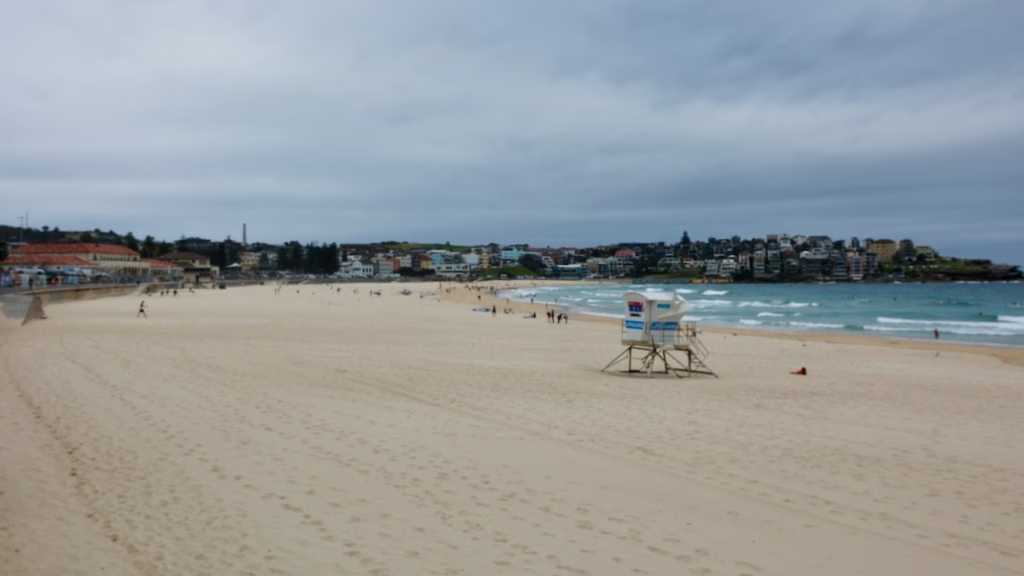
Grey days have their own appeal. On one overcast visit the sand was close to empty, but the surfers were still out in force, and with the crowds gone the lifeguard towers and the Pavilion had the beach almost to themselves.
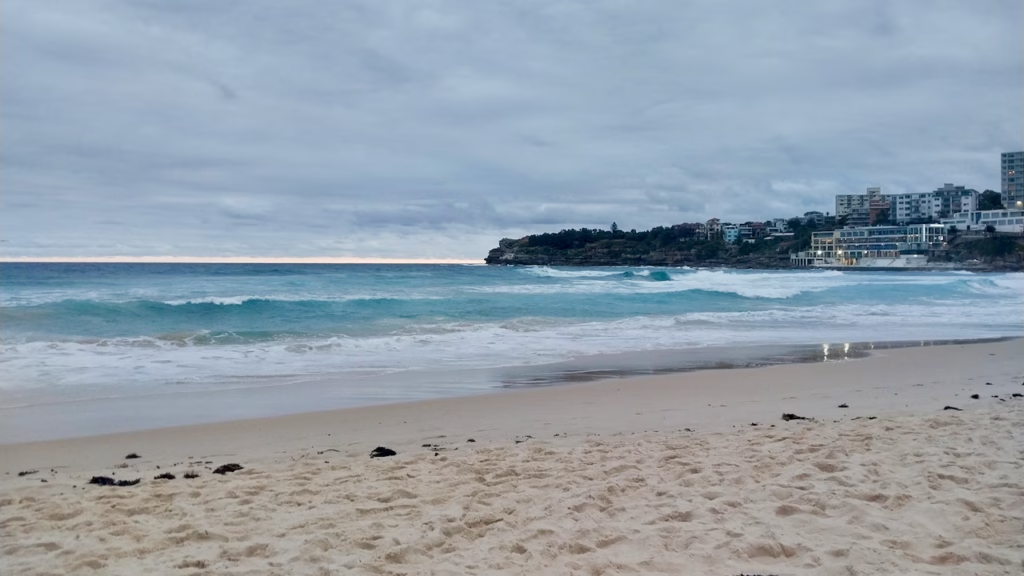
Bondi isn’t a sunset beach in the usual sense, because the sun goes down behind the suburbs. But the sky over the ocean turns pink, and the Icebergs building lights up at the south end. That’s when I set off on my second coastal walk, and it’s the best time to start it if you want the sunset on the way.
Getting to Bondi Beach
Bondi is one of the easiest beaches in Sydney to reach by public transport, which is a blessing, because driving here is a pain. There’s no train station at the beach itself. Most Sydney buses don’t take cash, so tap on with an Opal card or a contactless bank card.
Bus 333 runs from Circular Quay to Bondi Beach via Bondi Junction. It’s the simplest option from the CBD.
Take the T4 train to Bondi Junction, then bus 333 or 380 to the beach. The bus ride takes about 10 to 15 minutes.
Bus 380 runs from Watsons Bay to Bondi Beach, so you can combine the two in one day.
Parking is metered or time-limited and fills early on warm weekends. Leave the car at home if you can.
Check the Transport NSW trip planner on the day, especially during big events, when extra or diverted services run.
Tours From Bondi Beach
The links below are affiliate links. If you book through them, I may earn a small commission at no extra cost to you.
Where to Stay Near Bondi Beach
Hostels, apartments and beachfront hotels on and around Campbell Parade. Best if you want to wake up by the sea and walk everywhere.
Quieter and more residential, close to the rock pools, the markets and Ben Buckler.
Cheaper and practical, at the end of the T4 train line, with a big shopping centre and frequent buses to the beach.
Best if Bondi is a day trip within a longer stay. Bus 333 runs from Circular Quay to the beach.
Useful Official Links
- Bondi Pavilion: what’s on
- Bondi Icebergs pool conditions
- Beachsafe: Bondi Beach conditions
- Transport NSW trip planner
- Sculpture by the Sea
Bondi Beach FAQ
Is Bondi Beach free?
Yes. The beach, the promenade, Bondi Park and the Bondi Pavilion are all free. The North Bondi rock pools are free too. You only pay for extras like the Bondi Icebergs pool ($10 for adults), food, surf lessons and parking.
Is it safe to swim at Bondi Beach?
Yes, if you swim between the red and yellow flags, where lifeguards patrol. Bondi has strong rip currents, especially the Backpackers’ Express at the south end near Icebergs, so never swim outside the flags.
How do I get to Bondi Beach from Sydney CBD?
Take bus 333 from Circular Quay, which runs to Bondi Beach via Bondi Junction. There’s no train station at the beach, but you can take the T4 train to Bondi Junction and change to bus 333 or 380 for the short ride to the sand.
How long should I spend at Bondi Beach?
Half a day covers the beach, Icebergs, the Pavilion and the view from the cliffs. Allow a full day if you want to add the Bondi to Coogee walk.
How much does it cost to swim at Bondi Icebergs?
$10 for adults, $7 for children and $30 for a family, including the sauna. It’s open to the public, so you don’t need to be a member. The pool usually closes on Thursdays for cleaning, so check the club’s pool conditions page before you go.
When are the Bondi Markets on?
The Bondi Markets run every Sunday from 10am to 4pm at Bondi Beach Public School on Campbell Parade. The Bondi Farmers Market is held in the same place on Saturdays.
What is the best time to visit Bondi Beach?
November to April is best for swimming and beach weather. For fewer crowds and better light, go early in the morning or in the late afternoon.
Can you see the sunset at Bondi Beach?
Not over the sea. Bondi faces east, so the sun sets behind the city. You still get golden light on the beach and a pink sky over the ocean at dusk.
Is Bondi Beach overrated?
Not if you go for what it does best. It isn’t Sydney’s quietest or prettiest beach (Tamarama, Bronte and Coogee are calmer), but its size, surf culture, Icebergs pool and clifftop views make it the classic Sydney beach, and it’s the start of the city’s best coastal walk.
Can you drink alcohol on Bondi Beach?
No. Bondi Beach is an alcohol-free zone.
What is there to do at Bondi Beach with kids?
The North Bondi Children’s Pool is a free, shallow pool at the north end, and the rock shelf around it is good for rock-pooling at low tide. Icebergs also has a children’s pool, and surf schools run lessons for kids.
Where can you see Aboriginal rock engravings at Bondi?
At the north end. The biggest site is on a rock platform inside the Bondi Golf Course, with a fishing scene, sharks, whales and a turtle. Another, smaller site is at Ben Buckler Point at the end of Ramsgate Avenue.
What does Bondi mean?
Bondi is thought to come from boondi, an Aboriginal word usually translated as “water tumbling over rocks”. Waverley Council translates it as the “noise made by the sea waves breaking on the beach”.
What is the water temperature at Bondi Beach?
Roughly 22 to 24°C in summer (December to March) and 17 to 19°C in winter (June to September), when many swimmers wear a wetsuit. For measured readings, check the NSW Government’s Manly Hydraulics Laboratory data.
Are there sharks at Bondi Beach?
Sharks live off the whole Sydney coast, but encounters at Bondi are rare. Lifeguards watch the water all year and clear it if a shark is sighted, so swim between the flags and follow their instructions if the siren sounds.
Is Bondi Beach wheelchair accessible?
Partly. The promenade, Bondi Park and the Bondi Pavilion are accessible, and Waverley Council provides beach matting on set days and bookable beach wheelchairs at North Bondi. The coastal walk, rock pools and engravings are not accessible.
Final Thoughts
You can do a lot at Bondi, but you don’t have to. Some of my favourite hours in Sydney were spent sitting on the grass in Bondi Park, doing nothing more than watching the ocean, before I walked up the cliffs and saw the whole beach from above. Come with a plan or without one, swim between the flags, and leave time to walk south along the coast.
For more of Sydney and the rest of the country, browse my Australia travel guides, or see the best Sydney Opera House and Harbour Bridge viewpoints for the harbour side of the city.

Leave a reply