

A reverse Great Ocean Road tour drives inland from Melbourne to the Twelve Apostles first, then follows the coast road back east, so you reach the famous stacks before most of the day’s crowds and finish at the Memorial Arch in the evening. It’s a full day of 12 to 14 hours. I did it this way on a group tour from Melbourne, and below is the route stop by stop, from the Apostles, Loch Ard Gorge and London Arch to Apollo Bay. One change since my visit: the Twelve Apostles now has a new visitor centre with timed bookings, free until April 2027.
Direction
Twelve Apostles first
Inland drive out, coast road back to Torquay
Length
12 to 14 hours
A full day from Melbourne
Twelve Apostles
Timed booking
New visitor centre; free until April 2027
Main stops
Apostles, Loch Ard, London Arch
Then Apollo Bay and the Memorial Arch
Heads-up
Motion sickness
Sit near the front for the Apollo Bay to Lorne bends
There are road trips, and then there is the Great Ocean Road.
Stretching 243 kilometres along the south-eastern coast of Australia, from Torquay to Allansford in Victoria, it is widely considered one of the most scenic coastal drives in the world, and having done it, I’d argue that description still undersells it. This is a road that winds along the edge of cliffs, drops into quiet fishing towns, cuts through ancient rainforest, and ends at a series of limestone sea stacks rising from the Southern Ocean like something out of a geological dream.
If you’re planning a great ocean road tour from Melbourne (or GOR, as Australians tend to call it), most guides will tell you to start from Torquay and work your way west toward the Twelve Apostles. The logic makes sense on paper, you follow the coast in the direction the road was built.
I did it the other way around and it made all the difference.

I booked a group tour from Melbourne that ran the route in reverse: straight to the Twelve Apostles first thing in the morning, then working back east through every major stop along the way. By the time most visitors were just arriving at the famous stacks, we were already there, almost alone, in the quiet of early day, with the Southern Ocean doing exactly what it has done for millions of years.
Why a Reverse Great Ocean Road Itinerary Works Better
There are two reasons the reverse itinerary works better for most day trippers.
You beat the crowds. Tour buses and self-drive visitors typically leave Melbourne in the morning, travel west, and arrive at the Twelve Apostles by mid-afternoon. That’s when the viewpoints are at their busiest. Starting from the far end means you arrive early, before the rush.
The drive home is shorter. A standard tour finishes at the Twelve Apostles and then faces about three hours on the inland highway back to Melbourne, usually in the dark. In reverse, the long inland stretch is done in the morning, and the day ends near Torquay, about an hour and a half from the city.
If you’re considering a tour, look specifically for operators who run the reverse itinerary with an early departure.
Regular direction
- Melbourne, Torquay, Lorne, Apollo Bay, then the Twelve Apostles
- Coast from the start of the day
- Apostles in the busy early afternoon
- About three hours inland back to Melbourne at the end
Reverse direction (what I did)
- Melbourne inland to the Twelve Apostles, then east via Loch Ard Gorge, Apollo Bay and Lorne
- A long inland drive before you see the coast
- Apostles in the quieter morning
- The day ends near Torquay, about 90 minutes from the city
The trade-off: in the morning the stacks can be backlit, and the warm golden-hour photos come at sunset. On an overcast day like mine it made no difference, and the empty viewing platforms mattered more.
The Great Ocean Road Tour Route: Twelve Apostles Back to Melbourne
Here’s how the day unfolded, stop by stop.
Stop 1: Twelve Apostles and the Surrounding Viewpoints

We arrived at the Twelve Apostles before most other visitors. The car parks were nearly empty. The walkways were quiet enough that you could stand at the railing and actually hear the waves crashing against the base of the stacks far below, a sound that gets swallowed entirely when the viewpoints are packed.
The Twelve Apostles are limestone sea stacks, formed over millions of years as the softer parts of the coastal cliffs eroded away, leaving harder columns standing in the water. They are extraordinary to look at, but what surprises most people is the sheer scale of them. From the clifftop, with nothing to provide scale, they look large. From Gibson Steps beach, at sea level, they tower over you.

There isn’t just one viewpoint here, there are several, spread across both the eastern and western sides of the main car park, each offering a different angle on the same stacks. The signs suggest 15 to 30 minutes for the Twelve Apostles lookout walk. Double that if you want to do it properly and take photographs without rushing.
Gibson Steps is the one most visitors skip, and it’s the one I’d least want to miss. A set of steep carved steps leads down the cliff face to the beach below. At the bottom, you’re standing at sea level, and the full scale of the limestone walls becomes clear in a way that the clifftop view simply doesn’t convey. The beach itself is not for swimming (the surf is powerful and the rips are dangerous), but just standing there and looking up repays every step of the descent.

Don’t be put off by overcast weather. My visit was largely overcast, and the photographs tell their own story, the muted light actually suits the limestone and the churning Southern Ocean. Clear blue skies make for pretty postcards; heavy cloud makes for something rawer.
Walk both the eastern and western viewing platforms, they are different experiences. The western platform gives you the broader sweep of the coastline. The eastern platform puts you closer to the individual stacks and shows more of the beach below.
The stacks are actively eroding. The sea is patient and relentless, and the limestone is no match for it in the long run. One stack collapsed in 2005 and another in 2009, and Parks Victoria now counts seven still standing. Standing there knowing this gives the whole place a particular quality, not sadness exactly, but weight. The landscape you’re looking at right now will not look the same in fifty years.
Since my visit, the site has changed. The new Keerray Woorroong Visitor Centre opened on 16 October 2026, with a cafe, a rooftop lookout and much bigger car and coach parking, and independent arrivals now run on timed bookings. Booking is free until April 2027, when a fee starts. Tour operators have their own coach-parking arrangements, so on a tour you usually won’t need a separate booking, but check with your operator. Access to Gibson Steps and Loch Ard Gorge is unchanged.
Stop 2: Island Archway, the Razorback and London Arch

A short distance along the coast from the Apostles, the tour stopped at a cluster of formations that many visitors, particularly those on rushed half-day tours, skip entirely. That’s a mistake. The Island Archway and the Razorback beside Loch Ard Gorge, and London Arch further west near Port Campbell, are extraordinary in their own right, and because they’re less famous you can often have the viewpoints to yourself.

From the car park, the Island Archway lookout is just 160 metres along a gentle paved path through coastal scrubland, and the Razorback is 400 metres. Neither walk is challenging, but together they add a dimension to the coastline that the main Apostles viewpoints don’t have: the sense of walking through the landscape rather than just looking at it from a railing. Despite the name, the Island Archway is no longer an arch: it collapsed in June 2009, leaving two pillars now named Tom and Eva after the Loch Ard survivors.

London Arch is a natural rock arch, a flat-topped limestone island with a tunnel carved clean through its base by the sea. The water moves through it with every wave, dark and churning against the pale stone. It’s the kind of formation that makes you think about time in a way that’s difficult to articulate: the sea has been doing this for so long, so consistently, that it has carved a hole through solid rock.

It also has a remarkable recent history. Until January 1990, it was known as London Bridge: a double-arched formation connected to the mainland by a natural land bridge. Then, without warning, the span joining it to the mainland collapsed into the sea, leaving the seaward arch stranded as an island. Two tourists were standing on the outer section when it fell. Nobody was hurt, but they had to be rescued by helicopter, completely cut off from the shore. The formation was renamed the London Arch after the collapse, and what you see today is the single arch that remains.
Standing at the viewpoint knowing this history adds a layer to what you’re looking at. The coastline is not static. It collapses, without warning, on an ordinary afternoon. The Twelve Apostles are eroding. The London Arch lost half of itself in a moment. The whole GOR coastline is a landscape in the middle of its own story, and you’re watching one chapter of it.

Look carefully at the rock formations around the viewing platforms themselves. The layered sedimentary striations in the clifftop, bands of rust, cream, and grey running horizontally through the stone, are the same geological process as the stacks in the water. The whole coastline is one long story of deposition, erosion, and time.
Stop 3: Loch Ard Gorge

Loch Ard Gorge is named after the Loch Ard, a clipper ship that wrecked on the reef just outside the gorge on 1 June 1878. There were 54 people on board. Only two survived, Eva Carmichael, a passenger, and Tom Pearce, an apprentice officer, both aged 18. Tom heard Eva’s cries from the water, swam out to reach her, and guided her into the gorge. She had been in the water for hours.
The beach inside the gorge is enclosed, sheltered, and extraordinarily calm compared to the open coast just metres away. The limestone walls curve around it on three sides, filtering the wind and blocking the full force of the swell. Standing on the beach, looking up at the cliffs and then out through the narrow entrance to the open ocean, gives you a visceral sense of what those two teenagers must have experienced: the terrifying exposure of the open sea, and then this sudden, improbable shelter.
Most tour groups don’t linger here long enough. The history alone deserves more than a quick photograph from the clifftop. If you’re self-driving and have time to spare anywhere on the route, spend it here.
A Koala in a Eucalyptus Tree
Somewhere between the geological stops and the drive east, the tour guide pulled the bus over on a quiet stretch of road and pointed up into a tree.

A wild koala, sleeping in the fork of a eucalyptus, utterly indifferent to the bus full of people below. The grey-brown fur blends almost perfectly with the pale bark and the tangled shadow of the branches. If the guide hadn’t pointed it out, we would have driven straight past.
This is the kind of moment that a good guide makes possible, and it’s one of the real arguments for taking a tour rather than driving yourself. Knowing where the koalas tend to sleep, when they’re likely to be visible, and which trees to look at: that’s not something you can Google effectively. It comes from doing the route repeatedly, paying attention, and caring about the experience of the people in the bus.
Koalas are not as easy to spot in the wild as many visitors expect. They sleep up to 20 hours a day, high in the canopy, in a posture that makes them look like a knot in the wood. Seeing one in the wild without a zoo enclosure, without a ranger pointing to a designated tree, is a lucky thing.
Stop 4: Apollo Bay

Apollo Bay was the lunch stop, and it earns its place in the itinerary not just as a practical pause but as a real shift in atmosphere. After a morning of geological drama (stacks and arches and gorges and churning water), Apollo Bay is calm, green, and human-scaled.
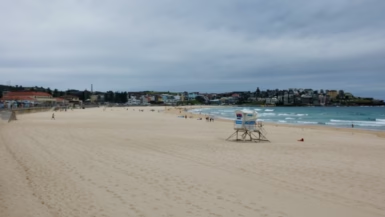
The town sits at the edge of a wide bay, with the Otway Ranges rising steeply behind it. The beach stretches for kilometres in both directions, wide and flat and almost always quiet compared to the more famous beaches further east. A couple of people were walking along the waterline in the distance. The sea here is gentler than the open coast, and the hills behind the town catch the mist in a way that makes the whole scene feel slightly apart from the rest of the world.
This is also where the character of the journey changes. After Apollo Bay, the road climbs into the cool, dense, dripping eucalyptus forest of the Otway Ranges before eventually descending back to the coast near Lorne. If you’re self-driving and haven’t been to this section before, the forest stretch is the place to slow down. It’s a completely different landscape from the limestone coast, and the contrast between the two halves of the drive is one of the things that makes the GOR more than just a coastal road.
Driving the Great Ocean Road

The road itself is part of the experience. There are stretches where it pulls back from the coast and you lose sight of the sea entirely, and then it rounds a bend and the ocean is suddenly right there again, enormous and close, the waves breaking on rocks thirty metres below the guardrail. It was built between 1919 and 1932 largely by returned soldiers as a memorial to those who died in World War I. The scale of that project, cutting a road through this terrain with largely manual labour, becomes clear the moment you see how the road hugs the cliff face.
One thing nobody really warns you about: a significant stretch of the Great Ocean Road is rough going on a bus. The road winds tightly along the cliff edge with continuous bends and very little straight road to recover on. I felt nauseated for a good part of it, and I wasn’t alone. A couple of fellow passengers had a harder time of it and were sick.
It’s not a reason to skip the trip. But it’s good to know before you go, and to be prepared for. If you’re prone to motion sickness, read the practical tips below before you travel.
The Great Ocean Road Memorial Arch

By the time we reached the Great Ocean Road Memorial Arch at Eastern View, between Aireys Inlet and Lorne, the day was winding down, the light was softer, and the group was quieter in a settled, satisfied way. The first arch went up in 1939 to mark the road as a memorial to the returned soldiers who built it; today’s timber arch is a rebuild after the 1983 Ash Wednesday bushfires. It spans the road, with a small car park on the ocean side, and a steady stream of visitors stops to photograph it throughout the day. There’s something slightly strange about arriving here at the end of the reverse trip, when most visitors pass it early in their day. Standing under the arch with the road behind you rather than ahead of you, you’ve already seen everything it leads to. The whole day played out the other way around, and it worked better for it.
An Unexpected Finish: Kangaroos on a Golf Course

The final stop of the day was one nobody had mentioned in advance: the tour pulled into the car park of a golf course near Torquay, and the guide pointed toward the fairway. A mob of eastern grey kangaroos, grazing unhurriedly on the grass while golfers played around them. Nobody seemed bothered by anyone else’s presence. The kangaroos grazed. The golfers golfed. This is just how it is in this part of Victoria, wildlife and daily life exist in the same spaces, on the same terms, without much ceremony.
It was a quietly perfect way to end the day. After everything (the stacks, the gorge, the arch, the winding road, the nausea, the koala in the tree), a mob of kangaroos on a golf course at dusk felt exactly right.
Practical Information for a Guided Tour
Tour length: Full day, usually departing Melbourne between 7 and 8am and returning between 7 and 9pm.
What’s included: Transport, guide, stops at major viewpoints. Some tours include lunch; check before booking.
What to bring: Comfortable walking shoes, layers, water, plenty of camera storage.
Motion sickness: If you’re prone to it, sit near the front of the bus, keep your eyes on the horizon rather than down at the road, and avoid a heavy meal before departure. Consider taking medication beforehand: the winding coastal sections are hard going.
Best season: Spring and autumn. Summer is busy; winter is atmospheric and quiet.
Self-drive tip: If you’re driving yourself, fill up with fuel in Apollo Bay or Port Campbell. Don’t assume you’ll find a petrol station at the smaller stops. And allow more time than you think: every “quick stop” on this road takes longer than planned.
Self-Driving the Great Ocean Road
If you prefer to go at your own pace, self-driving is a great option, and in some ways gives you a richer experience, because you can stop whenever you want and stay as long as you like at each place.
Getting there: From Melbourne CBD, head south-west on the Princes Freeway (M1) toward Geelong, then follow signs to Torquay. The drive from Melbourne to Torquay takes about 1.5 hours. If you’re doing the reverse route, head instead toward Warrnambool via the inland highway (A1/Princes Highway), which takes around 3 hours, then pick up the GOR at Port Campbell and drive back east.
Car hire: Rather than going directly to one provider, it pays to use a comparison platform to find the best deal. I use DiscoverCars: it searches across hundreds of rental suppliers worldwide, including both the big international names like Hertz and Avis and smaller local operators you’d never find otherwise. It’s essentially Skyscanner but for cars: transparent pricing, no hidden fees, and free cancellation up to 48 hours before pickup. A standard sedan is perfectly fine for the entire GOR route: you don’t need a 4WD. Book in advance, especially in summer.
How long do you need? Most people do it as a long day trip (12 to 14 hours), but if your budget allows, staying overnight in Apollo Bay or Port Campbell turns it into a much more relaxed experience. Two days lets you catch the stacks at sunset and again at sunrise, two quite different experiences.
Driving conditions: The road is sealed throughout but narrow in places, with continuous tight bends along the coastal sections. Drive cautiously, take breaks, and do not underestimate how long each stop takes. Allow at least 45 minutes at the Twelve Apostles alone.
Parking: Free at most viewpoints. At the Twelve Apostles, book a timed arrival through the new visitor centre (free until April 2027); parking at Loch Ard Gorge and Gibson Steps is unchanged.
👉 Compare car hire deals for the Great Ocean Road on DiscoverCars
FAQ
Is it better to do the Great Ocean Road in reverse?
For a day trip from Melbourne, yes. You reach the Twelve Apostles before most of the day’s crowds, and the day ends near Torquay, about an hour and a half from Melbourne, instead of with a three-hour inland drive back from the Apostles.
What is a reverse Great Ocean Road tour?
One that drives inland from Melbourne to the Twelve Apostles first, then follows the coast road east via Loch Ard Gorge, Apollo Bay and Lorne back towards Torquay, instead of starting at Torquay and working west.
Can I do the reverse trip without a car?
Yes. Several Melbourne tour operators run the route in reverse. A good guide will also spot things, like koalas in the trees, that you’d miss driving yourself.
How long does the Great Ocean Road day trip take?
A full-day tour from Melbourne usually runs 12 to 14 hours, leaving between 7 and 8am.
Do I need to book to visit the Twelve Apostles?
Yes, since the new Keerray Woorroong Visitor Centre opened on 16 October 2026: independent arrivals run on timed bookings, free until April 2027, when a fee starts. On a tour, coach parking is arranged by the operator, so check with them rather than booking yourself.
How many of the Twelve Apostles are left?
Seven, by Parks Victoria’s count. There were nine until one collapsed in 2005 and another in 2009, and the stacks keep eroding.
Is London Arch the same as Island Archway?
No. London Arch, formerly London Bridge until its span to the mainland collapsed in 1990, is about 8km west of Port Campbell. Island Archway, beside Loch Ard Gorge, lost its arch in 2009 and is now two pillars named Tom and Eva.
Does the Great Ocean Road cause motion sickness?
For some people, yes. The road has long stretches of tight, continuous bends. On my tour I felt nauseated, and a couple of fellow passengers were sick. If you’re susceptible, sit at the front, look at the horizon, skip the heavy breakfast and consider motion sickness medication before you leave Melbourne.
Should I take a Great Ocean Road tour or drive myself?
A tour is simpler, a good guide adds a lot, and the operator deals with coach parking at the Twelve Apostles. Self-driving gives you more time at each stop. For a first visit, a tour is the easier choice; for a slower trip, drive and stay a night in Apollo Bay or Port Campbell.
Can I see wildlife on the Great Ocean Road?
Often, though nothing is guaranteed. Kennett River and Cape Otway are good places to look for wild koalas in the eucalyptus, and eastern grey kangaroos are often seen around Anglesea and Torquay. A guided tour helps, since guides know where to look.
Where does the Great Ocean Road start and finish?
It runs 243km from Torquay to Allansford, near Warrnambool. The Memorial Arch that marks it as a war memorial stands at Eastern View, between Aireys Inlet and Lorne.
PS: Back in Melbourne, the free City Circle Tram (Route 35) is one of the easiest ways to see the city’s highlights without spending anything. And for architecture and history on foot, here’s a slow walk through Melbourne’s landmarks.
Back in Melbourne after the Great Ocean Road, my guide to where I ate in Melbourne covers every budget, from AUD 10 CBD lunches to hatted fine dining. With another evening free, book free St Kilda penguin tickets for dusk at the pier, and with another day, the Puffing Billy steam train runs through the Dandenong Ranges.
The Great Ocean Road is Day 2 of the 4 days in Melbourne itinerary if you want the full picture of what to do across your trip.
Some links in this post are affiliate links. I may earn a small commission at no extra cost to you if you book through them.


Leave a reply