
This Colonial Williamsburg itinerary starts with a walk that cost me nothing. On 29 August some years ago, the first day of my Virginia trip, I started at the Visitor Center at about 12:30 pm, crossed the footbridge, and spent an hour and a half walking the 18th-century streets to the Capitol and back. I didn’t need a ticket to walk any of it. On the way from Hopewell, where I stayed with family, I’d stopped at Berkeley Plantation on the James River, and the next day I drove to Luray Caverns and Shenandoah National Park.
Here’s my free route with the times from my photos, then a researched one-day plan if you want to go inside the buildings, plus current prices, parking and how to fit Williamsburg into a longer Virginia trip.
In short: Colonial Williamsburg’s Historic Area is free to walk. You need a ticket only to go inside the buildings and join the tours and programmes: a single-day ticket costs $37.50 for adults and $10 for children aged 6 to 12. A free walk from the Visitor Center to the Capitol and back takes two to three hours at an easy pace; a ticketed day with the Governor’s Palace and the Capitol tour takes a full day.
This post contains affiliate links. If you book through them, I may earn a small commission at no extra cost to you.
Entry
Free to walk the streets
$37.50 ticket to go inside
Parking
Visitor Center, $10 a day
Free bus or a short walk to the Historic Area
Hours
Most sites open until 5 pm
Open every day of the year
My visit
About 1.5 hours on foot
Visitor Center to the Capitol and back
Combine with
Berkeley Plantation
About 45 minutes away on Route 5
Is Colonial Williamsburg Free? What You Can Do Without a Ticket
Yes, the Historic Area is free to walk. The streets, the greens and the outsides of the buildings are open to everyone, and that’s how I saw it: no ticket, no tour, just walking. A ticket is what gets you inside the guided sites, the trade shops and the staged programmes.
Free
- Walk Duke of Gloucester Street and the greens
- See the Capitol, Courthouse and Magazine from outside
- Meet costumed interpreters on the street
- Read the timeline plaques on the way in
- New since my visit: the Art Museums and the archaeology centre, both free
With a ticket
- Guided tours of the Governor’s Palace, Capitol and Courthouse
- Working trade shops
- Staged performances, including in the Art Museums’ Hennage Auditorium
For a first visit with a few hours to spare, the free walk shows you the town. If you want to know what happened inside it, buy the ticket and give it a full day.
Colonial Williamsburg Ticket Prices
Colonial Williamsburg tickets
Prices are from Colonial Williamsburg’s own tickets page in November. If you plan to go inside, you can book a single-day ticket in advance here:
My Virginia Trip: Where Williamsburg Fits
Williamsburg was the first day of three I spent in Virginia, all by car from my family’s home in Hopewell, near Richmond. If you’re planning a similar trip, this is how the days fitted together:
Day 1 was the easy one: about 45 miles from Hopewell to Williamsburg, mostly along the James River. Day 2 was the long drive north to the Blue Ridge, so if you’re short of time, Williamsburg and Berkeley make a relaxed first day before it.
Day 1: from Hopewell across the James River to Berkeley Plantation, then east on Route 5 to the Colonial Williamsburg Visitor Center.
A Morning Stop at Berkeley Plantation
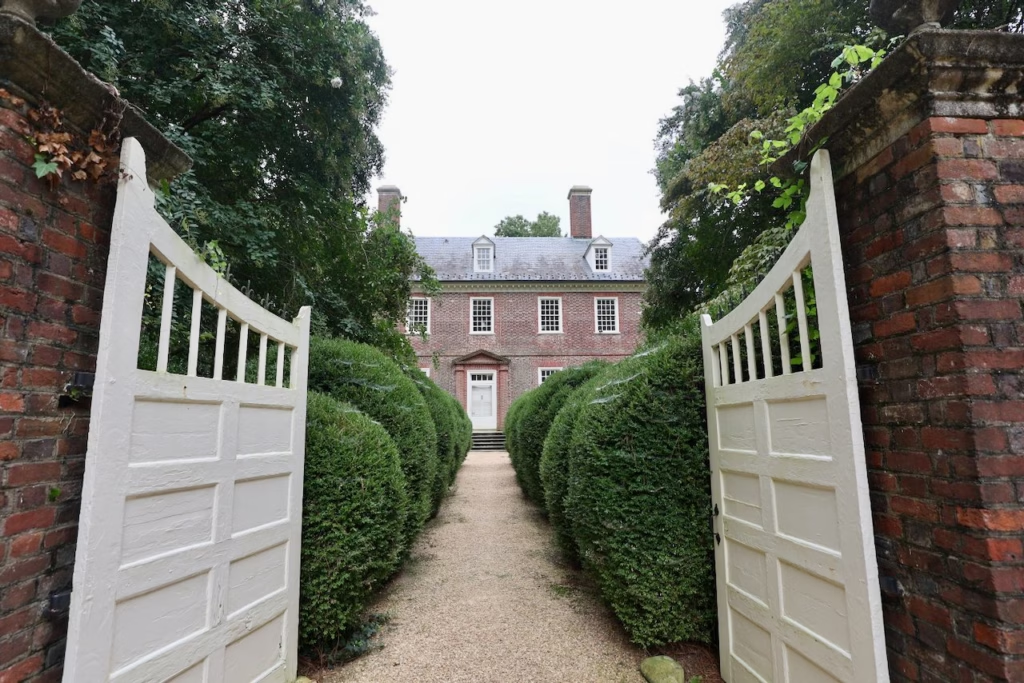
Berkeley Plantation sits off Route 5, about halfway between Richmond and Williamsburg, and it was my first stop of the day. I was there for a short look around from about 11:20 to 11:30 am. I saw a white gate in a brick wall with the brick mansion behind it, a tree-lined path and the old Guest House.
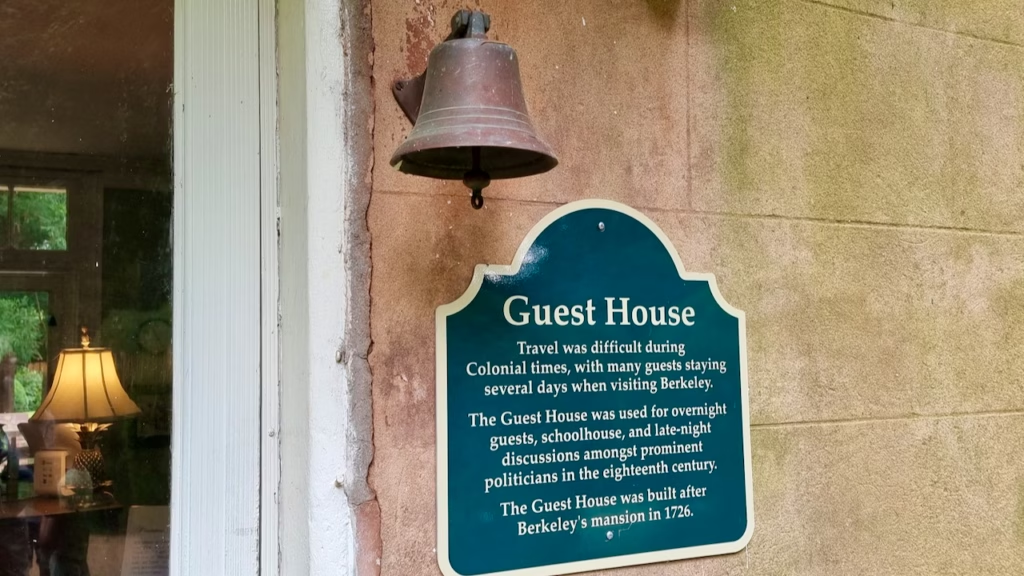
The sign beside the Guest House door gave me the short version. Travel was so slow in colonial times that guests often stayed for days, and the Guest House served as their lodging, a schoolhouse and a place for late-night political talk.
Researched, checked in November: Berkeley’s three-storey brick mansion was completed in 1726, using bricks fired on the plantation. It was the birthplace of Benjamin Harrison V, a signer of the Declaration of Independence, and of President William Henry Harrison. The plantation says settlers held the first official Thanksgiving in America here on 4 December 1619, and that the bugle call “Taps” was composed here in 1862, when Union troops camped at Harrison’s Landing.
The main season runs from 14 March to 13 November, with guided house tours on the hour from 10 am to 4 pm. From 14 November to 1 January hours are shorter (tours 10 am to 3 pm), and the house and grounds close from 2 January to 12 March. Admission is $19 for adults, $17.50 for seniors (60+), $8 for children aged 6 to 16, and free for under-6s.
My stop was short: Berkeley recommends at least two hours for the house tour, gardens and grounds. The drive on to Williamsburg along Route 5 takes about 45 minutes, and my first photo at the Colonial Williamsburg Visitor Center is from 12:33 pm.
My Free Colonial Williamsburg Walking Route
I walked out from the Visitor Center, along Duke of Gloucester Street to the Capitol at its eastern end, and back past the Magazine. The times below come from my phone’s photos.
My walk: from the Visitor Center to the Courthouse, east along Duke of Gloucester Street to the Capitol, and back past the Magazine.
The Footbridge and the Walk Back in Time Plaques
From the Visitor Center, a long footbridge leads towards the Historic Area, and set into its pavement is a timeline that counts backwards. A round plaque at the start reads “Walk back in time”, and every few steps a bronze plaque begins “From this date…” and tells you what you’d have to give up.
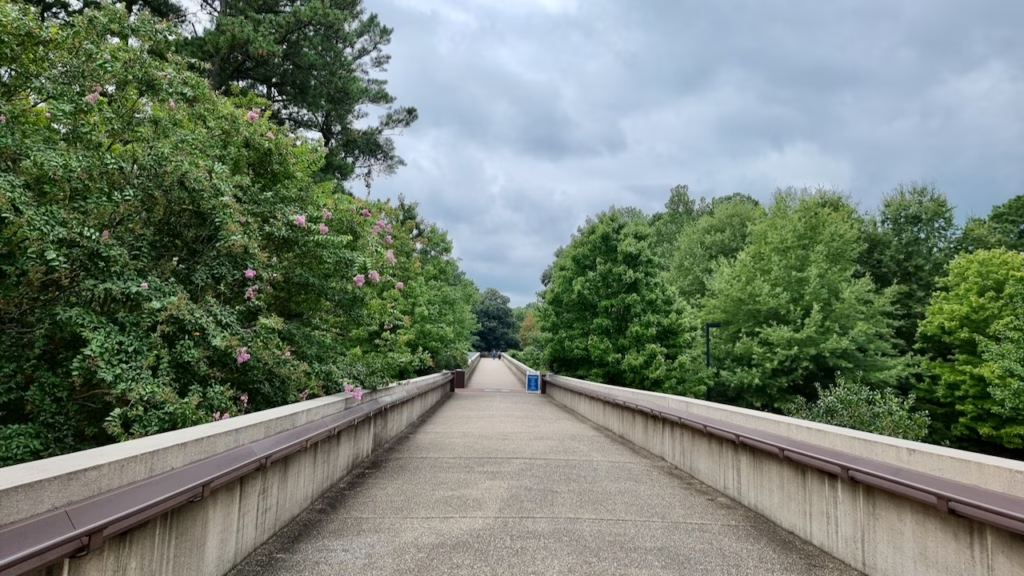
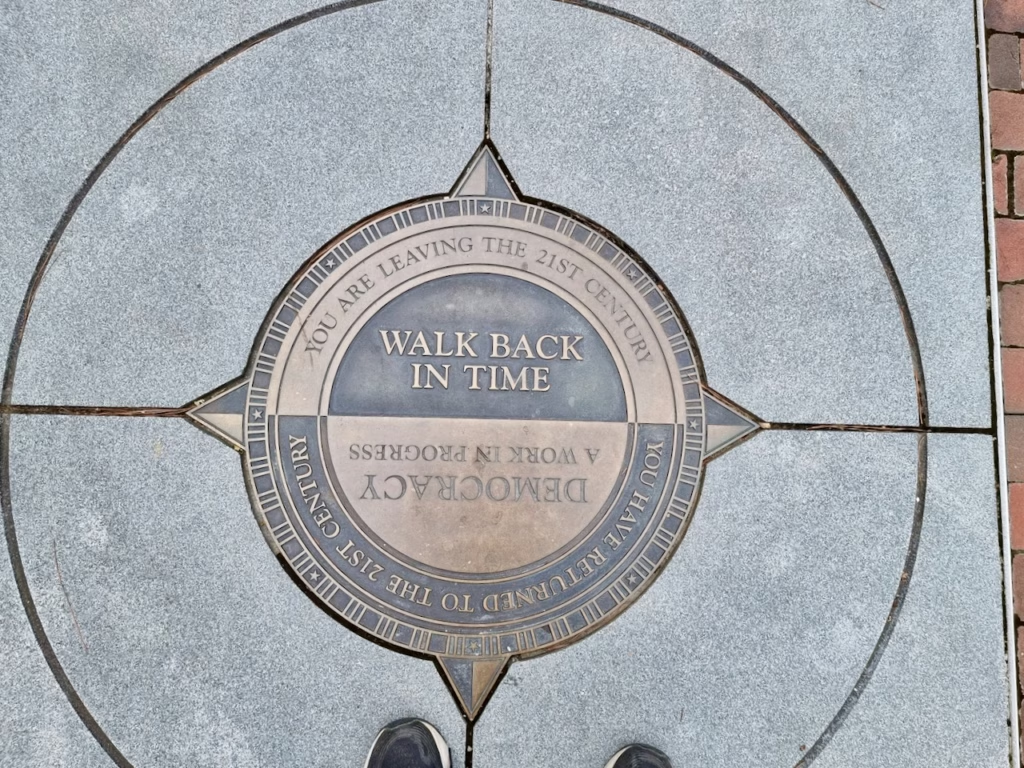
I photographed them as I walked: 1980s, “your personal computer is your brain”; 1920, “you accept that women cannot vote”; 1865, “you know people who own other people”; 1790s, “your latest news is more than one week old”. The last one, 1776, reads “you are a subject of His Majesty the King”, and a final round plaque marks the 18th century.
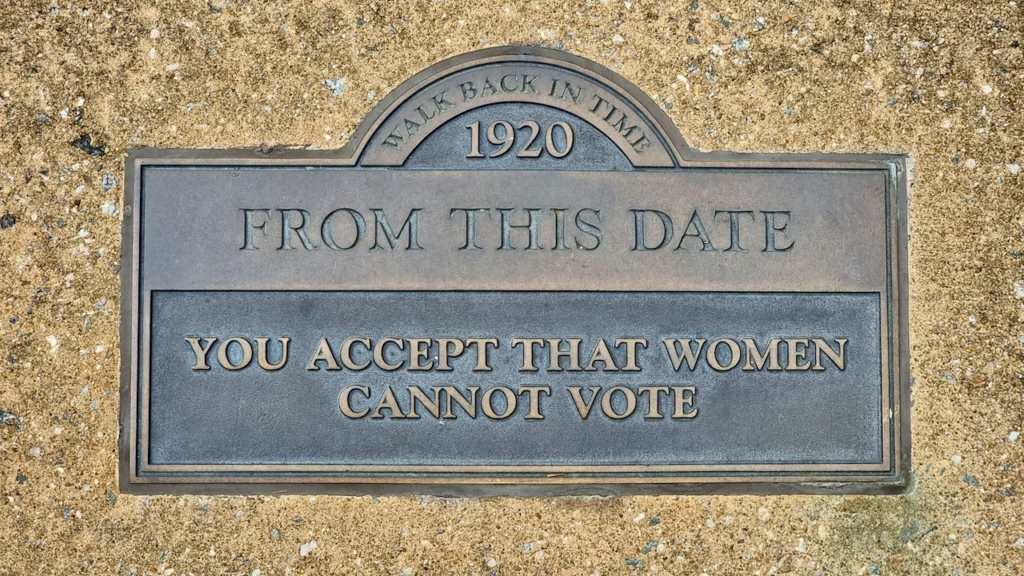
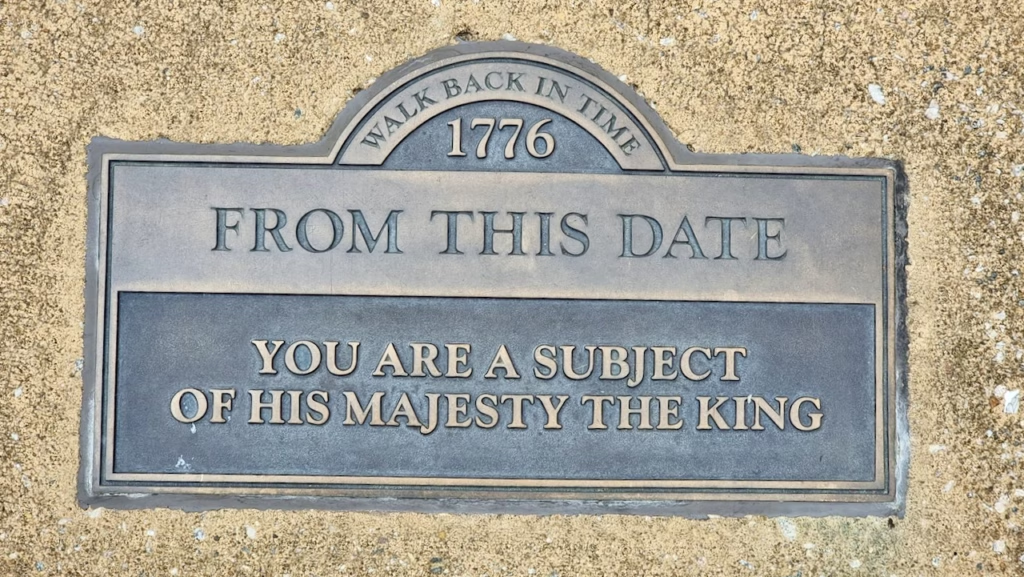
The plaques take about five minutes to read as you walk, and they set the scene for the colonial town at the other end.
The Windmill and Great Hopes Plantation
Just past the bridge, at 12:41 pm, I passed a wooden windmill in a field behind a split-rail fence, next to the sign for Great Hopes Plantation, a re-created 18th-century Virginia farm.
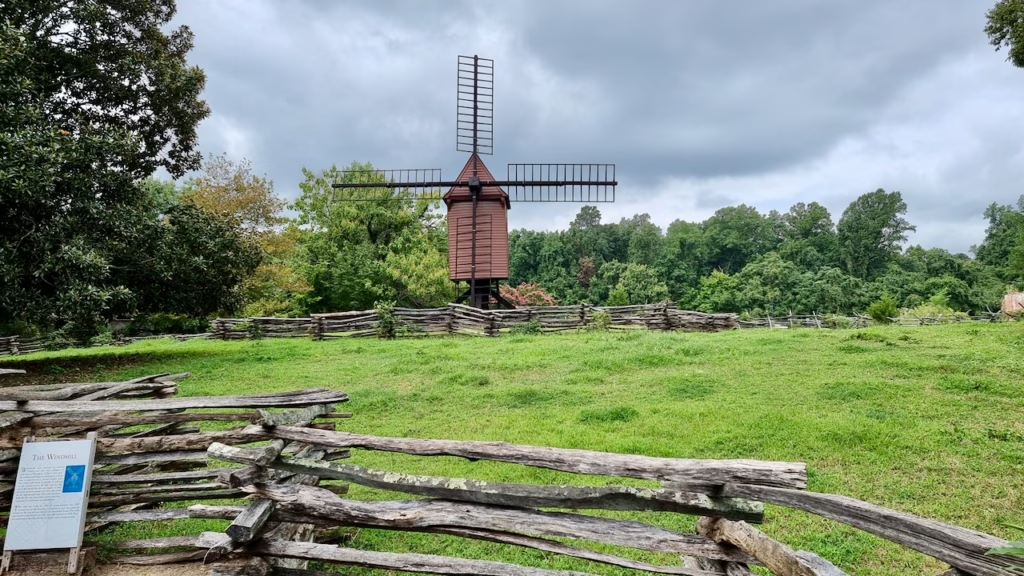
Researched, checked in November: the windmill has moved since my visit. Robertson’s Windmill, a 1957 reconstruction of a colonial post mill, was taken down Duke of Gloucester Street on 8 August to a new site at Ewing Field, near Francis Street and Bucktrout Lane. You won’t see it beside the path from the Visitor Center any more.
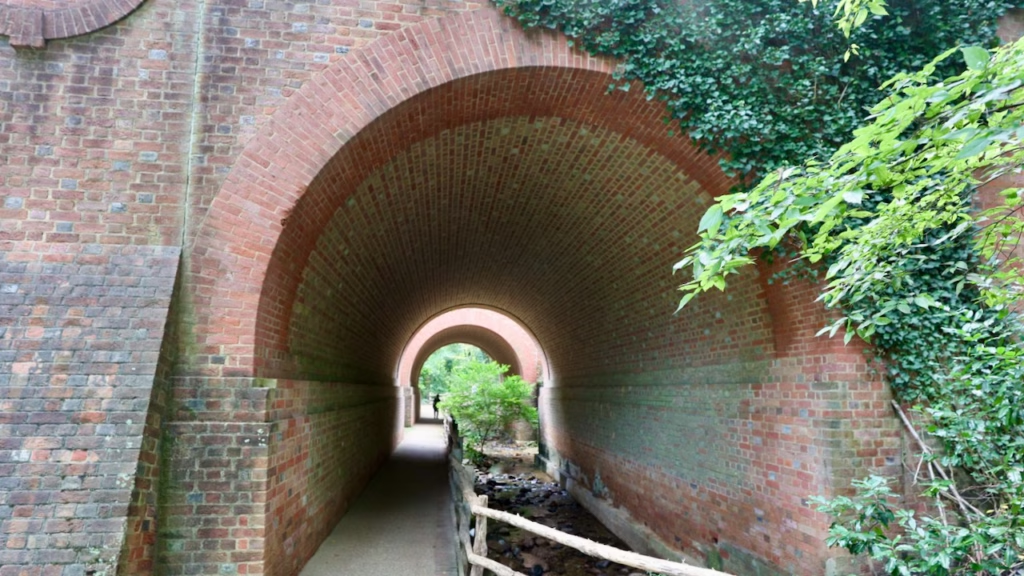
A little further on, the path passes through a brick tunnel under the road, and at 12:52 pm a wooden sign welcomed me to Colonial Williamsburg.
The Courthouse and the Pillory
The first big building I reached was the Courthouse on Market Square, at 12:56 pm: a brick building with tall arched windows and a white cupola. Beside it stands a wooden pillory, the kind where offenders stood with their head and hands locked in, and I took a couple of pictures of it.
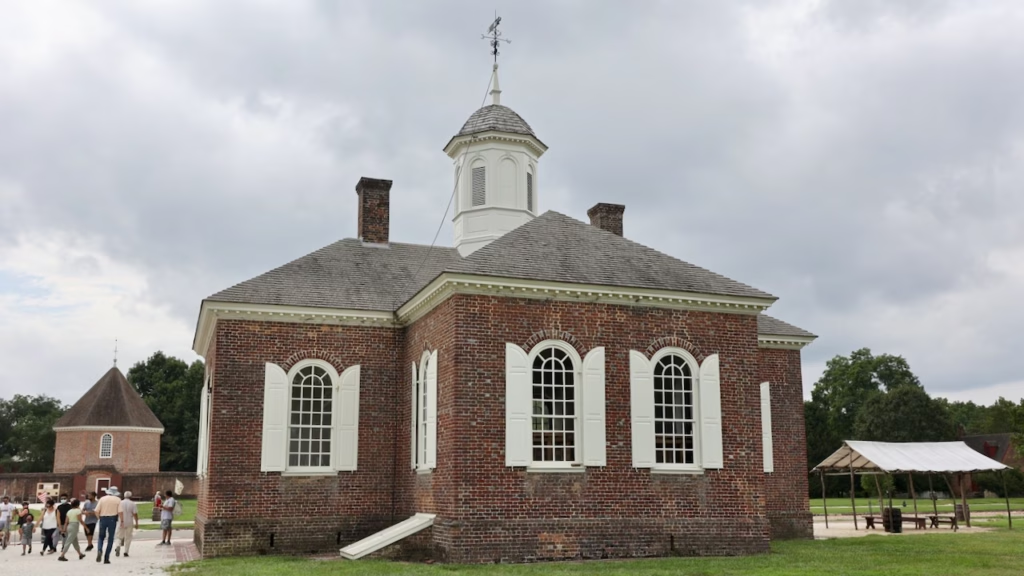
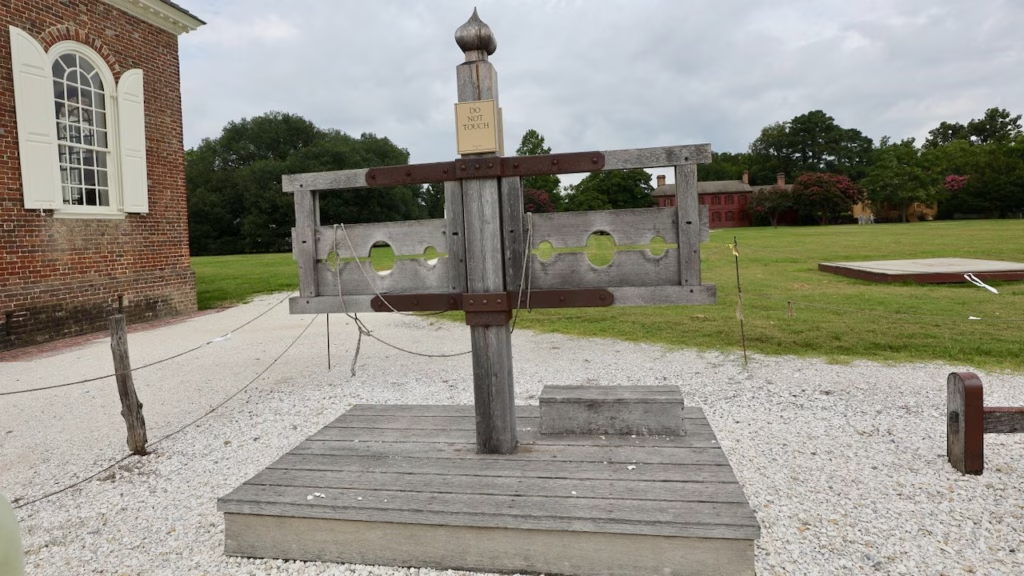
The Courthouse is one of the original colonial buildings, built in 1770 and 1771. With a ticket you can go inside; without one, the outside and the pillory are free.
Duke of Gloucester Street
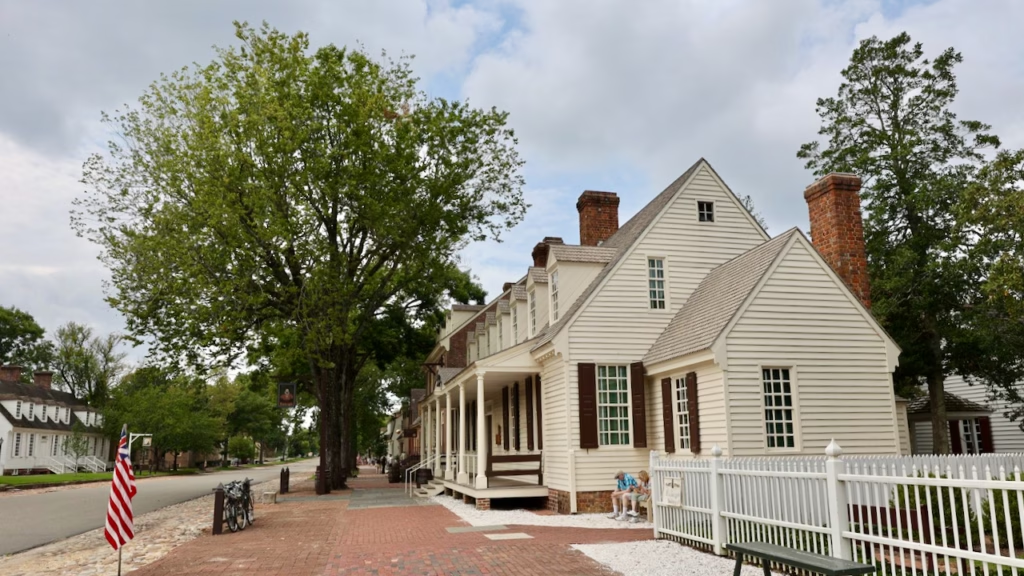
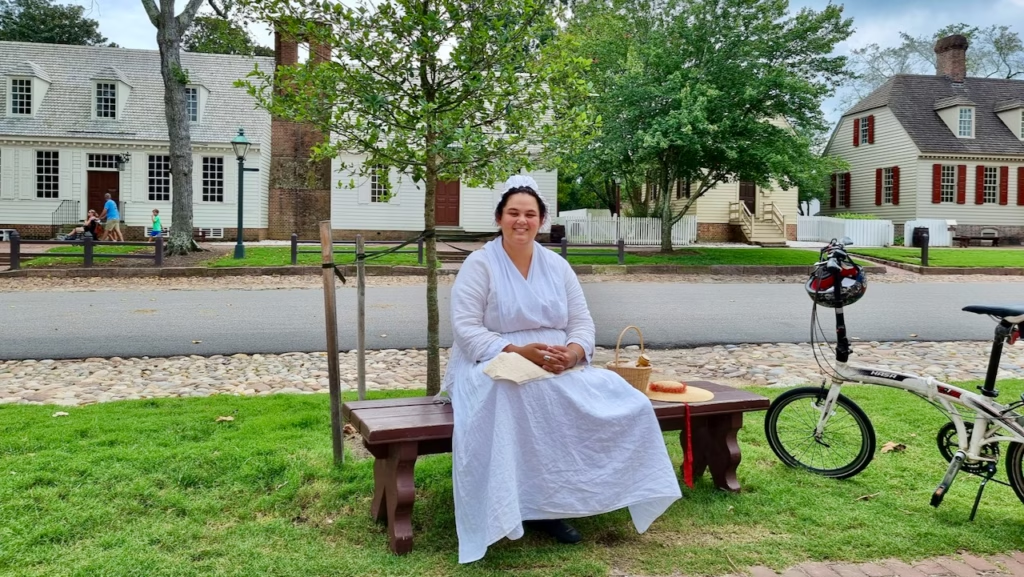
From Market Square I walked east along Duke of Gloucester Street, the main street that runs about a mile from the College of William & Mary to the Capitol. This is where the town comes to life: white clapboard houses behind picket fences, brick shops with painted signs, and costumed interpreters going about their day. At 1:21 pm one of them was sitting on a bench under a tree in a long white dress and cap.
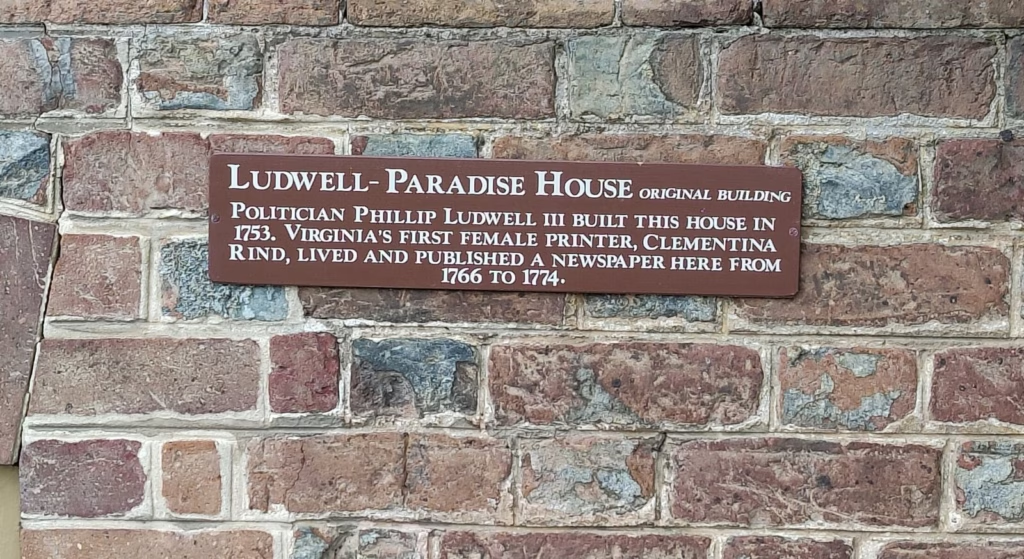
Look at the walls as you go, too. A brown plaque on the Ludwell-Paradise House says Philip Ludwell III built it in 1753, and that Clementina Rind, Virginia’s first female printer, published a newspaper there from 1766 to 1774.
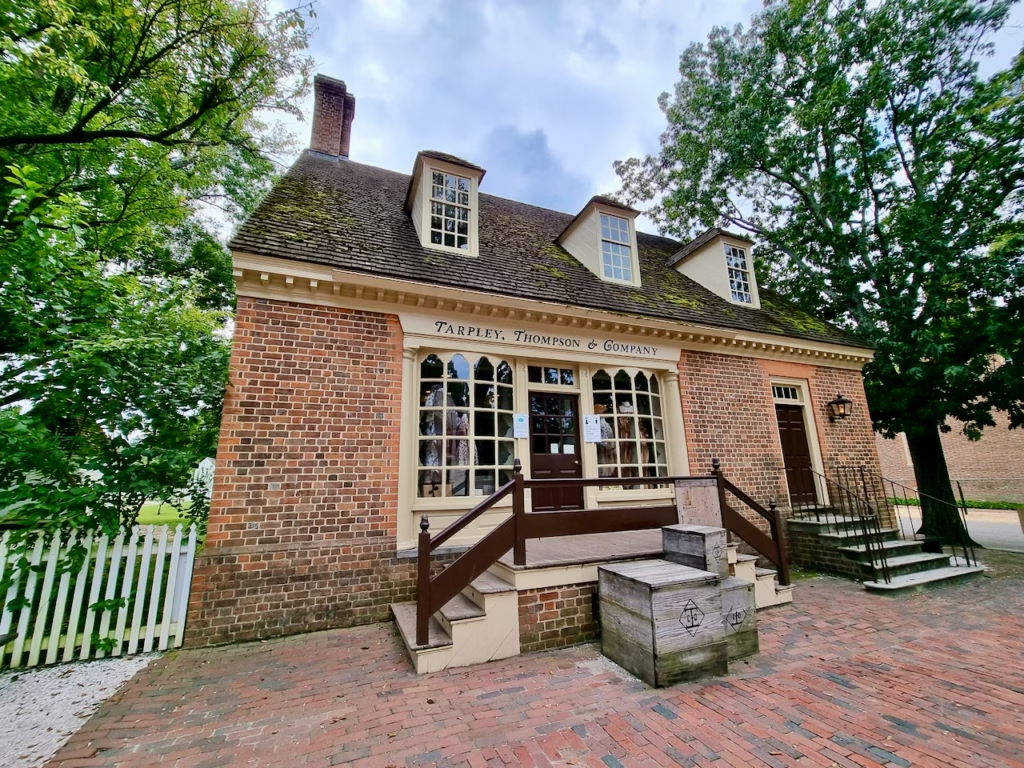
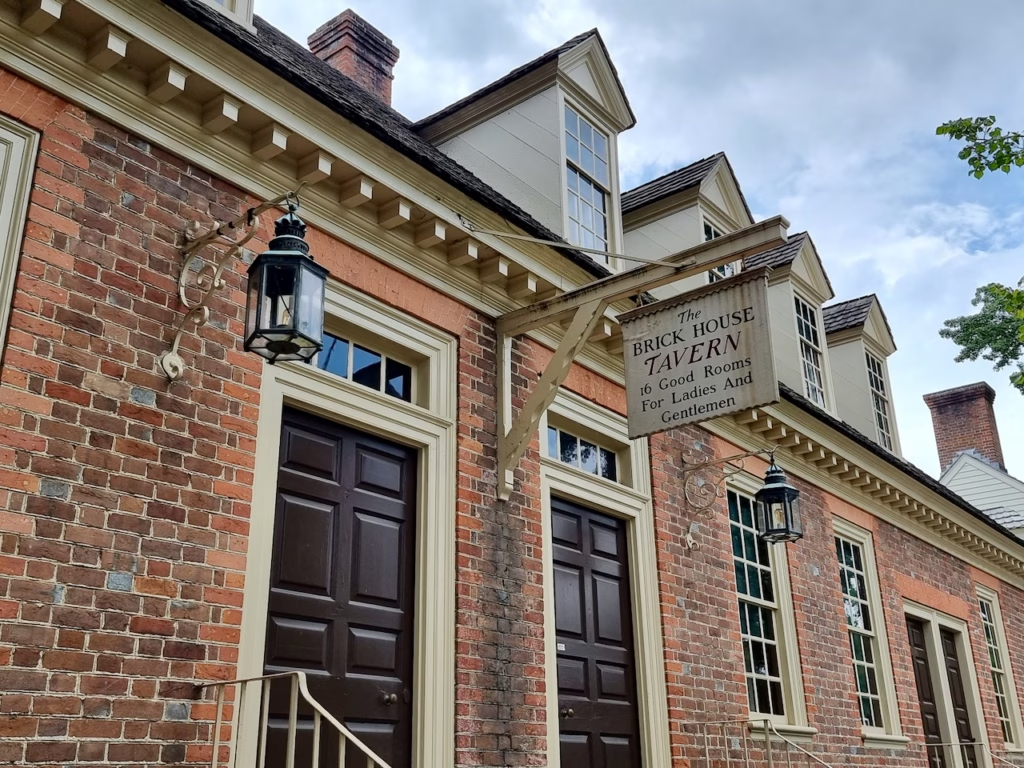
Shops and taverns line the street. I passed Chowning’s Tavern, with its menu board out front, and later the Tarpley, Thompson & Company store and the Brick House Tavern sign. The stores and taverns are open to anyone, so you can shop or stop for food without a ticket; it’s the historic trade shops, where tradespeople work, that need one.
I turned east towards the Capitol, but if you have more time, the street also runs west to Merchants Square, a block of shops and restaurants, and to the Wren Building of the College of William & Mary. Built between 1695 and 1700, it’s the oldest academic building still in use in the United States, and its first two floors are open to visitors. I didn’t go that far, so plan it as an extra half hour.
The Capitol
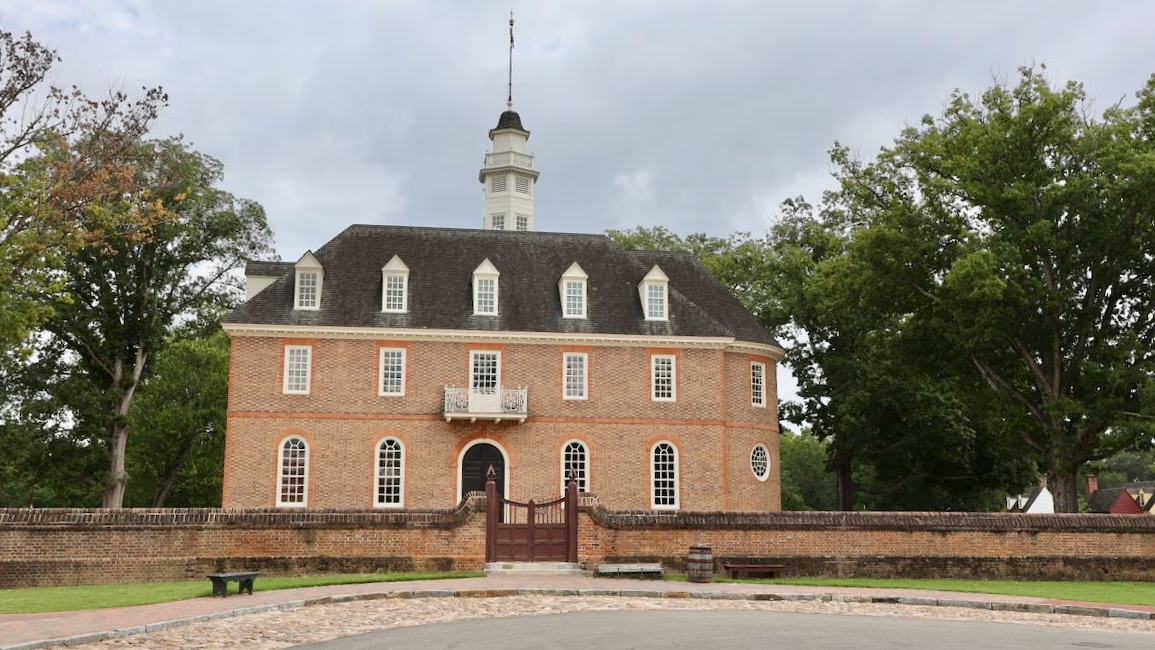
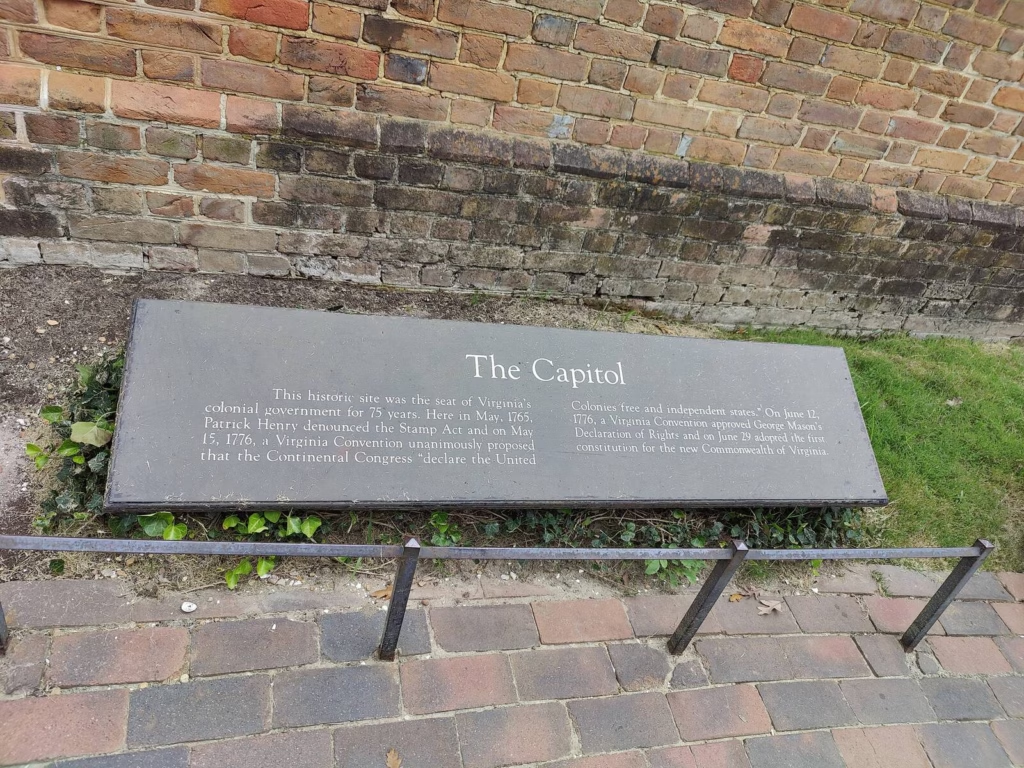
At 1:25 pm I reached the Capitol, at the eastern end of the street. The plaque in front of it sums up why it matters. This was the seat of Virginia’s colonial government for 75 years, and Patrick Henry denounced the Stamp Act here in May 1765. On 15 May 1776, a Virginia Convention here proposed that the Continental Congress declare the colonies independent.
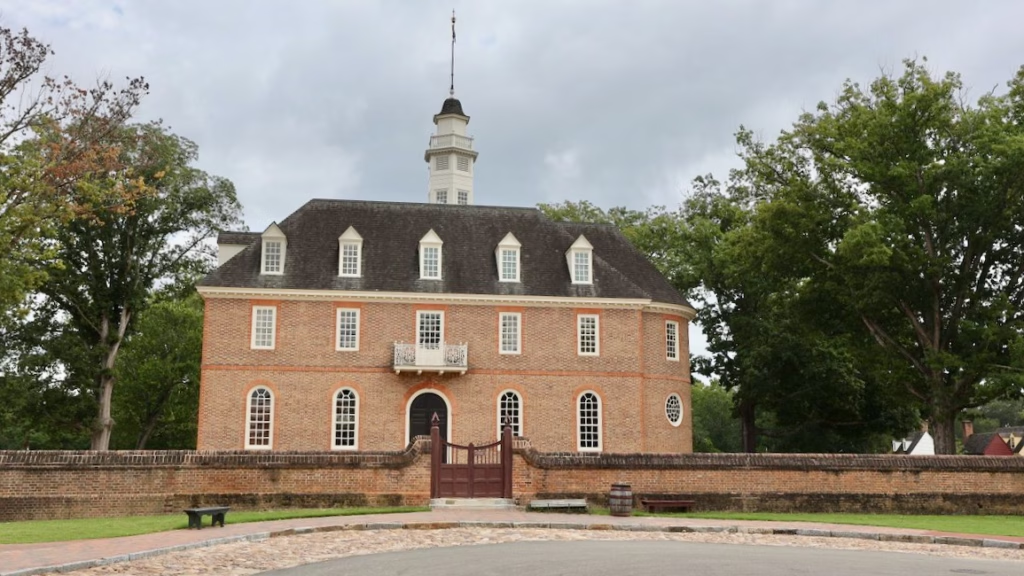
The building you see is a reconstruction, opened in 1934 on the site of the original Capitol, which was completed in 1705 and burned in 1747. It’s the photo at the top of this post: red brick, a white cupola and a wide sandy forecourt.
The Magazine and the Old Oak
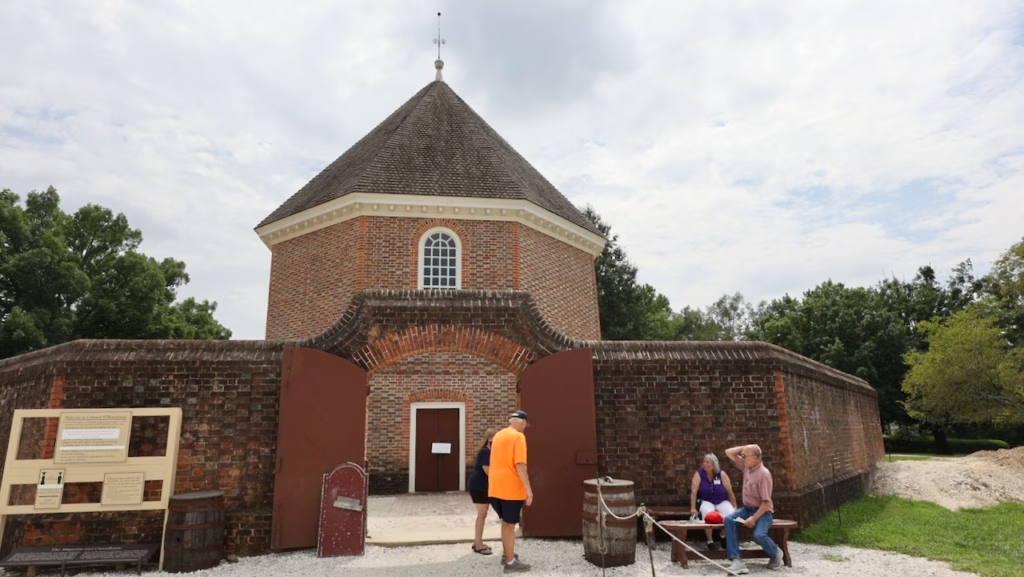
Walking back west, I stopped at 1:39 pm at the Magazine, the octagonal brick building inside its own wall on Market Square. It was built in 1715 to store the colony’s guns and gunpowder, and it’s another original building. In November it’s closed for restoration, so you can only see it from outside for now. In April 1775 the royal governor, Lord Dunmore, had the gunpowder taken from it, one of the events that sparked the American Revolution in Virginia.
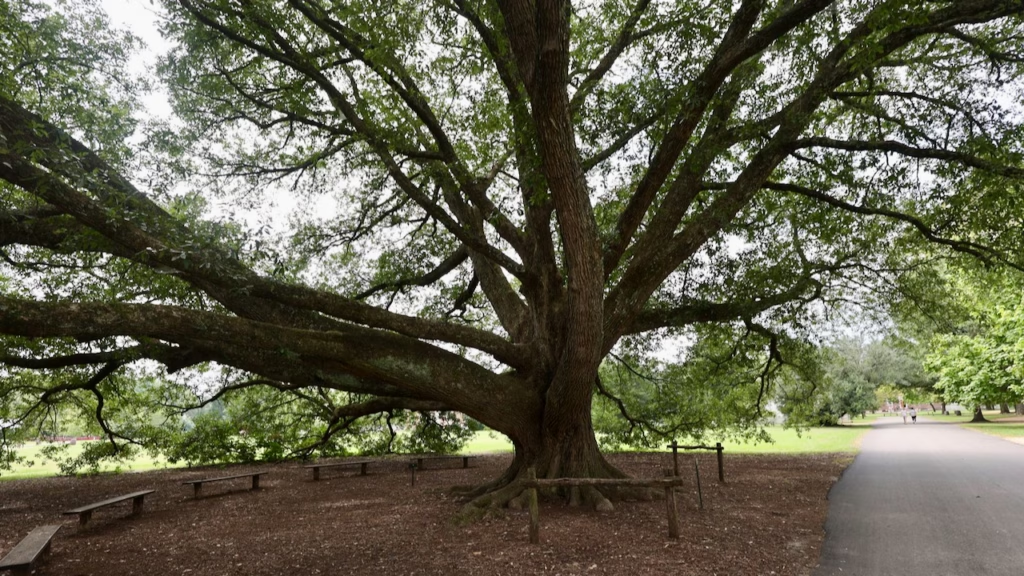
A few minutes later I walked under a huge spreading oak, its branches reaching almost to the ground, before heading back towards the Visitor Center.
The Nation Makers Plaques on the Way Out
On the walk back, from 2:03 to 2:07 pm, I found a second set of plaques in the pavement, called Nation Makers. Each names a person and a year: Thomas Jefferson (1786), Sacagawea (1805), Horace Mann (1837), Abraham Lincoln (1863), Thomas Edison (1879), Henry Ford (1908), Louis Armstrong (1928), Rosa Parks (1955) and John F. Kennedy (1961). The last one says “Your name here” and asks what difference you will make.
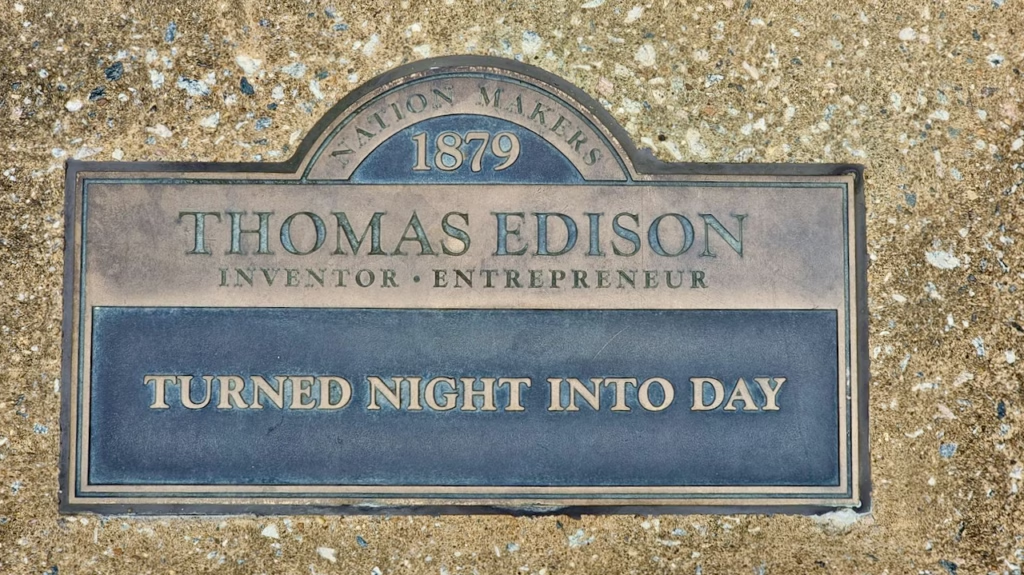
Where the first timeline takes you back to the colony, this one brings you forward again to the present. I headed back soon after and was home in Hopewell by about 3:40 pm.
A One-Day Colonial Williamsburg Itinerary With a Ticket
Researched, checked in November: I didn’t buy a ticket, so this plan comes from Colonial Williamsburg’s own information. Programmes and opening times change by season and by day, so check the day’s map and programme guide when you arrive.
If you want to go inside, give Colonial Williamsburg a full day. Here’s a plan that covers the essentials:
- Governor’s Palace: the home of Virginia’s royal governors, reconstructed in the 1930s on the original foundations after the first building burned in 1781. Go early in the day: it’s one of the most popular sites.
- Capitol: the guided tour takes you inside the chamber where the House of Burgesses met.
- Trade shops: blacksmiths, printers and other tradespeople work with 18th-century tools, and the ticket covers them.
- Bruton Parish Church: an Episcopal church in use since 1715 and still an active parish. It’s run by the parish, not Colonial Williamsburg, so you don’t need a ticket to go in, though donations are welcome. Check its visiting hours on the day.
- Art Museums: free for everyone now, with two museums under one roof. They suit the end of the day or a rainy one.
- Campbell Archaeology Center: opened in April, it’s free and sits across the road from the Art Museums, with a hands-on Discovery Lab and behind-the-scenes looks at the archaeology.
The order follows the town’s layout: the Palace, the church and Market Square sit near the middle, and the Capitol is at the eastern end. The free Route 15 bus stops at both the Capitol and the Art Museums, so you don’t have to walk back along the street at the end of the day. For dinner at one of the historic taverns, book ahead. And when the sites close at 5 pm, the streets stay open, and Colonial Williamsburg runs evening programmes well into the night.
If you’d rather have a guide for the story, there’s also a walking tour:
How Long Do You Need in Colonial Williamsburg?
2 to 3 hours (free)
- Footbridge plaques to the Capitol and back
- Courthouse, Magazine and Duke of Gloucester Street from outside
- Easy to pair with Berkeley Plantation or Jamestown
A full day (ticket)
- Governor’s Palace and Capitol tours
- Trade shops and a tavern lunch
- Art Museums at the end of the day
I spent about an hour and a half, which was enough to see the main street and the plaques. With a ticket, plan on a full day, or two if you add Jamestown and Yorktown.
Practical Tips for Visiting Colonial Williamsburg
The Visitor Center car park costs $10 a day. Other lots around the town use the Passport Parking app, and most give you the first 30 minutes free.
Route 15 Colonial is free to everyone, ticket or not, and runs every 15 minutes from the Visitor Center around the Historic Area: 9 am to 9 pm Monday to Saturday, 9 am to 6 pm on Sundays.
Look for the Grand Union Flag outside a building: it means it’s open. Not every site opens every day, so pick up the day’s programme guide.
The Historic Area is open every day of the year. Most sites and trades open from about 9 or 10 am, depending on the season, until 5 pm; the Art Museums open 10 am to 5 pm.
The walk from the Visitor Center is about half a mile, and Duke of Gloucester Street is about a mile long. Wear comfortable shoes: the pavements are brick and gravel.
Virginia summers are hot and humid, and much of the walk is in the open. Carry water and use the shade of the big trees along the greens.
How to Get to Colonial Williamsburg
Colonial Williamsburg is in the town of Williamsburg, in south-east Virginia, between Richmond and Norfolk. I drove from Hopewell via Berkeley Plantation and Route 5, which is the scenic way from the Richmond area: Route 5 runs along the north side of the James River past several old plantations. The faster route from Richmond is I-64.
If you’re flying in, Richmond International Airport suits this route, and a hire car lets you add Berkeley, Luray Caverns and Shenandoah, as I did.
Colonial Williamsburg is one corner of Virginia’s Historic Triangle, with Jamestown and Yorktown, and the three are linked by the Colonial Parkway. I didn’t visit Jamestown or Yorktown on this trip, but the Historic Triangle ticket in the table above covers all three.
Where to Stay for Colonial Williamsburg
I stayed with family in Hopewell, so I didn’t need a hotel in Williamsburg. If you’re staying a night, Williamsburg itself puts you within walking distance or a short bus ride of the Historic Area, and Richmond works as a base for a longer Virginia trip that includes Luray and Shenandoah.
Is Colonial Williamsburg Worth It?
Yes, and you don’t have to pay to find out. My free walk gave me the timeline plaques, the Courthouse and pillory, the Capitol and the Magazine, interpreters on the street and the feel of an 18th-century main street, in under two hours. What I missed were the interiors, the trades and the stories the guides tell inside, which is what the ticket is for. If you only have a few hours, walk it free and pair it with Berkeley Plantation, as I did. If you have a full day and a real interest in the American Revolution, buy the ticket.
For the rest of my Virginia trip, read about Luray Caverns and my Shenandoah National Park day trip, or see all my USA travel guides.
Frequently Asked Questions
Is Colonial Williamsburg free?
Walking the Historic Area is free, and so are the Art Museums. You need a ticket to go inside the guided sites and trade shops and to join the programmes. A single-day ticket costs $37.50 for adults and $10 for children aged 6 to 12.
How long does it take to walk around Colonial Williamsburg?
A free walk from the Visitor Center to the Capitol and back takes two to three hours at an easy pace. I did it in about an hour and a half. With a ticket and building tours, allow a full day.
Where do you park for Colonial Williamsburg?
At the Visitor Center, where parking costs $10 a day. From there you can walk about half a mile to the Historic Area or take the free Route 15 Colonial bus.
Is there a free shuttle in Colonial Williamsburg?
Yes. The Route 15 Colonial bus is free to everyone and runs every 15 minutes from the Visitor Center to stops around the Historic Area, from 9 am to 9 pm Monday to Saturday and 9 am to 6 pm on Sundays.
What are the Walk Back in Time plaques?
A timeline set into the footbridge from the Visitor Center. Each bronze plaque gives a year and something you’d have to give up, counting back to 1776, when you were “a subject of His Majesty the King”.
Which buildings in Colonial Williamsburg are original?
The Historic Area has 89 original 18th-century buildings, including the Courthouse and the Magazine. The Capitol and the Governor’s Palace are reconstructions, built in the 1930s on their original sites.
Can you combine Colonial Williamsburg with Jamestown and Yorktown?
Yes. The three make up Virginia’s Historic Triangle and are linked by the Colonial Parkway. A Historic Triangle ticket covering all three costs $126 for adults and is valid for five consecutive days; allow at least two.
Should you stop at Berkeley Plantation on the way to Williamsburg?
If you’re driving from the Richmond area on Route 5, yes. It’s about 45 minutes from Williamsburg, and the 1726 mansion and the grounds on the James River make a good start to the day. Allow about two hours if you want the house tour. Admission is $19 for adults, and the plantation is closed from 2 January to 12 March.

Leave a reply