
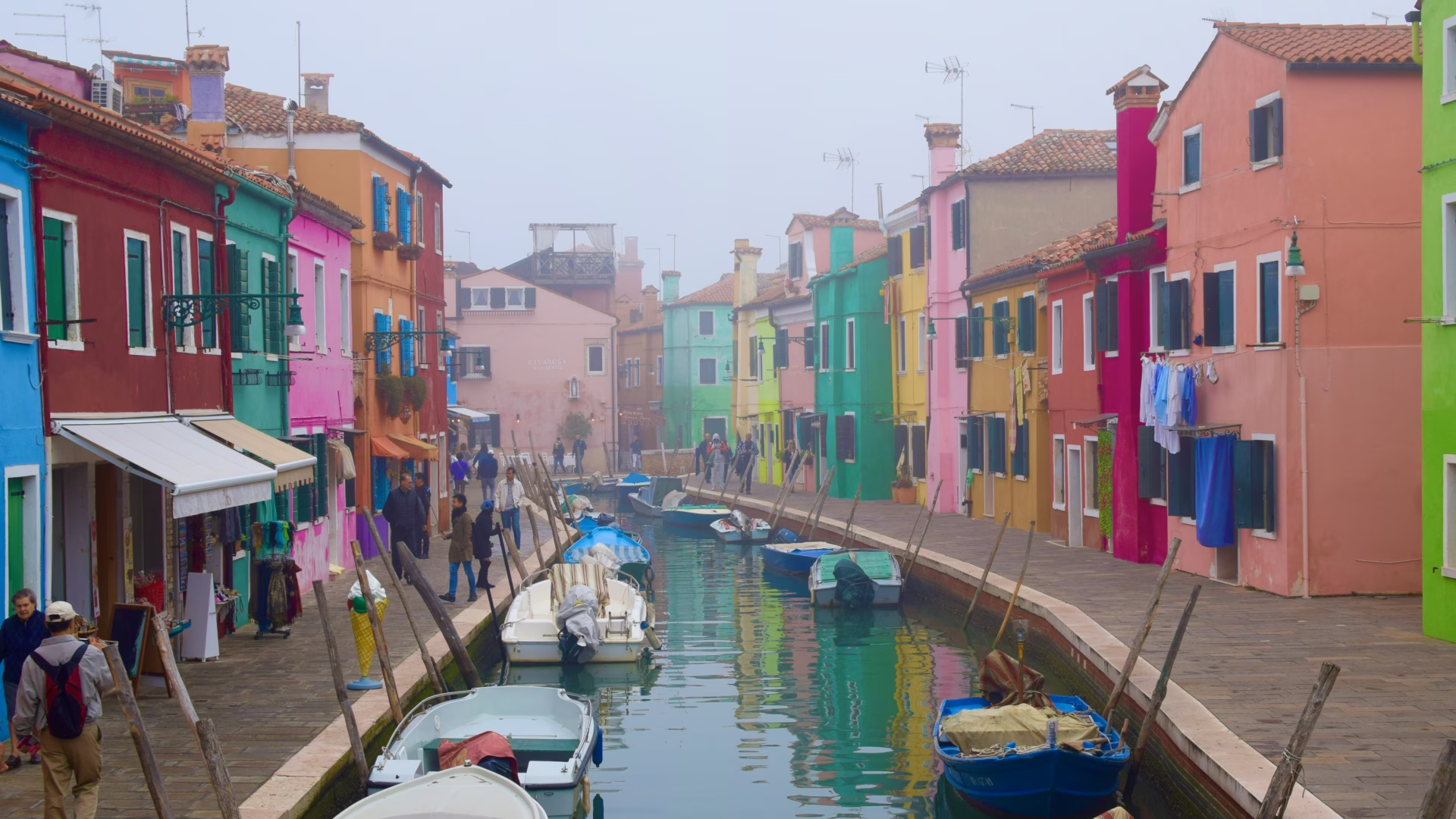
Burano is a small island in the Venetian Lagoon, about 45 minutes from Venice on Vaporetto Line 12 from Fondamente Nove. It is free to visit, easy to reach without a tour, and famous for its colourful houses and handmade lace. Three to four hours is enough, and Murano is on the way, so the two islands fit into one day. I went in November after two foggy days in Venice, and this guide covers how to get to Burano from Venice, what to see, where to eat and how to combine it with Murano.
Getting there
Line 12 from Fondamente Nove
About 45 minutes
Cost
Free to visit
Vaporetto €9.50 each way, or use a pass
Time needed
Half a day
3 to 4 hours, including lunch
Combine with
Murano
Line 12 stops there on the way
Best time
Morning
Before the day-trip crowds arrive
I had spent two days in Venice walking through fog, photographing Gothic palazzi emerging ghostlike from the mist, and getting lost in alleys that seemed to lead only to other alleys. Venice in November is extraordinary but it is also relentlessly grey.
Then I took a 45-minute vaporetto ride northeast across the lagoon, and the colour hit me like walking into a different film.
Burano is everything Venice is not. Where Venice is monumental, Burano is domestic. Where Venice is all stone and shadow, Burano is painted in every shade of the rainbow and protected by law to stay that way. The fog was still there when I arrived, but it didn’t matter. Nothing could have dulled what I saw stepping off that boat.
Why Visit Burano Island?

Burano is a small fishing island in the Venetian Lagoon, and it has been famous for two things for centuries: handmade lace and extraordinarily colourful houses.

The colour has a popular legend attached to it. Fishermen, returning across the lagoon in thick fog, needed to be able to identify their home from a distance. The solution was paint: bright, bold, unmistakable. Each family chose a different colour, and those choices were passed down through generations.
Today, the tradition is protected by local ordinance. If you own a house in Burano and want to repaint it, you must submit a formal request to the city council, who then send you an approved list of permitted colours. Even the shade of your repaint has to pass scrutiny.
The result is the most systematically colourful place I have ever stood in.
How to Get to Burano from Venice
From Venice, Burano is reached exclusively by water. There are no road connections; the island sits in the middle of the lagoon.
By vaporetto (recommended): Take Vaporetto Line 12 from Fondamente Nove (Fondamenta Nuove), on the northern edge of Venice in Cannaregio. Fondamente Nove has several landing stages, so check the signs for Line 12 towards Burano. It is the main direct water bus to Burano, takes about 45 minutes and calls at Murano Faro and Mazzorbo on the way; some runs also stop at Torcello on request. A few Line 14 services reach Burano from San Zaccaria via the Lido and Punta Sabbioni, but they are slower and much less frequent.
In the winter timetable, daytime boats leave Fondamente Nove for Burano about every 30 minutes, with fewer in the evening, when a night line takes over. Check the ACTV timetable before you go, and again before you head back.
Tickets: A single vaporetto ticket costs €9.50 and lasts 75 minutes, so the return trip is €19. A 24-hour pass (€25) or 48-hour pass (€35) covers Burano too, and is better value if you also use the vaporetto in Venice that day. Validate your ticket at the machine before boarding: inspectors check regularly.
If you have been following my Venice in November guide, you may already have a multi-day pass, and it covers Burano.
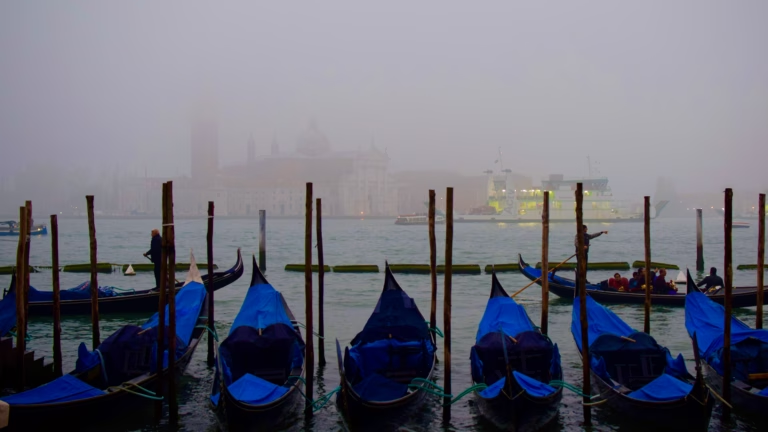
By water taxi: A private water taxi is faster but expensive: published fares from central Venice to Burano start at around €115 per boat, before supplements. It only makes sense for a group splitting the fare, and you should confirm the price before boarding.
Murano and Burano Day Trip from Venice
Line 12 stops at Murano Faro on its way to Burano, so the two islands fit into one day. Get off at Murano Faro, explore the glass furnaces and showrooms (the Glass Museum is a short walk away), then catch a later Line 12 boat on to Burano for lunch and the afternoon. Give yourself about two hours on Murano and three on Burano, and aim to reach Burano by early afternoon, as some shops there close in the late afternoon. On a wet November day, Murano is a sensible first stop: the Glass Museum and the showrooms keep you indoors. You will take at least three boats, so a 24-hour pass pays for itself.
If you would rather not juggle timetables, these guided trips cover the islands with transport included:
This post contains affiliate links. If you book through them, I may earn a small commission at no extra cost to you.
Arriving in Burano

You step off the vaporetto onto a small dock and walk through a gate into the island. There’s no dramatic arrival moment: no bridge, no grand entrance. One moment you’re on a boat, and the next you’re standing in front of a lime-green wall next to a coral-pink wall next to a cobalt-blue wall.
It takes a moment to adjust.
The main street, Via Baldassare Galuppi, runs from the vaporetto stop through the centre of the island to Piazza Galuppi. It’s lined with lace shops, souvenir stalls, restaurants, and art sellers. In summer this street is packed. In November, it was busy enough to feel alive but quiet enough to walk without being pushed.
Galuppi was an 18th-century composer born here, and if you’re wondering why a small fishing island has a famous square named after a Baroque musician, Venice has a way of making that kind of thing seem normal.
On the same square is the church of San Martino, whose bell tower leans visibly, and inside it a Crucifixion by Giambattista Tiepolo.
The Coloured Houses: What to Look For

Most visitors walk the main canal and the main street, take a few photos, and leave. That’s the tourist circuit, and it’s fine, but the best of Burano is in the side streets.

The main canal (Fondamenta di Cavanella) is the one in all the photographs: rainbow houses on both sides, boats moored, washing hung between windows. It’s as good as it looks. But walk one street back and you find the same colours in a quieter key, residential alleys where actual people live and nobody is holding up a phone.

The fog, on the morning I visited, turned the far end of every alley into a soft vanishing point. What could have been an overcast disappointment became one of the most atmospheric things I’ve photographed. This is why November works: the colours are vivid enough to overpower any grey sky.

What to notice: Beyond the big colour blocks, the details are where Burano rewards slow walkers. Window boxes overflowing with cyclamen. Doors framed by climbing vines. Lace draped over windowsills, not for sale, just there. House numbers painted directly onto the wall in the old Venetian way.


The Bridges and Canals
Burano is really several small islands joined by bridges, not a single island. Most visitors don’t notice: the bridges are small and numerous, and crossing them is just part of walking around.

The wooden footbridges are particularly photogenic: dark timber against the pastel walls, with reflections of the houses in the water below when the surface is calm. Early in the morning, before the boat traffic builds, the water is often calm enough for near-perfect reflections of the colour above.
At the western edge of the island, a long footbridge crosses to Mazzorbo, a quieter island of gardens and vegetable plots, home to the Venissa estate and its walled vineyard. It is a five-minute walk and a good escape from the main street.

💡 THE RETURN JOURNEY
The Burano stop gets busy between midday and late afternoon. Check the departure board when you arrive and allow some flexibility in your return time. Boats towards Venice leave Burano and then call at Mazzorbo, Murano and Fondamente Nove; you can walk over to Mazzorbo to board, but don’t assume it will be easier there.
Casa di Bepi Suà: Burano’s Most Famous House
A short walk from Piazza Galuppi, along Via al Gottolo, is the island’s most photographed building: Casa di Bepi Suà. It was the home of Giuseppe Toselli (1920 to 2002), known as Bepi Suà, who sold sweets on the square and ran a small open-air cinema outside his house. From the 1960s he covered the facade in bright geometric shapes, repainting and adding to them for the rest of his life. The house was restored in 2005 from photographs and postcards of his designs. It looks like a Mondrian painting scaled up to life size, and you see it from the street, as it is a private house.
It’s easy to find: follow the signs or ask anyone on the street, and they’ll point you in the right direction. The patterns cover every surface: triangles, diamonds, squares, each in a different bright colour. It’s slightly mad and completely wonderful.
Burano Lace and the Lace Museum
Burano’s lacemaking developed in the 16th century, when Venetian needle lace was prized across Europe. It declined in the 18th century as fashions changed, and in 1872 a lacemaking school opened on the island to revive the craft; the school building on Piazza Galuppi is now the Museo del Merletto (Lace Museum).
Machine-made lace undercut the handmade craft through the 20th century, and the number of skilled lacemakers fell sharply, but a few still work on the island. The museum documents the craft with a real collection. It opens Tuesday to Sunday, 10am to 4pm (last entry 3.30pm), and closes on Mondays. A ticket costs €7 (€3.50 reduced), or €20 for a combined ticket that also covers the Murano Glass Museum and the Torcello Museum.
⚠️ BUYING LACE
Not everything sold as Burano lace is handmade on the island: much of it is machine-made or imported. If you want a real handmade piece, ask the seller who made it and where, and look for “Fatto a mano” (handmade), though the label alone proves little. Traditional needle lace takes great time and skill, so expect it to cost far more than a souvenir.
Shopping in Burano

Beyond lace, the island has a good selection of art and souvenirs, and unlike Venice’s tourist shops, some of it is local.
The painted miniature canvases of Venice and Burano scenes are sold from outdoor stalls and make reasonable souvenirs: small, light, and the kind of thing that actually looks good on a wall. Prices start from around €10 for small pieces. Postcards, handmade jewellery, and glass pieces (imported from Murano) are also widely available.
Opening hours vary from shop to shop, and some close in the late afternoon, especially in the quieter months. If shopping is part of your plan, arrive before lunch.
Where to Eat in Burano
Burano is a fishing island, and its restaurants reflect that. The local speciality is risotto de gò, a creamy risotto made with a broth of goby, a fish from the Venetian Lagoon. You won’t often find it in Venice itself, though not every restaurant has it every day. The places below are picks from research.
Trattoria al Gatto Nero (Via Giudecca 88) One of the best-known restaurants on the island, run by the Bovo family since 1965 and known for seafood and traditional lagoon cooking. It serves lunch Tuesday to Sunday and dinner on selected evenings, so book a table on its website. Look for: the seafood risotto, or ask about the day’s specials.
Riva Rosa (Via San Mauro 296) A canal-side restaurant and wine bar known for Venetian seafood and its wine list, good for a slower lunch. Check its opening days before you go.
Osteria al Ponte del Diavolo (Torcello) On the neighbouring island of Torcello, about five minutes from Burano on Line 9, and often cited as one of the best restaurants in the lagoon. It generally opens for lunch, Tuesday to Sunday, so book and check your return boat. Torcello itself has an ancient cathedral with Byzantine mosaics, a good reason to add it to your day.
Bussolà buranello: Burano’s traditional biscuit, a rich, buttery ring made with flour, sugar and egg yolks, traditionally baked for Easter. There is an S-shaped version too, called esse. Buy a bag from a bakery to take back to Venice: they travel well.
The Park Almost Nobody Mentions
Right beside the vaporetto stop, on the southwest side of the island near Fondamenta del Pizzo, there is a small public park and lawn that most visitors walk straight past on their way to the main street. Green grass, bare trees in November, benches, and a bronze sculpture called Attesa di Pace (Waiting for Peace).

In the fog, the park looked completely unexpected, like a different island entirely. The bronze figure emerged from the mist in a way that had nothing to do with colour and everything to do with atmosphere. It is the kind of place you stumble into by accident and remember long after you’ve forgotten which canal was which.
Nobody was there. It was completely quiet. After the sensory overload of the main streets, it was exactly what I needed.
Photography Tips for Burano

Burano is the most photographed island in the Venetian Lagoon, and for good reason. But most photographs of it are the same photograph: the rainbow canal on a sunny day, taken from the same bridge, at the same angle.

Here’s how to do it differently:
Go early. The vaporetto from Venice starts running early in the morning. Get on one of the first boats and you’ll arrive before the day-trip crowds. The light is softer, the water calmer, and the reflections sharper.
Embrace the fog. Sunny Burano photographs look like postcards because thousands of them already exist. Foggy Burano photographs look like yours. The colours are vivid enough to read through any amount of grey sky; the fog just adds depth to the far end of every alley.
Leave the main canal. Turn left, turn right, follow a street until it ends. The residential alleys have the same colours with none of the tourists.
Shoot the details. Window boxes, door numbers, peeling paint, lace on a sill, a bicycle leaning against a teal wall. The macro story of Burano is as interesting as the wide shot.
Reflections. On calm mornings, every canal becomes a perfect mirror. Get low, as low as you can, and shoot the reflection directly. The colours double.
Burano in November
The summer crowds on Burano are reportedly extraordinary: boats queuing to dock, the main street shoulder-to-shoulder, the photography near-impossible without strangers walking into every frame. In November, none of that applies.
The shops are open, the restaurants are serving, the colours are as vivid as ever, and the fog, the same fog that gave Burano’s houses their original purpose, adds something that no amount of sunshine can replicate.
If you’re visiting Venice in November and wondering whether to make the trip, the answer is yes. Take the Line 12 vaporetto from Fondamente Nove, arrive by mid-morning, spend three to four hours wandering, eat lunch by the canal, and be back in Venice before the afternoon vaporetto crowds build up.
If you haven’t already planned your Venice base, my full Venice in November guide covers vaporetto passes, where to stay, and everything else you need before you leave the main island.
Practical Tips for Visiting Burano
Getting there: Vaporetto Line 12 from Fondamente Nove (Fondamenta Nuove), Venice, about 40 to 45 minutes. Buy a 24-hour or 48-hour ACTV pass if you plan several vaporetto trips.
How long to spend: 3 to 4 hours is enough to see everything comfortably, including lunch. A full day gives you time to explore Mazzorbo or Torcello as well.
What to bring: Comfortable shoes with good grip (paving can be uneven and wet), a waterproof layer (November is damp and often windy on the lagoon), a camera with a wide lens and something for close-ups, and some cash for smaller shops and bakeries. Burano is flat, but its bridges have steps, so it is not entirely step-free.
FAQ: Burano Day Trip from Venice
How do you get to Burano from Venice?
Take Vaporetto Line 12 from Fondamente Nove, on the northern edge of Venice. It takes about 45 minutes and stops at Murano Faro and Mazzorbo on the way. Daytime boats run about every 30 minutes in winter, so check the current ACTV timetable.
How long does it take to get to Burano from Venice?
About 45 minutes on Line 12 from Fondamente Nove. A private water taxi is faster but costs from around €115 per boat.
Is Burano worth visiting from Venice?
Yes. It is one of the most striking places in the Venetian Lagoon and nothing like Venice itself. The coloured houses, the canals, the slower pace and the seafood restaurants make the boat ride a good use of half a day.
How much does it cost to visit Burano?
The island is free to enter. You pay for the vaporetto (€9.50 each way, or covered by a €25 24-hour pass), food and anything you buy. The Lace Museum costs €7.
Can you do Murano and Burano in one day?
Yes. Take Line 12 from Fondamente Nove, get off at Murano Faro for the glass, then catch a later Line 12 boat to Burano for lunch and the afternoon. Allow about two hours on Murano and three on Burano.
How long should I spend in Burano?
Three to four hours is comfortable: enough to walk the main canal and the side streets, see the Lace Museum, have lunch and browse the shops before they close.
What is Burano famous for?
Its brightly coloured houses, each painted a different shade and protected by local rules, and its handmade lace tradition, which dates to the 16th century.
What is Casa di Bepi Suà?
The most photographed house in Burano, on Via al Gottolo near Piazza Galuppi. Giuseppe Toselli (1920 to 2002), known as Bepi Suà, covered it in bright geometric shapes from the 1960s; it was restored in 2005. It is a private house, seen from the street.
Is the Lace Museum in Burano open?
The Museo del Merletto on Piazza Galuppi opens Tuesday to Sunday, 10am to 4pm, with last entry at 3.30pm, and is closed on Mondays. A ticket costs €7, or €20 combined with the Murano Glass Museum and the Torcello Museum.
Can you visit Burano without a tour?
Yes. The vaporetto is easy to use on your own and Burano is small enough to explore without a guide. A guided tour mainly saves you working out the boats between islands.
Are shops open in Burano in November?
Many shops and restaurants stay open in November, but not every business opens daily or keeps summer hours, and some close in the late afternoon. Arrive by late morning and check opening times for anywhere you particularly want to visit.
What should I eat in Burano?
Risotto de gò, made with goby from the lagoon, is the local speciality, though not every restaurant has it every day. Trattoria al Gatto Nero is one of the best-known restaurants. Try bussolà too, Burano’s buttery ring-shaped biscuit, sold at bakeries across the island.
Is Burano crowded in November?
Much less than in summer. In the morning you will have many streets almost to yourself, though the main street and the boat stop get busier from midday.
Is Burano Worth Visiting?
Forty-five minutes on a vaporetto. No entry fee. No queue.
I stepped off the boat into fog and came face to face with a wall painted the colour of a ripe tangerine, next to a wall the colour of the sea, next to a wall the colour of a summer dress. After two days of Venice’s beautiful greys, the effect was almost physical.
Burano is the kind of place that makes you slow down without deciding to. The streets are too narrow to walk fast. The colours demand that you stop. The cats (and there are always cats in Burano) are entirely indifferent to your schedule.
There is no great monument here, no UNESCO interior to queue for, no audio guide to follow. It is just a small island where people have lived for centuries, painted their houses every colour they could find, and carried on. The fog still rolls in every November, exactly as it did when the fishermen first needed to find their way home.
Take the Line 12 from Fondamente Nove. Bring a camera and a comfortable pair of shoes. Arrive before the crowds and stay for lunch. And before the boat back, step into the little park beside the vaporetto stop, where Attesa di Pace stands in the mist and nobody else has bothered to look.
You’ll know you made the right call before you’re halfway there.



Leave a reply