
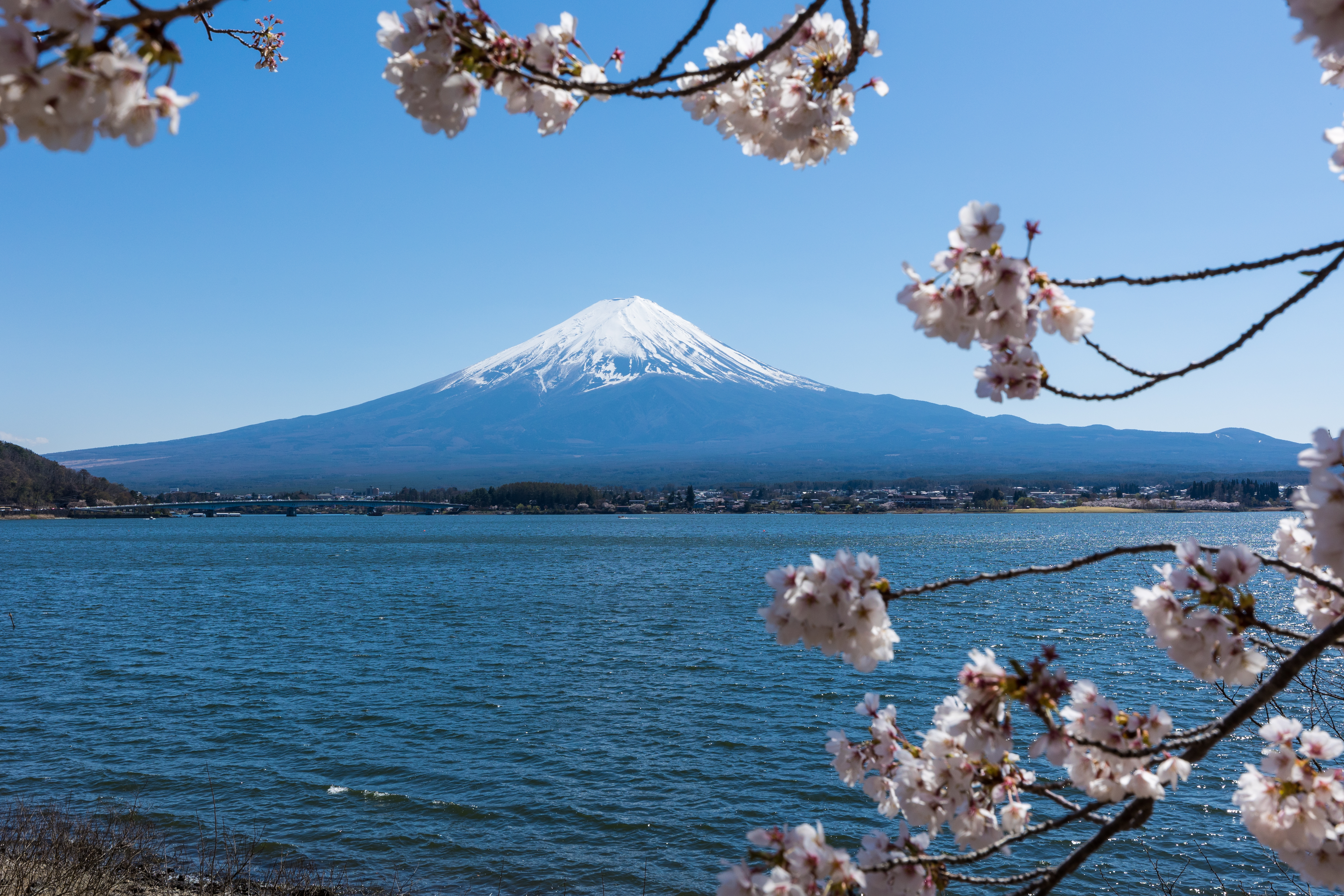
Sushi and Mount Fuji. Those are the two things I always think of when someone says Japan. One you can eat in a few bites. The other is a 3,776-metre volcano that has been inspiring artists, poets, and bewildered tourists for centuries — and that spends a frustrating amount of time hidden behind clouds. I came to Japan with the specific intention of seeing it clearly. After one cloudy false start, I did. Here is everything I learned about where to stand and when.
First time in Japan? Read my complete guide for first-timers before you go.
The best place to see Mount Fuji is the north shore of Lake Kawaguchiko, about two hours from Tokyo, where the mountain rises directly over the water with nothing else in the frame. For the single most photographed angle, it’s the Chureito Pagoda in nearby Fujiyoshida. Clearest skies come December through February, always before 9 AM.
QUICK FACTS
- Best base for views: Lake Kawaguchiko (most accessible from Tokyo, best lake views)
- Most iconic viewpoint: Chureito Pagoda in Fujiyoshida (free, but 398 steps)
- Best months: December–February (77% visibility); October–November also excellent
- Best time of day: Before 9 AM — clearest air, fewest clouds
- Day trip or overnight? Overnight gives you two morning chances — strongly recommended
- From Tokyo: ~2 hours by bus from Shinjuku or train (Fuji Excursion from Shinjuku)
- Check before you go: Fujisan Watcher live webcam — check conditions from Tokyo before you leave
- Book a tour: Mt. Fuji & Oishi Park & Oshino Hakkai day tour (GetYourGuide)
When Is the Best Time to See Mount Fuji? (Visibility by Month)
This is the question to answer before you book anything else. Mount Fuji is famously a cloud magnet — the summit is obscured more days than not in summer, and many travellers arrive to find nothing but a white sky where the mountain should be. The chances of seeing it clearly vary dramatically by season:
| Month | Visibility | Notes |
|---|---|---|
| December | ~77% | Best month — cold, dry air, classic snow cap |
| January | ~77% | Equally excellent — fewest tourists of the year |
| February | ~65% | Still very good; occasional snow at lake level |
| October | ~61% | First snow on summit; autumn colours begin |
| November | ~55% | Maple leaves + Fuji = extraordinary combination |
| March | ~45% | Cherry blossom season starts late March |
| April | ~40–50% | Peak cherry blossom — worth the gamble |
| September | ~30–40% | Days after typhoons often give the clearest views of the year |
| May | ~35% | Snow cap still visible; greenery arriving |
| August | ~19% | Summit visible but no snow — not the “classic” look |
| June–July | ~10–15% | Rainy season — avoid if seeing Fuji is the goal |
My recommendation: Visit between October and April. The winter months give the most reliable visibility and the fewest crowds. Cherry blossom season (mid-April) is magical but requires flexibility — cloud is common and crowds are intense.
Pro tip before leaving Tokyo
Use the Fujisan Watcher live webcam to check whether Mount Fuji is visible right now. This saves you the frustration of a 2-hour journey to find the mountain invisible. Check it the night before and again in the morning. If the webcam shows clear sky, go immediately — morning is always the best time.
Best time of day: Before 9 AM without exception. Heat builds through the morning and creates cloud. Even on days with perfect forecasts, the summit often disappears by early afternoon. Plan to be at your viewpoint at dawn.
The 9 Best Places to See Mount Fuji — Ranked
| # | Viewpoint | What makes it special | Best season |
|---|---|---|---|
| 1 | Chureito Pagoda | Iconic red pagoda + Fuji — the defining image of Japan | April (blossom) / November (foliage) |
| 2 | Oishi Park, north shore | Flower fields + unobstructed lake-and-mountain view | All year |
| 3 | North shore of Lake Kawaguchi | Fuji reflected in the lake (Sakasa Fuji) | Winter & spring, calm mornings |
| 4 | Oshino Hakkai village | Traditional thatched village, sacred springs, rural Fuji backdrop | Any clear day |
| 5 | Mount Tenjo Ropeway | Elevated view over lake, forest and Fuji | Any clear day |
| 6 | Momiji Tunnel | Maple trees arching over the road toward Fuji | October–November |
| 7 | Kawaguchiko Station | First spontaneous glimpse as the train arrives | Any clear day |
| 8 | Hakone / Lake Ashi | Fuji across the water from a different angle, with onsen | Winter (clearest) |
| 9 | Mount Fuji 5th Station | The mountain itself, halfway up | July–August (open season) |
Lake Kawaguchiko — The Best Base for Seeing Mount Fuji
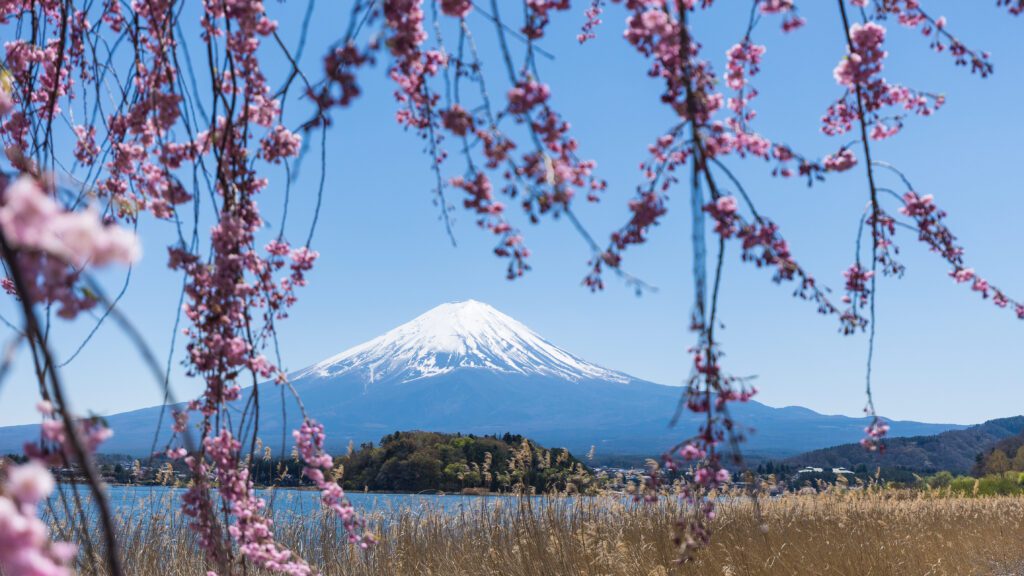
Lake Kawaguchiko is the most accessible of the Fuji Five Lakes and the best base for first-time visitors. It sits in Fujikawaguchiko town, about 2 hours from Tokyo — the natural add-on to a 4-Day Tokyo Itinerary if you have a spare day — and on a clear day Mount Fuji rises above the water in a way that looks almost theatrical — too perfect, too symmetrical, too large.
One detail most articles skip: the best views of Fuji from the lake are specifically from the north shore. The south side — where the station and most restaurants are — gives you the town in the foreground. Walking over the Kawaguchiko Ohashi Bridge and continuing along the northern bank puts the mountain directly ahead of you with the lake in the foreground. On still winter mornings you can see it reflected in the water — what locals call Sakasa Fuji (reverse Fuji). It is one of the great sights in Japan and it costs nothing to walk there.
Getting to Lake Kawaguchiko from Tokyo
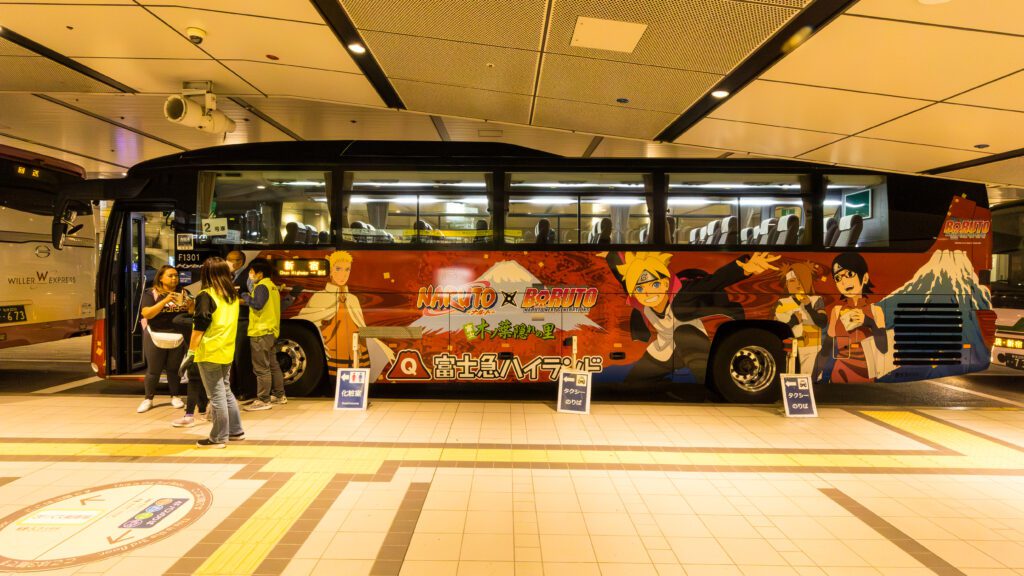
I recommend treating Kawaguchiko as at least a one-night trip. A day trip gives you one morning chance to see Fuji clearly. Staying overnight gives you two. Given how often the mountain hides in clouds, that extra chance is worth more than any cost saving.
If you haven’t sorted your Tokyo arrival yet, start with which airport to fly into — see the Best Airport to Fly into Tokyo guide before booking your ticket.
By Bus — Cheapest and Usually Fastest
The bus is the best option for most travellers. All three routes depart from central Tokyo:
- Shinjuku Expressway Bus Terminal (4F): 2 hours, JPY 2,200 one way. Take the south exit from JR Shinjuku Station. Book in advance here — weekend morning seats sell out.
- Ikebukuro: Seibu tourist bus, slightly over 2 hours.
- Shibuya: Tokyu transit bus, approximately 2.5 hours.
By Train
Take the Fuji Excursion Limited Express direct from Shinjuku Station — just under 2 hours, JPY 4,400. Does not accept JR Passes. If you want to use your JR Pass, take the JR Chuo Line to Otsuki, then switch to the Fujikyuko Line.
By Car — Best for Flexibility
Renting a car unlocks the spots that buses barely reach: Oshino Hakkai, the Momiji Tunnel, the quieter northern viewpoints. The drive from Tokyo takes about 2 hours on the Chuo Expressway. Compare car hire rates via Discover Cars — they aggregate local and international agencies so you can find the best price.
Navigation tip
Download your maps offline before leaving Tokyo. Mobile data drops in parts of the Fuji Five Lakes region. A Japan eSIM from Airalo gives you better coverage than most tourist SIMs and works on navigation apps throughout the trip.
Book a Guided Day Tour
The easiest option — especially for a first Japan trip — is a day tour that handles all logistics and takes you to multiple viewpoints:
Chureito Pagoda — The Most Iconic View of Mount Fuji
If you have ever seen a photo of Japan with a red five-storey pagoda rising from a hillside and Mount Fuji perfectly framed behind it — most likely surrounded by cherry blossoms — that is the Chureito Pagoda. It is the single most reproduced image of Japan. Seeing it in person is one of those moments where the real thing is better than the photograph.
The pagoda is part of the Arakurayama Sengen Shrine in Fujiyoshida, about 15 minutes from Kawaguchiko by train. Getting there requires climbing 398 stone steps from the shrine entrance. The climb takes about 20 minutes. Wear proper shoes — not sandals, not flip-flops. The view at the top is worth every step.
How to get there from Kawaguchiko: Take the Fujikyu Railway from Kawaguchiko Station to Shimoyoshida Station (10 minutes, JPY 310). Walk 10 minutes to the shrine. Alternatively, take the Mount Fuji World Heritage Loop Bus to the Chureito Iriguchi stop (every 90 minutes).
Best seasons:
- Mid-April: Cherry blossoms frame the pagoda — the postcard. Extremely crowded. Go at sunrise.
- Early November: Red maple leaves replace the blossoms. Equally beautiful, slightly fewer crowds.
- Winter: Snow on the summit, crisp clear sky, almost nobody there. The most reliable for clarity.
Admission: Free. Open 24 hours.
Oishi Park — Best for Unobstructed Lake Views

Take the Red Line bus all the way to the final stop: Kawaguchiko Natural Living Center (stop 20). Cross the street and you are in Oishi Park.
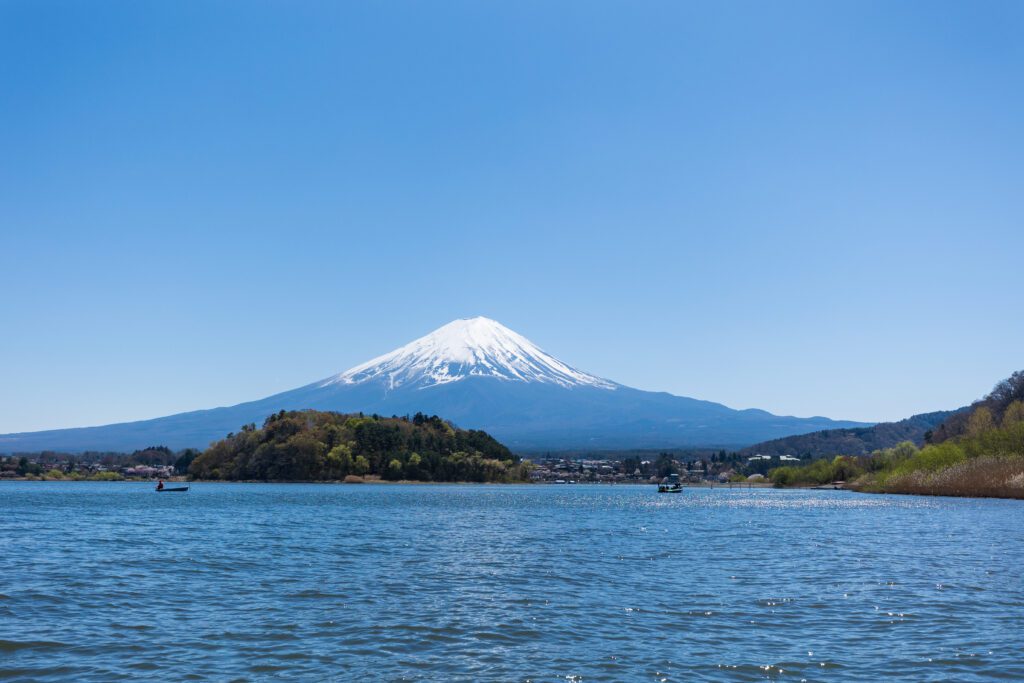
Oishi Park sits on the lake’s northern bank and gives you one of the cleanest, most unobstructed views of Mount Fuji in the entire area. The flower fields change with the seasons — lavender in summer, vivid red kochia balls in autumn, cherry blossoms in spring — but the mountain behind them stays reassuringly constant. Grab an ice cream, sit on the grass, and look at Fuji for as long as you like. There is no other agenda here.
Lakeside Walk — North Shore of Lake Kawaguchi
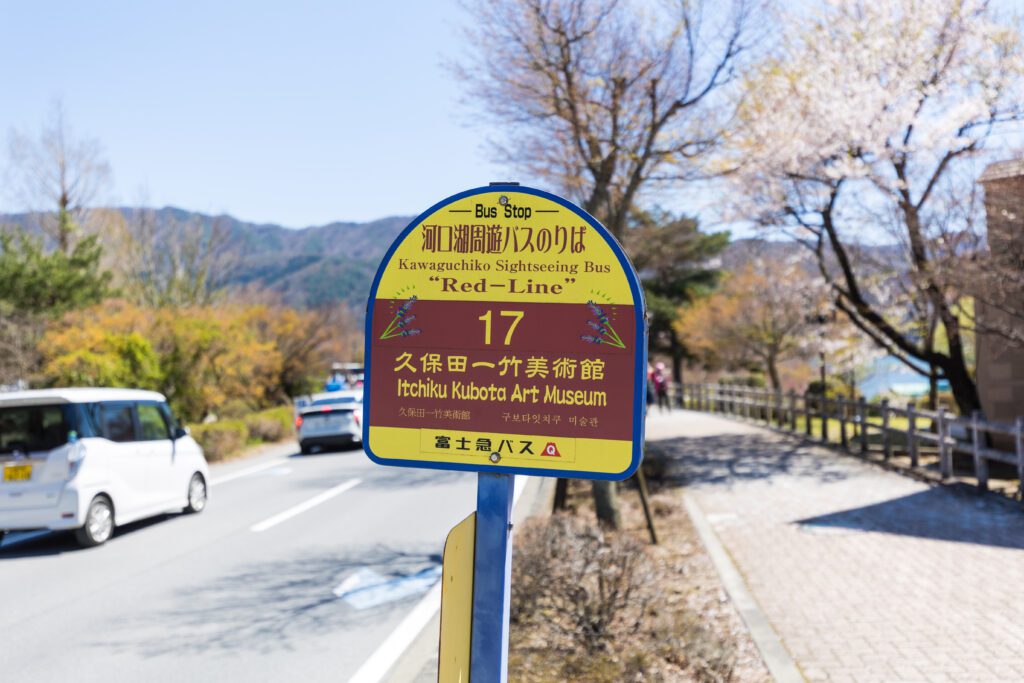
Take the Red Line bus to stop 17 and walk from there, keeping the lake to your left. The promenade follows the northern bank through trees, past a boat hire spot, and eventually leads to Oishi Park if you walk long enough. Mount Fuji appears and disappears through the branches as you move — it makes every clearing feel like a reward.
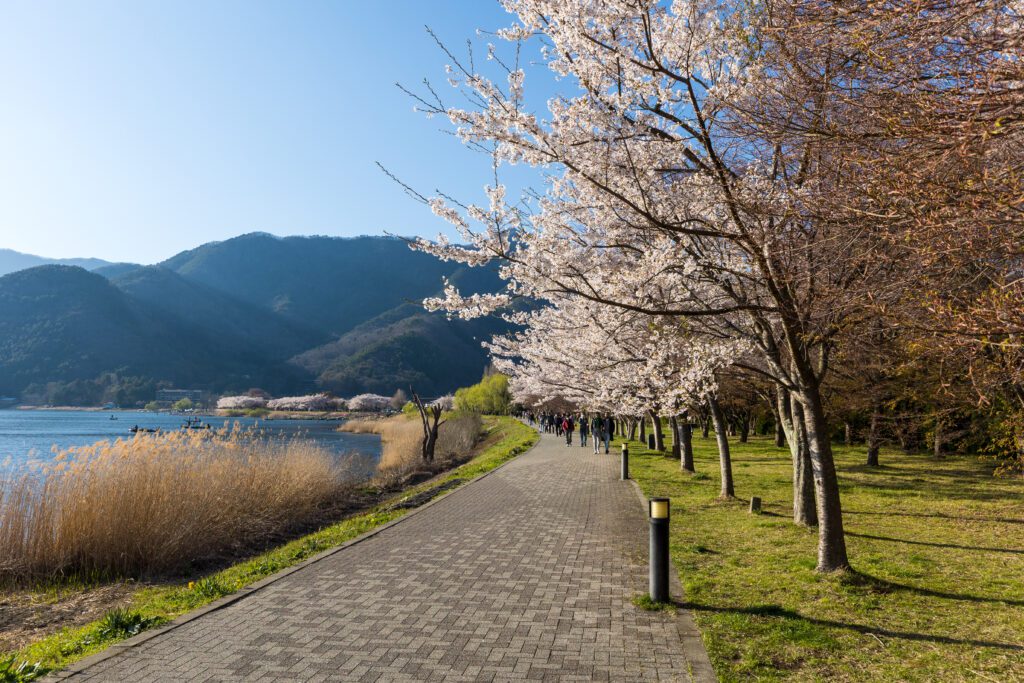
The promenade faces the lush mountains. After a while, you’ll locate a place to rest. If you arrive in April (spring), you will be able to see the beautiful cherry blossoms—all pink! If you come during autumn, you will see a completely different color of red and oranges.

Mount Fuji, Japan’s famed monument, may be found on your left side. It simply sits there like a wise monk. In front of it stands the lovely, ever-smiling Lake Kawaguchiko, one of Japan’s famed five Fuji lakes.

I was fascinated by the surrounding beauty. All I did was walk on the pavement and observe the scenery.
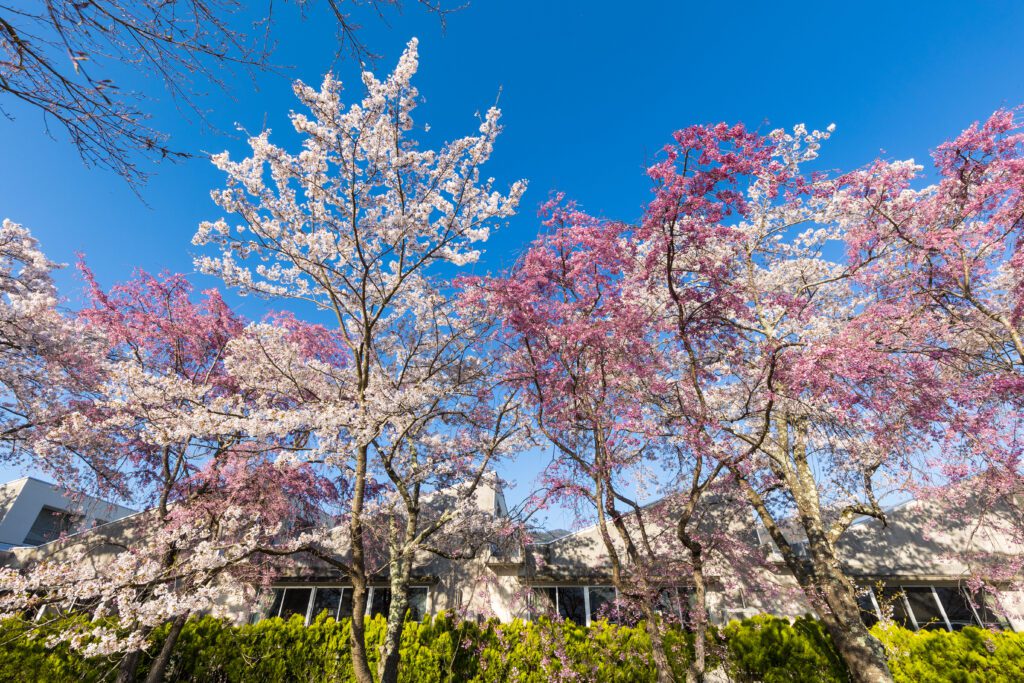
It wasn’t just about the pink cherry blossoms and ume trees; there were also some other interesting colors. When you’ve had enough of walking around the lake, return to the main road and board the red line bus, keeping the lake to your left.
Oshino Hakkai — Traditional Village with Sacred Springs
Oshino Hakkai is a short drive northeast of Kawaguchiko and one of the most atmospheric Fuji viewpoints in the entire region. Eight natural springs — fed by snowmelt from the summit — fill crystal-clear ponds surrounded by traditional thatched-roof buildings. Koi fish drift through water so clear it looks artificial. Mount Fuji rises directly behind the village on a clear day, creating a view that looks more like a woodblock print than a photograph.
Most organised day tours include Oshino Hakkai precisely because it photographs so well and explains something important: the mountain is not just a backdrop — it is the source of the water these communities have depended on for centuries.
Getting there independently is easiest by car. Alternatively, take the Fujikyu Bus from Kawaguchiko or Fujisan Station. Admission to the village is free; some individual spring areas charge a small entry fee of around JPY 300–500.
Mount Tenjo Ropeway — View From Above
The ropeway carries you 400 metres up the side of Mount Tenjo to a panoramic observation deck with views of the lake, the Aokigahara forest (also known as the Sea of Trees), and Mount Fuji from above. It is a genuinely different perspective from the lake-level views — you see the full scale of the landscape instead of just the mountain rising at you.
Expect a significant queue on clear weekend mornings. Go early or late to avoid the worst of it. Book the Kawaguchiko tour with Ropeway experience via Klook.
Momiji Tunnel — Hidden Autumn Gem
The Momiji Tunnel is a stretch of road near the northern shore of Lake Kawaguchi where maple trees arch overhead forming a natural canopy. In October and November, the leaves turn deep red and orange, and if you position yourself correctly, the road appears to funnel toward Mount Fuji at the end. It is not well-known internationally, which means it is significantly less crowded than the Chureito Pagoda in autumn.
Easiest to reach by car or rental bike. Follow the northern lakeshore road west past Oishi Park.
Kawaguchiko Station — First Glimpse
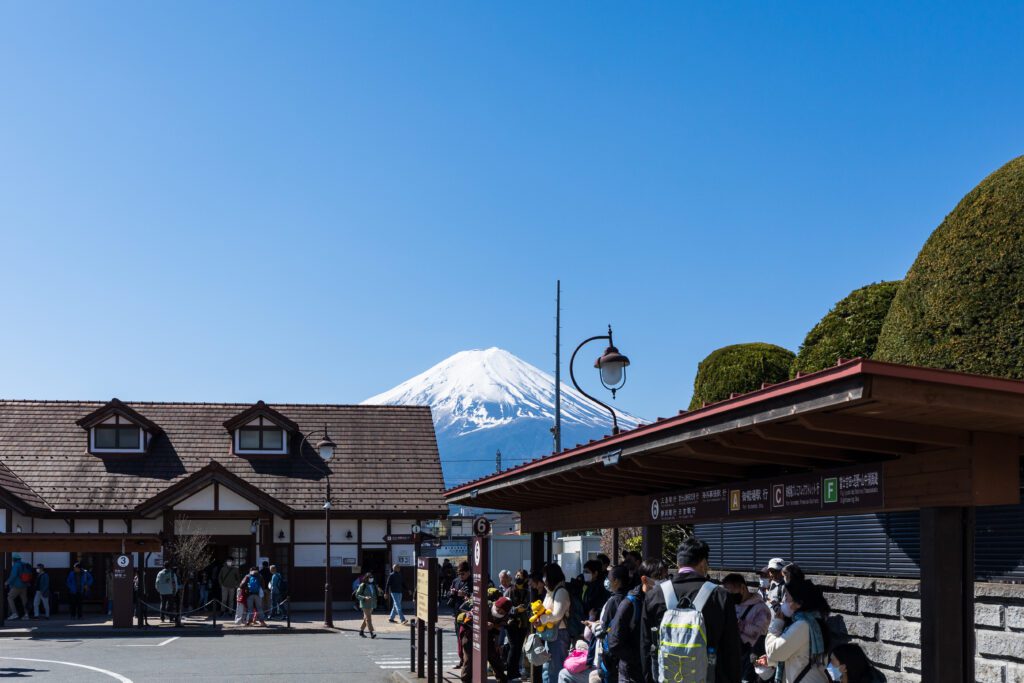
This is not a viewpoint you plan. It is the first sight of Mount Fuji as your train pulls into Kawaguchiko Station — the mountain filling the frame of the window before you have even stood up. Almost everyone on the train reaches for their camera at the same moment. It is chaotic and slightly ridiculous and completely wonderful.
Hakone — Different Angle, Onsen Setting
Hakone is about 85 minutes from Tokyo on the Romancecar from Shinjuku and offers views of Mount Fuji across Lake Ashi from the south — a fundamentally different angle to Kawaguchiko. The mountain is more distant here, but the combination of a volcano, a crater lake, and occasional swans is its own kind of drama.
Kawaguchiko vs Hakone — which is better for seeing Mount Fuji?
| Kawaguchiko | Hakone | |
|---|---|---|
| Views of Fuji | Multiple direct viewpoints; north shore reflection | Across Lake Ashi — more distant but dramatic |
| Access from Tokyo | ~2 hours (bus or train from Shinjuku) | ~85 minutes (Romancecar from Shinjuku) |
| Hot springs | Available, fewer options | Famous for onsen — much stronger choice |
| Best for | Photography, Chureito Pagoda, Fuji focus | Onsen, Hakone Open Air Museum, variety |
| Budget | More affordable overall | Pricier ryokans |
My verdict: Go to Kawaguchiko if Mount Fuji is your primary goal. Go to Hakone if you want onsen culture with Fuji as a bonus. If you want both in a single day without renting a car, the Mt. Fuji, Hakone Ropeway, Owakudani & Lake Ashi tour from Tokyo is the cleanest way to do it — Fuji views, volcanic valley, cable car ride, and Lake Ashi, all in one circuit.
Mount Fuji 5th Station — Closest Without Climbing
The 5th Station sits at approximately 2,300 metres elevation on the north face of the mountain. It is as high as you can go without entering the official climbing zone, and the views from here are obviously dramatic — you are looking out from the mountain, not at it.
2026 Update — Yoshida Trail Climbing Regulations: Since 2024, the Yoshida Trail (the most popular climbing route) requires a mandatory fee of JPY 4,000 per person and imposes a daily cap on climbers to manage overcrowding. The trail gate also closes at 4 PM. Even if you are not climbing, these measures have changed the 5th Station experience — it is significantly less crowded at the base than in previous years, which actually makes the viewpoint more enjoyable. If you plan to climb, you must factor in the fee and book your place in advance during peak season (July–August).
Access to the 5th Station is by bus from Kawaguchiko Station (seasonal — typically July to early September only).
If a hike is more your pace than a viewpoint, the hike to Karikomi Lake in Nikko is the other great half-day trail near Tokyo, in a completely different mountain landscape.
Mount Fuji Views Beyond Kawaguchiko
Kawaguchiko and Hakone cover the classic routes, but Fuji is visible from a surprisingly wide radius, and a few of these are worth knowing about even if they don’t make it into most itineraries.
From Tokyo itself, on a clear day. The Tokyo Metropolitan Government Building in Shinjuku has two observation decks, both free, at 202 metres up. It’s not a reliable view — Fuji is roughly 100km away and needs near-perfect conditions to show — but if you’re short on time and the sky is clear, it costs nothing to check.
From the Shinkansen. The Tokaido Shinkansen between Tokyo and Osaka runs close enough to Fuji for a genuine window-seat view, no detour required. Take a right-side window seat heading from Tokyo (left side coming from the Kansai direction), and watch for it roughly 40–45 minutes into the journey, around Shin-Fuji Station. It’s a fun bonus view if you’re already making that train journey, not a reason to book it on its own.
Gotemba. On Fuji’s southeastern flank, this outlet-shopping town gets clean views from several elevated points around the city, including from the shopping mall itself. Worth a stop if you’re heading toward Hakone and want a different angle than the lake views.
The Shizuoka side. The Izu Peninsula’s western coast (Nishiizu) offers rural coastal views of Fuji across Suruga Bay, and just south of it, Dogashima Onsen is one of the only places where you can soak in a hot spring bath with Fuji visible across the water — a genuinely unusual combination if you’re building a longer Japan itinerary that includes Izu.
Lake Motosuko. The westernmost of the Fuji Five Lakes, and the one that appears on Japan’s ¥1,000 banknote — worth knowing if you want the “banknote view” specifically. It’s quieter and harder to reach by public transport than Kawaguchiko, which keeps the crowds away but makes it more of a car-only detour.
A bonus phenomenon to look for: if you’re at Kawaguchiko’s north shore or one of the other lakes at sunrise or sunset in winter, keep an eye out for what’s sometimes called “Double Diamond Fuji” — the sun touching the summit exactly as its reflection appears in the still water below. It’s rare, weather-dependent, and one of the more spectacular things a patient photographer can catch here.
Beyond the Views — More Things to Do in Kawaguchiko
Most people come to Kawaguchiko for Mount Fuji, and the viewpoints will fill your first day completely. But if you are staying two nights — which I recommend — here is what to do with the rest of your time.
Fuji-Q Highland
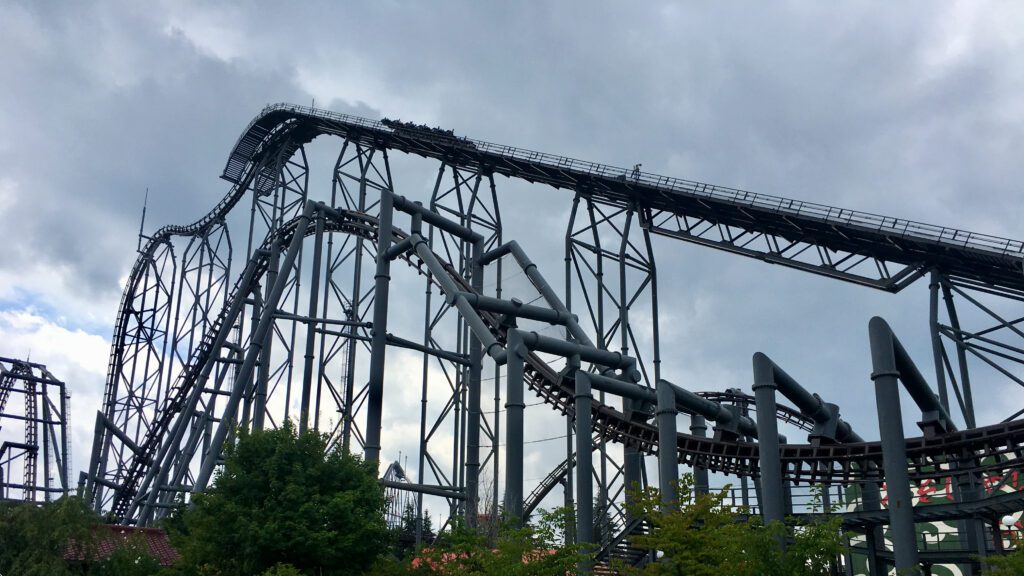
Fuji-Q Highland is an amusement park directly next to Kawaguchiko Station with some of Japan’s most famous roller coasters. Fujiyama stands 70 metres tall and runs at 130 km/h — third longest roller coaster in the world. There are haunted houses, gentler rides for younger visitors, and the mountain is visible as the backdrop to the whole park. The honest reason to come here is if the sky is completely overcast and you need something to do while waiting for Fuji to appear. Book tickets in advance to skip the gate queue.
Eat Hoto Noodles
Before you leave Kawaguchiko, eat hoto at least once. It is the local dish — thick flat udon-style noodles simmered in a rich miso broth with pumpkin, mushrooms, and seasonal vegetables, served in a cast iron pot that stays hot at the table. Every restaurant in town does its own version and almost all of them are good. It is a warming, filling meal that makes particular sense after a cold morning walking the north shore. Ask your accommodation for the nearest restaurant — they will all have a recommendation.
Rent a Boat on the Lake
One of the quietest and most rewarding ways to spend an hour is renting a rowing or paddle boat directly on Lake Kawaguchi. Being on the water gives you a completely different perspective — the lake in the foreground, Mount Fuji rising behind you, no roads or buildings in the frame. Boat hire costs around JPY 1,500 per hour and rental points are easy to find along the southern shore near the station. Go early in the morning when the water is still and the reflection is clearest.
Itchiku Kubota Art Museum
The Itchiku Kubota Art Museum sits near the north shore walking path and houses the extraordinary kimono artwork of Itchiku Kubota — a technique he spent decades developing that recreates landscapes and seasons across panels of silk. Even if you are not usually drawn to textile art, the scale and colour of the work is genuinely striking, especially the Mount Fuji panels. The museum building itself, designed in the style of Antoni Gaudí, is worth seeing. Admission is around JPY 1,500. Get off the Red Line bus at stop 17 (the same stop as the lakeside walk) and it is right there.
Hotels in Lake Kawaguchiko
One thing that makes Kawaguchiko different from most tourist destinations: where you stay directly affects how likely you are to see Mount Fuji. Hotels on the north shore put the mountain outside your window. Hotels near the station are more convenient but face south — you will need to walk to see it. If seeing Fuji clearly is your main reason for being here, pay a little more for a room with a view. Waking up and finding it already there, without rushing outside, changes the whole experience.
Here are honest options across three budgets.
Budget — Koyabashi Ryokan (my personal stay)
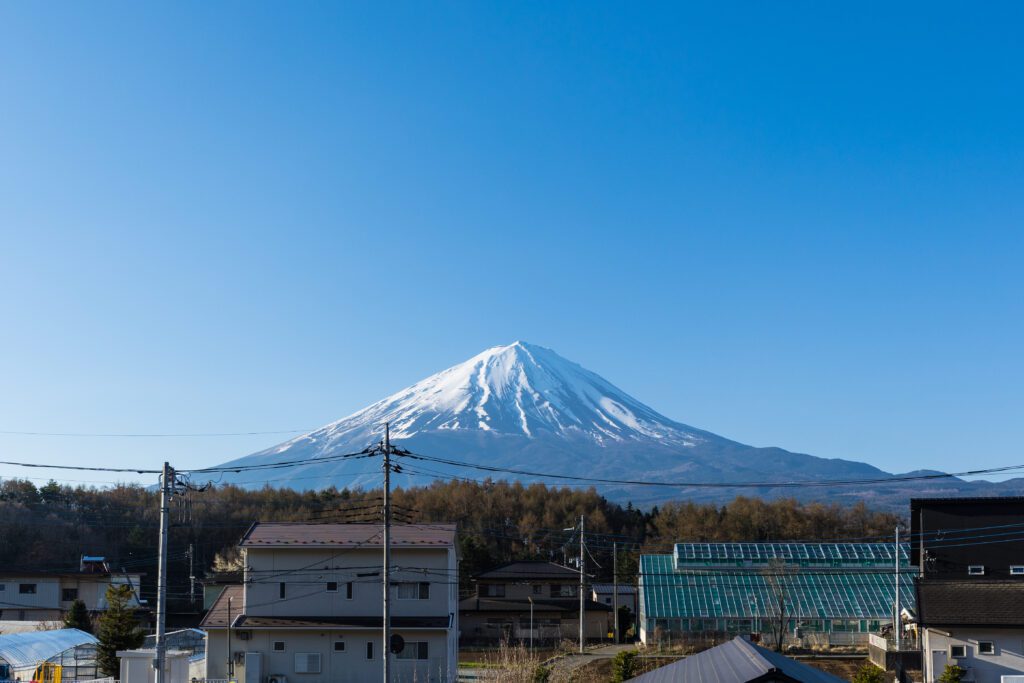
Koyabashi is the place I actually stayed, which is why I am recommending it first. It is a simple budget ryokan — nothing fancy, a little far from the station — but every room has a direct Mount Fuji view. The photo above was taken from my bed. It is one of the cheapest options in the area that still delivers the view you came for. Take the Blue Line bus to get here and check the timetable before planning your day, because it runs infrequently.
Mid-Range — Fuji Kawaguchiko Onsen Hotel New Century
Fuji Kawaguchiko Onsen Hotel New Century is located directly on the shore of Lake Kawaguchi, with rooms and baths looking out to Mount Fuji. It is within walking distance or a short shuttle ride from Kawaguchiko Station and has a top-floor onsen with mountain views. A solid choice if you want comfort and the Fuji view without committing to full ryokan pricing.
Luxury — La Vista Fuji Kawaguchiko
La Vista Fuji Kawaguchiko is a Provence-inspired onsen hotel overlooking Lake Kawaguchi, with most rooms having balconies facing Mount Fuji and many including private baths. If you want to watch the mountain change colour from sunrise to sunset without leaving your room, this is the place. It has both large communal onsen and private hot spring baths you can reserve. The most consistently recommended luxury option in the area.
For Something Truly Special — Hoshinoya Fuji
Hoshinoya Fuji is Japan’s first glamping resort, with luxury cabins featuring stellar views of Mount Fuji. It sits on a hill above the lake with unobstructed sightlines and is the most memorable accommodation option in Kawaguchiko — not a traditional ryokan but a very Japanese take on high-end outdoor living. If budget is not a constraint, this is the one.
Booking tip
When searching Agoda or Booking.com, filter for “Fuji view” and read recent reviews carefully. Some properties market “Mount Fuji views” that turn out to be visible only from one corner of the roof bath at a specific angle. The north shore properties are the most reliable for genuine room-facing views.
How to Get Around Kawaguchiko
Lake Kawaguchiko is relatively accessible on your own. Aside from walking around, you have two excellent possibilities.
Take a Bus
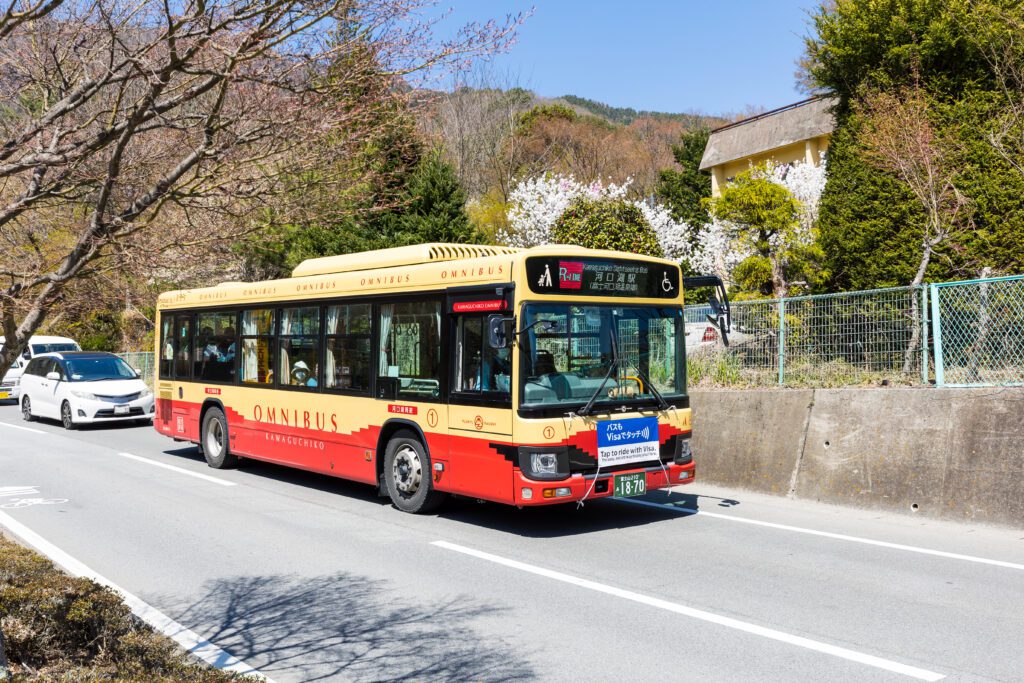
Three colour-coded lines cover the main sights. If seeing Fuji is your goal, the Red Line is the one you want:
- Red Line: Every 20 minutes, covers the north shore and Oishi Park
- Green Line: Hourly
- Blue Line: Every 2–4 hours (useful for Koyabashi ryokan)
A 2-day all-lines pass costs JPY 1,500. Payment also accepted via IC cards (Pasmo, Suica) and Visa contactless. Board from the back, exit from the front.
Download the timetables:
Rent a Bike
Rental shops near the station offer regular and electric bikes. Rates:
- Manual: ¥500/hour, ¥1,000 for 3 hours, ¥1,500/day, ¥2,500 for 24 hours, ¥3,000 for 1 night + 2 days
- Electric: ¥3,000 for 3 hours, ¥4,000/day, ¥5,500 for 24 hours, ¥6,500 for 1 night + 2 days
Rent a Car
For maximum flexibility — especially for the Chureito Pagoda, Oshino Hakkai, and the Momiji Tunnel — a car is the best option. Book via Discover Cars to compare rates. Driving in the Fuji Five Lakes area is straightforward and well sign-posted.
Planning the rest of your Japan trip around this? The 4-Day Tokyo Itinerary and Tips for Traveling to Japan for the First Time cover everything else you’ll need.
Frequently asked questions about Mount Fuji and Lake Kawaguchiko
What is the best place to see Mount Fuji clearly?
Lake Kawaguchiko is the most accessible and reliable base. Specifically, the north shore of the lake gives the best unobstructed views with the water in the foreground. For photography, the Chureito Pagoda is the most dramatic spot.
Can I see Mount Fuji without a car?
Yes. The bus network covers all the main viewpoints including Oishi Park and the north shore walk. A car is only necessary for Oshino Hakkai and the Momiji Tunnel if you are travelling independently.
What is the best time of day to see Mount Fuji?
Before 9 AM. The air is clearest at dawn and cloud builds through the morning. On days that start beautifully clear, the summit is often covered by early afternoon.
How can I check if Mount Fuji is visible before I leave Tokyo?
Use the Fujisan Watcher live webcam. Check it the night before and again early in the morning. If the webcam shows a clear summit, go immediately — do not wait.
Is one day enough to see Mount Fuji from Kawaguchiko?
One day is enough to visit the main spots. But staying overnight gives you two morning chances to see the mountain clearly, which significantly improves your odds, especially in spring and autumn. My 2-week Japan itinerary builds Day 4 around exactly this trade-off, if you’re weighing it against a longer trip.
Can I find luggage lockers in Kawaguchiko?
Yes. Lockers are available at Kawaguchiko Station.
What are the 2026 changes to climbing Mount Fuji?
The Yoshida Trail now charges a mandatory JPY 4,000 fee per climber and has a daily capacity limit. The gate closes at 4 PM. These regulations only apply to the climbing routes — visiting the 5th Station as a viewpoint is not affected.
When were the photos in this article taken?
9 April — peak cherry blossom season. One of the most beautiful times to visit, and one of the most crowded.
Mount Fuji does not owe you a clear day. That is part of the deal — you show up, you hope, and sometimes the mountain decides to hide. But when it appears, and it will if you give it enough chances, there is nothing quite like it. A perfectly symmetrical volcano rising above a lake, or framed by a red pagoda and a thousand cherry trees, or simply filling the window of your train as you pull into the station. It is one of those sights that does not shrink with familiarity. I had seen it in photos hundreds of times and it still stopped me cold the moment I saw it in person.
Give yourself at least two mornings. Check the webcam before you leave. And go to the north shore. Mount Fuji sits on Day 4 of my 2-week Japan itinerary if you’re building out the full trip, and it works equally well as a day trip from the 4-Day Tokyo Itinerary.

Leave a reply