

Tiger’s Nest (Paro Taktsang) trek guide: distance, altitude, time, entry fee, guide rules, cameras and what to expect, with my December trek photos, checked November 2026.
The first time I saw the photo of the tiger’s nest, I thought it an optical illusion. I won’t be surprised if you think of it as a photoshopped image. A set of buildings or monasteries perched on an extraordinary cliff in a dramatic fashion with the lush green valley in the background. How did they build it there? This came across my mind instantly when I saw it. It’s nearly impossible to go there with construction materials. I got the answer later. According to legend, Guru Rimpoche (Guru means the master) arrived there on the back of a pregnant tigress all the way from Tibet and meditated there. So, instead of approaching from the bottom, he approached there from the top. Maybe that’s how it was built! Makes sense now, right? Whatever it is, I wanted to go to the Tiger’s nest someday on a trek instantly.
Last checked 13 November 2026. My trek was on a December morning some years ago, so the photos and trail notes are mine, while fees, ticketing and rules were checked against recent sources. Bhutan changes its fees and visitor rules often, so confirm the current details with your tour operator before you go.
Official name
Paro Taktsang
Also called the Tiger’s Nest Monastery
Altitude
3,120 m
About 900 m above the Paro valley floor
Distance
About 8 km round trip
Guides quote 6 to 8.4 km
Time
4 to 6 hours
Including about an hour at the monastery
Difficulty
Moderate
Steady climb with steep steps at the end
Entry fee
Nu 1,000 (about US$12)
Per foreign adult since March 2023. Under-18s pay half. Your operator usually arranges it
Guide
Required
Visitors to monuments need an accredited guide
Cameras
Not inside
Phones, cameras and bags stay outside
Best time
March to May, September to November
Clearest skies and easiest trekking
Little more about Tiger’s Nest
As Rimpoche, the spiritual master went to the place on a tigress and meditated there, it is called the tiger’s nest. But its official name is Taktsang Monastery. It was built in 1692, more than three hundred years from today, by Gyalse Tenzin Rabgye. It’s located in Paro valley. I believe Tiger’s nest is synonymous with the tourism poster or postcard of Bhutan. This should be your number one place to go during your trip to Bhutan.
What most visitors don’t realise: the monastery you see today isn’t entirely original. A fire severely damaged much of the structure on 19 April 1998, and it took until 2005 to fully restore it to its earlier form. Knowing this makes the place feel less like an untouchable ancient relic and more like something the Bhutanese have actively fought to preserve, which, in its own way, is just as remarkable as the original construction legend.
But, there is a slight problem
You just cannot take a car and go there. There is no cable car either. So, you need to trek there for several hours on foot. While the trek is not extremely difficult, it is not easy either. You need to be relatively fit and possess mental strength to reach there. Besides, the oxygen gets thinner in the higher altitude and it becomes difficult to do it.
On the altitude and elevation gain:
You will often see two different numbers for how much you climb, 900 metres and about 500 to 700 metres, and they measure different things. The monastery sits about 900 metres above the Paro valley floor. The trailhead already sits partway up the mountain, at around 2,600 metres, so the climbing you do on foot is less than that. Because the trail dips into a gorge before the last climb, one hiker’s watch recorded roughly 670 metres of total ascent, so plan for about 600 to 700 metres of climbing.
Can I do the Tiger’s nest trek?
Of course, you can! All you need to do is to start the journey. If you are afraid of doing it, take plenty of time, as there is no time limit or reward for reaching the top faster. I saw kids and old people on the trail.
On timing within your trip
Many itineraries schedule this trek toward the end of a Bhutan visit rather than the very first day, after you’ve spent some time at similarly high elevations elsewhere in the country (Thimphu sits at ~2,334m, Paro itself at ~2,235m). Some travellers find this helps them feel more acclimatised for the exertion at 3,120m. If your schedule allows the flexibility, it’s worth discussing with your guide.
My Trek to the Tiger’s Nest in Bhutan Began

It was a beautiful sunny morning in December. The sky was so blue and clear, I could see the moon even at daylight. We started the day early. Rinjhin, our driver for the trip, dropped us at the base where the trek starts. It is about 10 to 12 km from the centre of Paro and less than 30 minutes of drive. He promised to wait there for us along with some other drivers. Only a handful amount of tourists were there for the trek. Tourism in Bhutan is more controlled than other parts of the world.

There was no particular mark to start the journey. But one could easily understand the path. During the beginning, I saw three small temples dotted among the pine trees. Those looked beautiful in the morning ray.

I started my journey to heaven. It was a continuous ascent not particularly steep keeping the valley in on side and mountains on the other side. I walked mostly on dirt paths. There are some shortcuts to reach to the top, those will cut your time but take an excellent test of your stamina because of their steepness.

Where the bushes are not thick, you will get unobtrusive views of the green mountain range with a ray of sun. One can easily sit here and spend the day looking at this lushness.

If you want to avoid walking, you can hire a person with a mule. The mule will not take you exactly to the top, but it will carry you quite a distance, only as far as the halfway cafeteria, and no further; the final and most memorable stretch is on foot regardless. For me, riding a mule felt like the wrong way to visit such a fantastic place, and a scary one, because I would be trusting a mule rather than my own feet on a path where a mistake can throw someone deep into the valley.

The roads are not narrow all the way. I saw it getting widened in places. My eyes got stuck with colourful prayer flags in different places. As I was approaching higher, I could feel the dry and thin air with depleted oxygen.

Within half an hour of trek, I got a glimpse of a tiny dot far away. Yes, that is the dramatic Tiger’s nest! It looked so far! While I was happy seeing it, I was tense about if I could make it! I continued my journey and the view of the tiger’s nest disappeared before coming back again. This cycle of hiding and seek continued.
Halfway to the Tiger’s Nest

When you will reach to a relatively flat terrain with prayer wheels, you know that you are already halfway! You will find a Cafeteria there with the view of the monastery, sitting at about 2,950 metres, this is also where the mule ride ends regardless of how far you’ve paid it to go. Many people end their journey in this place (such a shame!). If you are hungry, you can grab some food from there. I continued my journey spinning the prayer wheels, I need those prayers right now to cover the rest of the journey. I was not sure which one was more powerful between the big one at the bottom or the collective ones at the top!

Twist
After a while, I started to descend. Maybe I lost my path? Why would I go down? I am supposed to go up to the tiger’s nest. Then I realised that the path to the top goes down before going up again. Argh!
Last Leg
At this point, I became frustrated, the monastery was tantalisingly close, yet the journey was not completed yet. That is a common scenario in the mountains. You get a false notion of the distance. So, I walked and hiked endlessly. The pleasant news was, it was a relatively easy path to follow.

Finally, I got very close after about 3 hours of hiking. I could see a stair with a railing going straight up. I buckled up for a steep ascent. Don’t be fooled by the greying nature of these photos, this is winter in Bhutan, during monsoon those become green.

Keeping the Tigers’ nest to the right, I saw a waterfall to my left. The water was not very thick. Interestingly, I saw ice where the water was falling. Maybe the temperature went beyond zero at night and it did not have time to be melted in the shadow.

There is a small shade before reaching the temple where you can ignite candles. You will get free water there. Here is an interesting thing, I saw multiple sources of water while going to the top, which was completely free. This is the beauty of Bhutan! I drank a couple of litres of water; I guess. I was telling you about the prayer flags during the trek. Now I see all of them have gathered in a single place. Green, white, red, blue, a million of them if not billions. Such a treat for the eyes.
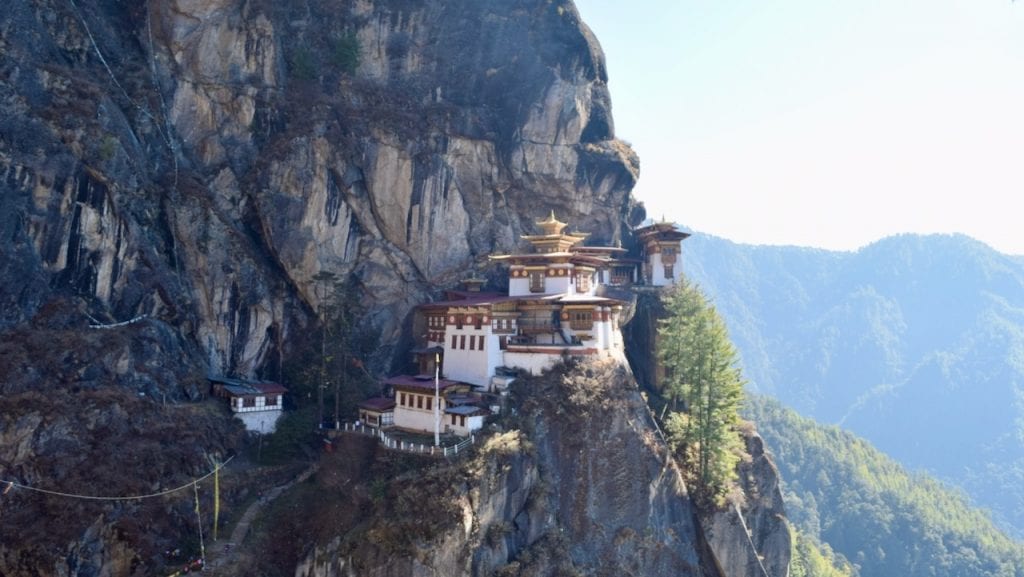
I felt pains in my thighs, my century-old knees rattled, and my lungs were not happy with me, but my mind felt with absolute joy to see the Tiger’s nest, the Taktsang Monastery right before my eyes. I have made it to the top. It was gorgeous! It was majestic! It still looked like an optical illusion to me!

I started taking photos from fresh angles. Although from far off it looks like a single one there are multiple buildings there. There were four of them.

I came closer. The major building became more prominent. While there was no entry fee for me to get inside, I had to show my passport and enter my name in a register book to the guard. I entered the monastery on barefoot. Sadly, I could not take my cameras inside as it’s not allowed.
What’s Inside?
It’s a monastery. There are several prayer rooms along with dormitories. I saw colourful paintings on the wall. The monks were roaming around inside with typical orange dress. I joined a monk who showed us different rooms and described their significances. One room contained secret prayer. I was more interested in looking at the valley from the top.
The complex is built directly around the cave where Guru Rinpoche is said to have meditated for three months after arriving on the back of the tigress, the sacred core the entire site grew up around. The murals and thangka paintings throughout depict his eight manifestations and his chief disciples, and one hall houses a large tiger statue as a reference to the founding legend. No photography, phones, or bags are permitted anywhere inside, and shoes come off before you enter.
Nothing electronic goes inside
Cameras, phones, and bags all stay outside the monastery gates. This isn’t loosely enforced, plan to simply be present rather than documenting this particular part of the day.
The Descent
After about an hour inside the monastery, I descended the same way. As I was approaching down, I kept looking back to the monastery. I was hungry as I did not take lunch. So it was quick. It’s easier to get down than to go up. However, you should be careful otherwise you might end up twisting an ankle.
Alternate Path
I took the most common path to reach to the Tiger’s nest. However, one can approach the monastery from the top! No, it’s not through a helicopter or on top of a tigress. Some operators describe an alternate, longer route that reaches the monastery from a different side. This route is known as “A Hundred Thousand Fairies”.
Final Words
Almost everyone in the world knows about the Eiffel Tower. When I went there, I said to myself, okay; I see it. But I did not get bemused by seeing it. However, when I stood in front of the tiger’s nest, it blew my mind. It’s not because of its architecture, but its breathtaking location. It keeps coming back to me, “How on earth it got there?”
Best Time for the Tiger’s Nest Trek
Spring (March to May) and autumn (September to November) offer the clearest skies and the most comfortable trekking conditions, this is when most photographs of the monastery against a blue sky are taken. Winter brings cold, crisp air and occasional ice on the higher sections, much like what I experienced myself in December. Summer monsoon (June to August) turns the trail muddy and views cloud over more often, though the surrounding hills turn a much deeper green than the winter brown you’ll see in my own photos here.
What to Pack
- Sturdy hiking shoes with good grip, not sandals
- At least 1.5 to 2 litres of water (though free refill sources exist along the trail)
- Sunscreen and a hat, there’s little shade once you’re past the initial forest section
- A light jacket, even in warmer months, since the wind picks up at altitude
- Cash, in case you want a snack at the cafeteria or want to tip your mule handler
- A camera for everything up to the monastery gates, it stays outside after that
Frequently Asked Questions
How high is Tiger’s Nest?
Tiger’s Nest (Paro Taktsang) sits at about 3,120 metres (10,240 ft), roughly 900 metres above the Paro valley floor. The trailhead is already at around 2,600 metres, so the climb on foot is less than 900 metres.
How long is the Tiger’s Nest trek?
About 8 km round trip in most recent guides, though older guides quote 6 to 6.5 km. Expect roughly 600 to 700 metres of total climbing, because the trail dips into a gorge before the last ascent.
How long does the Tiger’s Nest hike take?
Keep a full day. It takes about 2.5 to 3.5 hours to reach the monastery, around an hour to visit it and 1.5 to 2 hours to come down, so roughly 4 to 6 hours in total. Fit hikers can be faster.
How many steps are there on the Tiger’s Nest hike?
I could not confirm an official count. One operator says there are more than 700 steps on the way down into the gorge and about 120 steps up to the monastery entrance, so expect plenty of stairs near the end.
How much is the Tiger’s Nest entry fee?
The Tiger’s Nest entry fee is Nu 1,000 for foreign adults (about US$12). The Department of Tourism cut it from Nu 2,000 from 15 March 2023, as reported by the Bhutan Broadcasting Service. Under-18s pay half and children aged 5 and under go free. When I visited, I did not pay an entry fee to get in, and I only showed my passport and signed a register, so my trip arrangements may have covered it. Check the current fee with your operator.
Do you need a guide for Tiger’s Nest?
Most foreign visitors to Bhutan travel with a licensed guide arranged through a tour operator, and Bhutan’s national monument ticketing system notes that visitors must be accompanied by an accredited guide at monuments. Your operator normally handles the guide, the driver and the ticket.
Can you take photos at Tiger’s Nest?
You can photograph the monastery from the trail and the viewpoints, but not inside the complex. Phones, cameras and bags must be left at the security check outside, and I could not take my camera in.
What are the Tiger’s Nest opening hours?
One 2026 operator guide lists 8am to 5pm daily with a lunch closure from about 1pm to 2pm, and a few dates reserved for Bhutanese visitors. Hours can change, so confirm with your guide and plan to arrive well before lunch.
What is the difficulty level for trekking to the Tiger’s Nest?
Moderate. Anyone with a modest fitness level should be able to do it by pacing themselves. There is no time limit, and resting often is completely normal.
Can you ride a horse or mule the whole way to the Tiger’s Nest?
No. Mules only go as far as the halfway cafeteria, and guides quote roughly US$15 to US$18 for the ride. From there, the final and most dramatic section, down into the gorge, past the waterfall and up the last stone stairs, is on foot only.
What is inside the Tiger’s Nest monastery?
A complex of temples built around the cave where Guru Rinpoche is said to have meditated, including painted murals, thangkas and shrines. Photography, phones and bags are not permitted inside, and you need to remove your shoes.
When is the best time to do the Tiger’s Nest trek?
Spring (March to May) and autumn (September to November) offer the clearest skies and the most comfortable trekking conditions. Many itineraries also schedule the hike toward the end of a Bhutan trip, after a few days at similar altitudes, which some find helps with acclimatisation.
Can you get altitude sickness on the Tiger’s Nest hike?
Mild symptoms such as a headache or breathlessness are possible, because the monastery sits at about 3,120 metres. Spending your first night in Paro, at roughly 2,200 metres, helps you adjust. Walk slowly, drink water, and turn back if symptoms get worse. If you have a heart or lung condition, ask a doctor before you go.
How much does a trip to Bhutan cost?
Most international visitors pay a Sustainable Development Fee of USD 100 per person per night (children aged 6 to 11 pay half and under 6 are free), confirmed at that rate through 31 August 2027 according to a 2026 guide. It comes on top of your tour, guide and entry costs.
Tips for visiting Tiger’s nest
- If you are short in time, don’t get inside. The key attraction for me was the view of the tiger’s nest. You will only get it from outside.
- Tshechu festival is celebrated in the Paro valley in memory of Guru Rimpoche during March or April. If you could visit the monastery during the four-day festival, it will amaze you.
- Bring your passport. The guard checked mine and I signed a register before going in.
- Dress modestly. Shoulders and knees should be covered, and shoes come off before you enter the temples.
- Hiking poles can be rented at the trailhead for a small fee if you want them for the steps.
A Question Readers Often Ask
One reader, Jose Luis, asked in the comments about doing this as a single, budget-conscious day trip, and how a “day” is counted. You can keep your visit short, but the Sustainable Development Fee is charged per person per night (USD 100 for most international visitors, confirmed at that rate through 31 August 2027 according to a 2026 guide), and a licensed guide, a driver and a tour operator booking apply as well. I did not find a discounted single-attraction rate. How a day is counted can vary by operator, so confirm it directly with whoever arranges your trip.

Hello Fuad,
you are doing a great job on tourism, and enjoing your hobby -travel.
I would like to ask you about, total cost for visiting Bhutan
All I would to visit is the Tiger Nest Monastery, at a minimum cost. Yes, there are many of nice place I could visit, but I can not afford to pay more than one day at that cost -$200/per day.
Q1 how is the day counted, 24 hours? or it ends a midnight.
Q. can I get in and out in one day, for just visiting the tiger net monastery,
Thanks, look forward to meet you.