
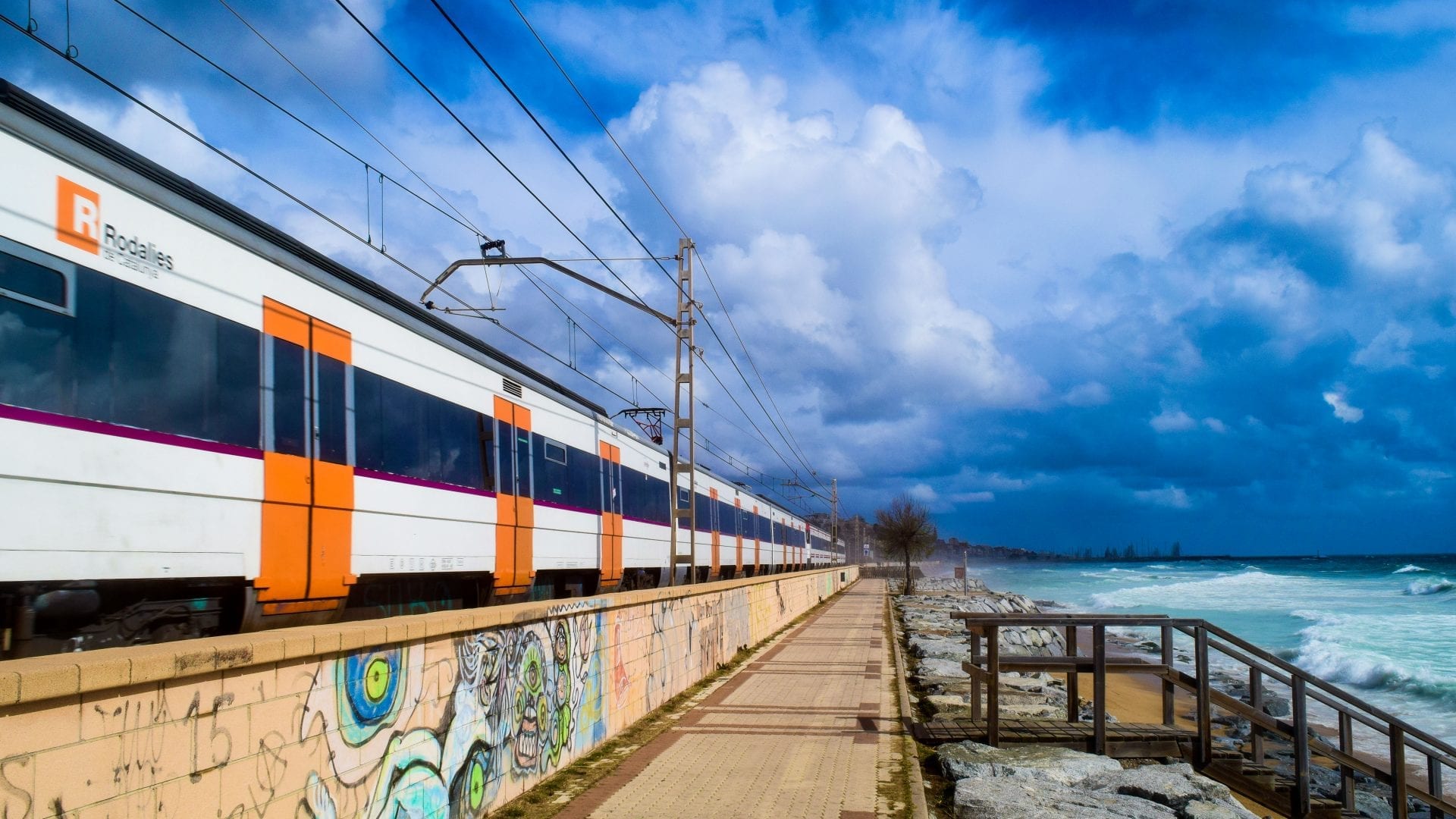
The best beaches near Barcelona by train: the Maresme beach towns I hopped between on the R1, plus Sitges, Castelldefels and more, with 2026 train times, fares and tips.
The best beaches near Barcelona by train are on the Maresme coast to the north, where the R1 line runs right beside the sea: Montgat is about 20 minutes from the city centre, and El Masnou, Ocata, Premià de Mar, Vilassar de Mar and Mataró follow within about 45 minutes. To the south, the R2 Sud reaches Castelldefels and Sitges in 25 to 45 minutes. I spent a day hopping on and off the R1 along the Maresme, and this guide covers both directions.
Trains
R1 north, R2 Sud south
From central Barcelona stations
Journey time
20 to 45 minutes
Montgat about 20, Mataró about 45
Fare
From €2.90 one way
€4.15 to El Masnou, €5.40 to Mataró
Swimming season
June to September
Sea around 24°C in August
Best for
Quiet local beaches
Sitges if you want a resort town
I always dreamed of a moment. I am inside a pretty train running along the coast. I can see the waves right from my window. A gusty wind is blowing my spectacles away and I can taste the salt on my tongue. At one point I feel like touching the water, so I get off and enjoy the vastness. When I have had enough, I get back on the train and get off somewhere else when I feel like it. This dream came true in Barcelona when I visited some of the beach towns along its coast.
Why Leave Barcelona for a Beach Day?
Barcelona has its own city beaches, from Barceloneta up to Llevant, but from June to September they are packed. The beaches a few stops along the coast aren’t empty in July and August either, but they usually give you more space and a different, more local feel.
North of the city, the Costa del Maresme runs for roughly 50 kilometres to Blanes, where the Costa Brava begins, and the railway hugs the shore for most of the way. People from Barcelona have spent their weekends here for generations, while many international visitors stick to the city beaches or the famous resorts. It’s easy, it’s cheap and it’s beautiful.
I did this trip on a whim: I got on a train in central Barcelona, watched the city fall away and spent the day getting off wherever the coast caught my eye.
Quick Picks: Which Beach Near Barcelona?
- Closest beach town: Montgat, about 20 minutes on the R1
- Most space on the sand: Platja d’Ocata in El Masnou, more than 2 km long
- Beach plus a sight: Mataró, with Gaudí’s first building
- Gentle, shallow water for families: Castelldefels, on the R2 Sud
- Lively resort town: Sitges, 35 to 45 minutes on the R2 Sud
- Quiet hopping between small towns: the Maresme coast between Montgat and Mataró
Beach Towns North of Barcelona on the R1
These are the main beach stops between Barcelona and Mataró, in the order the train reaches them. I didn’t note down every station where I got off, so treat the town notes below as a guide to help you choose rather than a record of my day.
Montgat: The Closest Beach Town to Barcelona
Montgat is the first beach stop that feels like a small town, about 20 minutes from Plaça de Catalunya. It has two stations, Montgat and Montgat Nord, and is still in fare zone 1. (Badalona, just before it, is closer still, but it feels more like an extension of Barcelona’s city beaches.) The beaches run right alongside the railway, and the line passes through a tunnel under the Turó de Montgat, a rocky headland about 40 metres high with a short climb to a viewpoint over the coast.
It’s a neighbourhood town rather than a resort. Fishing boats are still pulled up on the sand at Platja de les Barques, and the restaurants cater mostly to locals, so look for a menú del día (set lunch) instead of paying Barcelona seafront prices.
El Masnou and Platja d’Ocata: The Widest Beach
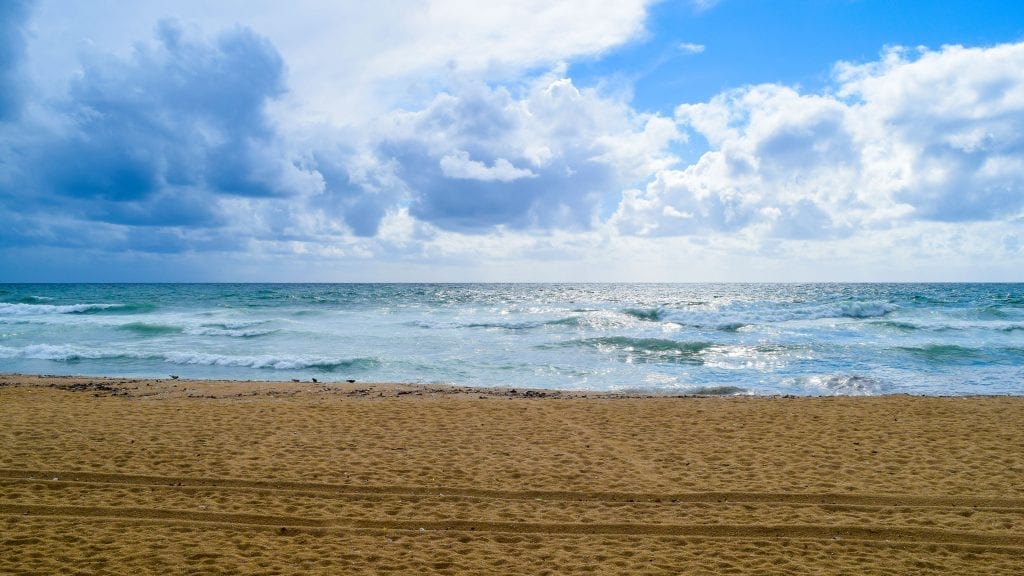
El Masnou has a large marina with restaurants around it and two beaches. Platja del Masnou, on the Barcelona side of the marina, is about 1.2 km long. Platja d’Ocata, next to Ocata station, runs for more than 2 km and is around 50 metres wide, so it’s the easiest place on this stretch to find room for your towel.
Ocata has beach bars (chiringuitos) in summer, and in autumn and winter surfers sometimes wait for waves near the harbour wall.
Premià de Mar: A Local Family Beach
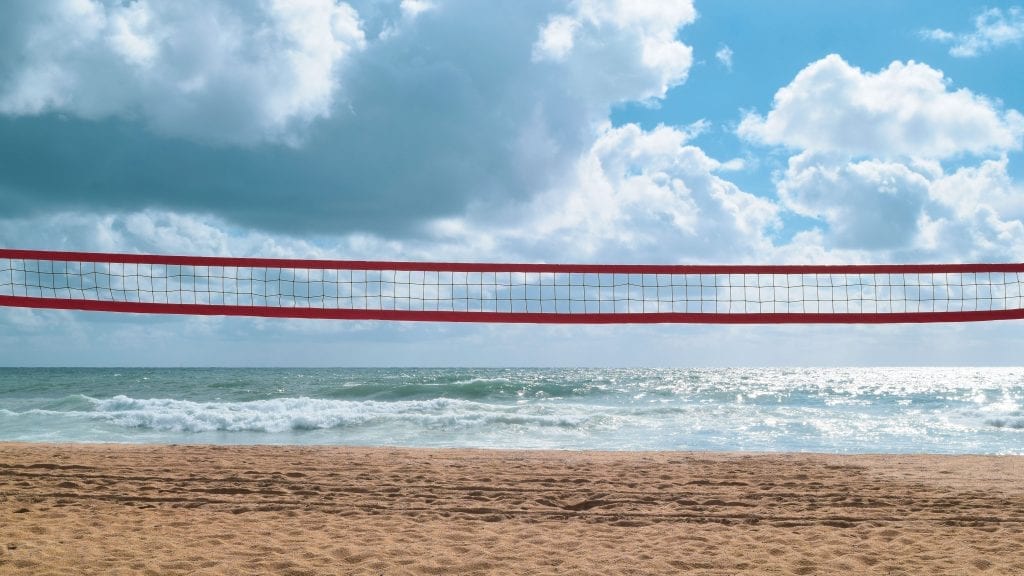
Premià de Mar is a working town with a local beach scene. On summer weekends, families from Barcelona arrive with parasols and cool boxes, and the seafront cafés are a good place to sit with a coffee and watch the sea.
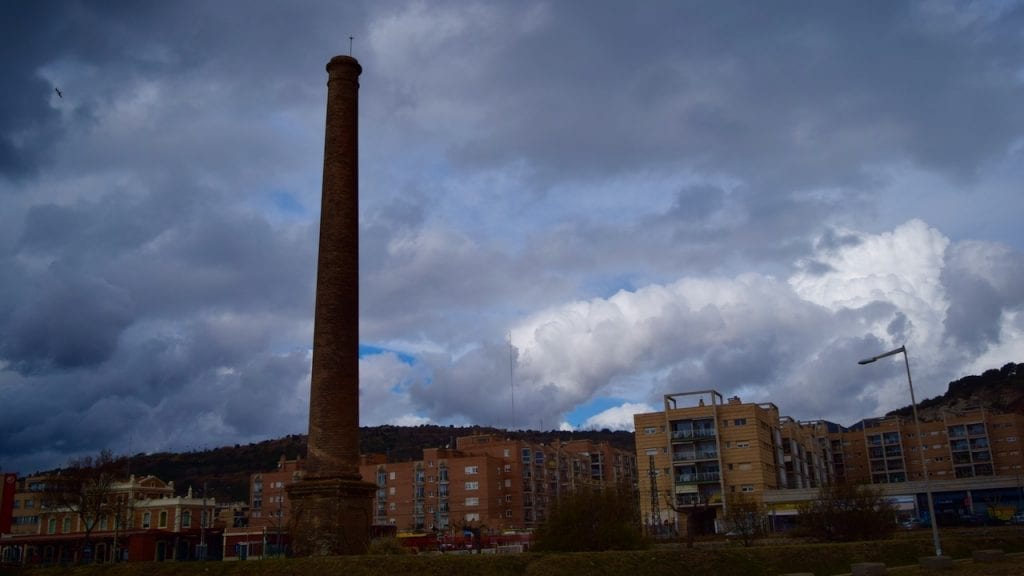
Vilassar de Mar: A Short Walk Into Town
Vilassar de Mar rewards a short walk inland from the beach. The Torre de Can Nadal is an old defence tower from the days when the town had to guard against pirate raids. The Museu de la Marina, in a 1902 Art Nouveau building, tells the story of the town’s fishermen, boatbuilders and transatlantic sailors. Vilassar de Mar station serves the town itself; the next stop, Cabrera de Mar-Vilassar de Mar, is at its northern edge.
Mataró: The Biggest Town, and Gaudí’s First Building
Mataró is the capital of the Maresme and the largest town on the line, about 45 minutes from Plaça de Catalunya. Besides its long beach, it has a sight most Gaudí fans miss: the Nau Gaudí, a cotton-bleaching hall he designed for the La Obrera Mataronense workers’ cooperative, completed in 1883. It’s one of his earliest surviving buildings, and the first place he used the parabolic arches that later appear all over Barcelona. Today it houses the Bassat collection of contemporary art. It usually opens in the afternoons from Tuesday to Saturday, with some weekend mornings, so check the times before you go.
Since 29 September 2026, some weekday R1 trains that normally run to or from Calella start or finish at Mataró while Calella station is being upgraded. Other trains still run through, but check the timetable if you’re heading further north.
The Train Ride Along the Sea
The train journey is part of the attraction.
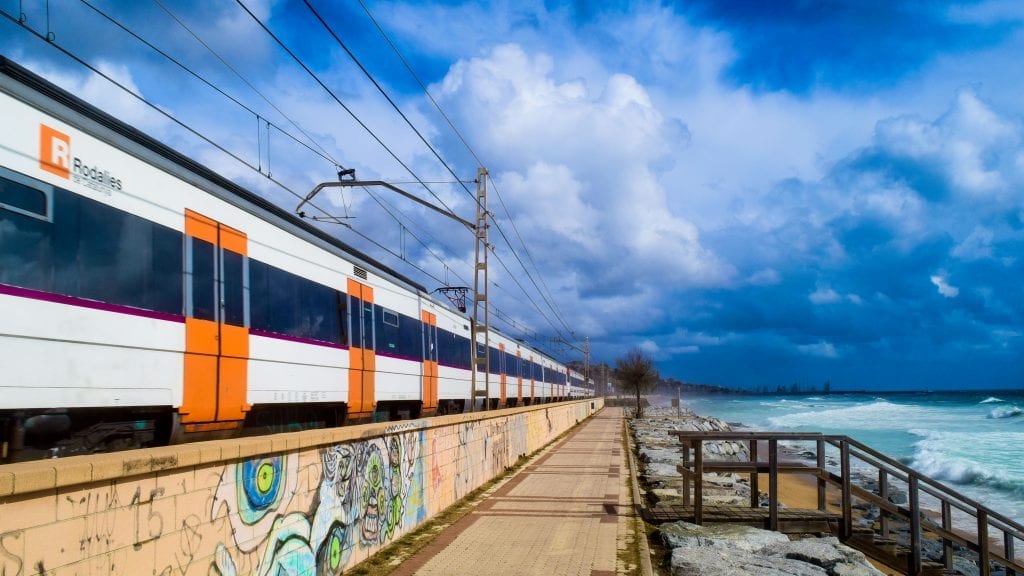
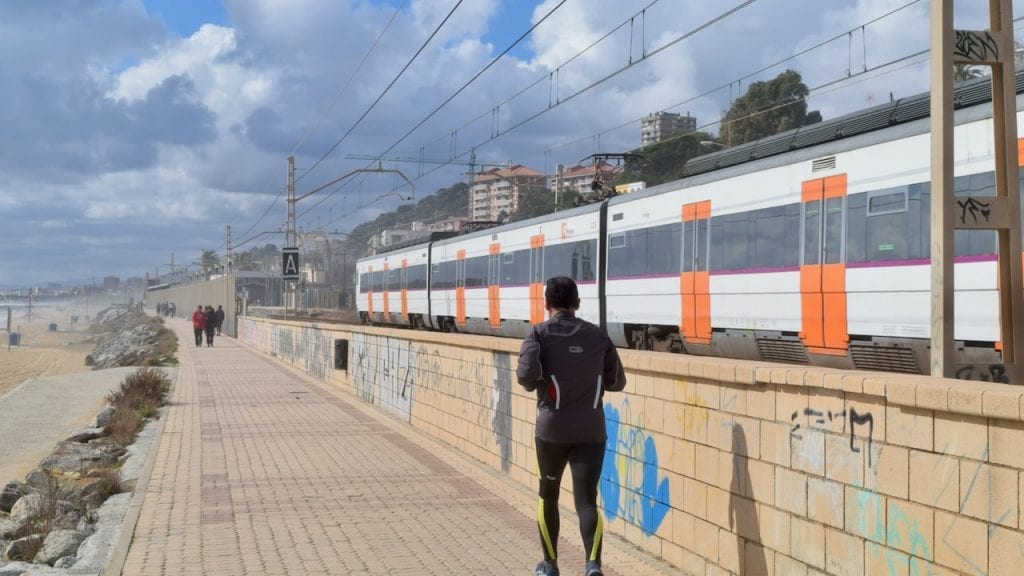
Once you clear the city, the line runs directly beside the sea for much of the way. Sit on the right-hand side heading north (the left on the way back) and you’ll see the Mediterranean rolling blue-green to the horizon, broken by small coves, rocky points and the odd fishing boat.
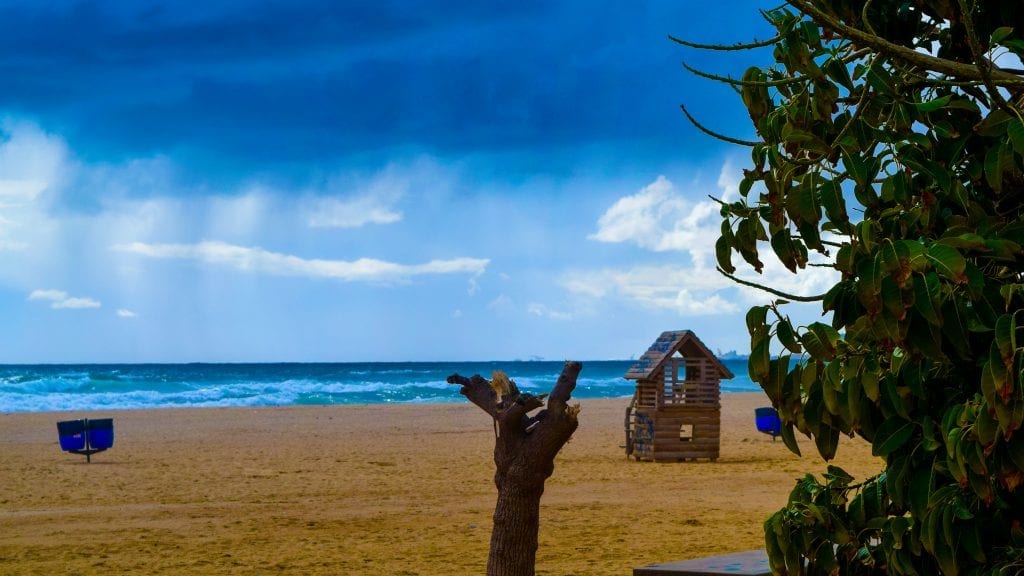
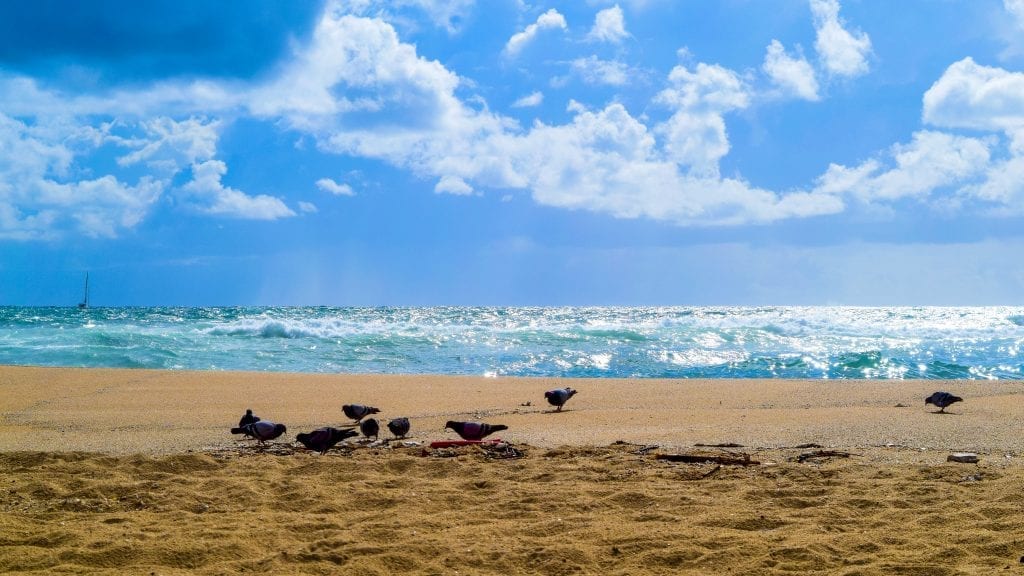
I got on and off almost at random, spending a while on one beach watching pigeons squabble over the same patch of sand, then catching the next train north to see what the next town offered. It’s the ideal day trip if you don’t want a plan.
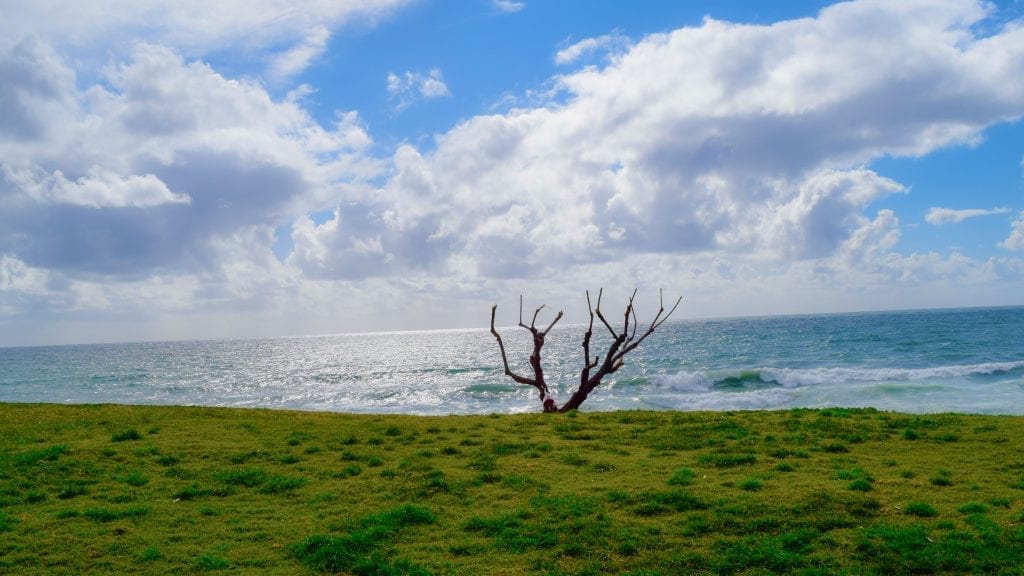
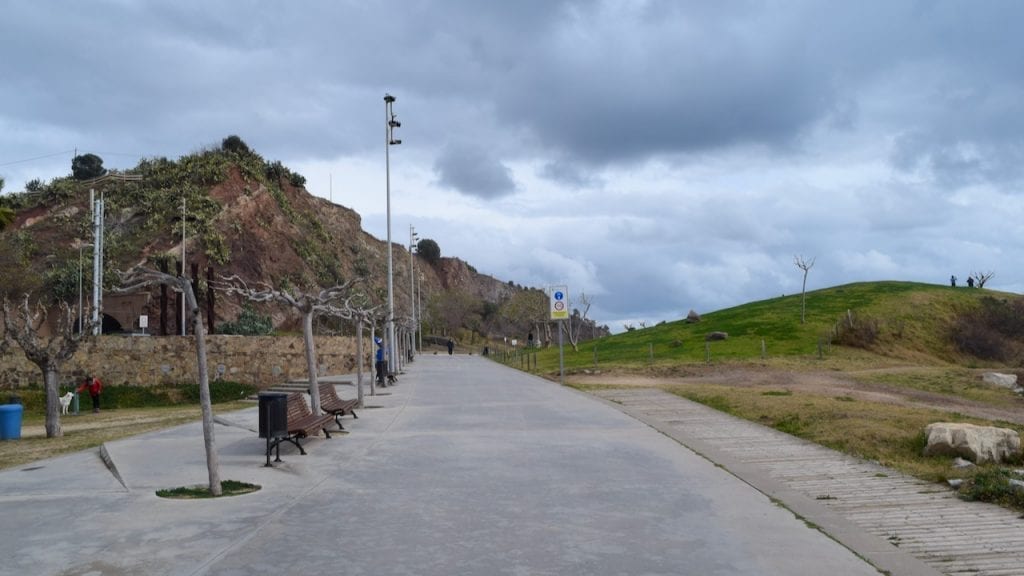
It wasn’t all sandy beaches. There were patches of green too, and a lone tree right beside the sea. I wished I could take its place!
Further on, I came to a harbour full of boats and yachts. I wanted to take one out to sea.
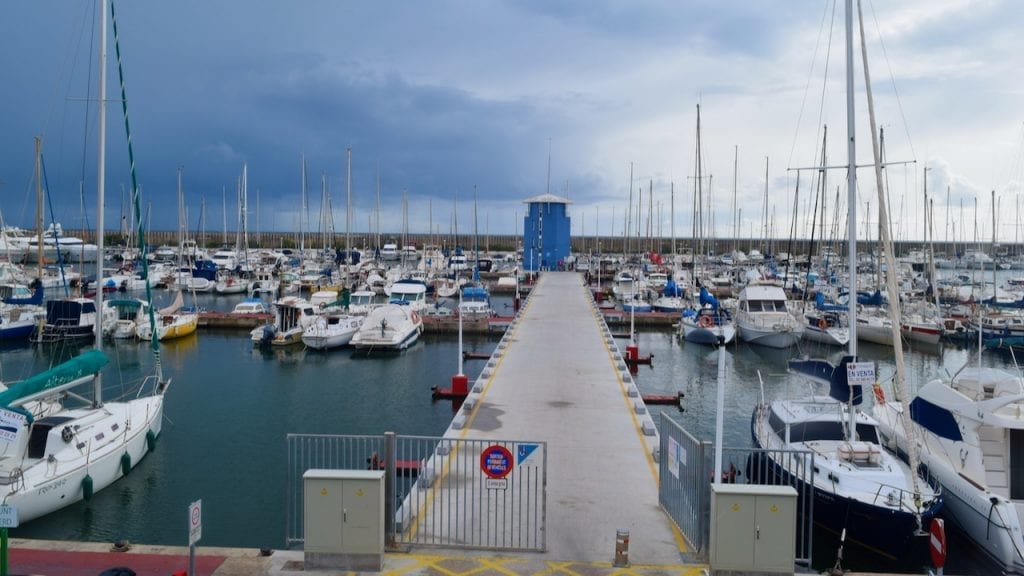
Then the sky turned grey all of a sudden and a storm was looming. I was hungry too, after a whole day of walking and train hopping.
When I first wrote this post, I didn’t name the places where I stopped, because the fun of this route is finding your own. I’ve added the towns above as a starting point, but my advice hasn’t changed: get on the train towards Montgat and get off wherever the sea looks right. You’ll find your own place and pace.
Have you done this trip? Tell me in the comments where you got off; I’d love to hear.
More Beaches Near Barcelona by Train
I haven’t been to the beaches in this section, so it’s based on research rather than my own trip. They’re the other easy train options: further north on the R1 beyond Mataró, and south of the city on the R2 Sud.
Further North on the R1: Caldes d’Estrac, Sant Pol de Mar and Blanes
- Caldes d’Estrac: a small spa town about 50 minutes from Plaça de Catalunya. Platja de la Riera is a long sandy beach that shelves quickly, so it’s good for proper swimming.
- Sant Pol de Mar: about an hour from the city. Platja de les Barques by the station is the convenient one; Platja del Morer is quieter, and Roca Grossa further along is a wilder, rockier beach without lifeguards.
- Canet de Mar: about an hour out, a beach town with Modernista architecture, including the Castell de Santa Florentina.
- Blanes: the end of the R1, about an hour and a half away, where the Costa Brava begins. Sa Palomera, the rock at the end of the bay, is the local sunset spot, and the Marimurtra botanical garden sits on the cliffs above the sea. The station is inland, so allow for a walk or a local bus to the beach. Buses run on to Lloret de Mar and Tossa de Mar; check whether you need to change.
South on the R2 Sud: Castelldefels, Garraf and Sitges
- Castelldefels: about 25 minutes from Passeig de Gràcia. A long, wide beach with fine sand and a gentle slope into the sea, popular with families and kitesurfers. For the beach, use Platja de Castelldefels station, a few minutes’ walk from the sand, rather than Castelldefels station in the town centre, about 2 km inland. Not every train stops there.
- Garraf: a small cove under the cliffs, known for its row of green and white beach huts. Not every train stops here either, so check the timetable.
- Sitges: about 35 to 45 minutes away. A resort town with an old centre, a long promenade and more than a dozen beaches, including Sant Sebastià next to the old town. It’s very busy on summer weekends, so go on a weekday if you can.
⚠️ CHECK FOR ENGINEERING WORKS
Works at Castelldefels station planned for late 2026, which would have replaced R2 Sud trains between Gavà and Vilanova i la Geltrú with buses, were suspended in October and are due to be rescheduled. Rodalies has had a lot of disruption in 2026, so check the Rodalies app or website before you travel, whichever line you take.
The Costa Brava coves further north, such as Tossa de Mar and Calella de Palafrugell, are better reached by bus or car and make for a long day. Don’t mix up Calella de Palafrugell with Calella on the R1, a big resort town an hour from Barcelona.
Train Times, Tickets and Tips
Which Station to Use
For the Maresme, take the R1 from Barcelona Sants, Plaça de Catalunya, Arc de Triomf or El Clot-Aragó. It doesn’t stop at Passeig de Gràcia. For Castelldefels and Sitges, take the R2 Sud from Sants or Passeig de Gràcia. As far as Mataró, R1 trains are frequent (roughly every 10 to 15 minutes, depending on the time of day); beyond Mataró they run less often.
Tickets
A single costs €2.90 to Montgat and rises with each fare zone you cross: €4.15 to El Masnou and Ocata, and €5.40 to Mataró (2026 prices). The ticket machine works out the zones for you, and a return costs the same as two singles. If you’ll make several journeys around Barcelona too, a T-casual (ten journeys, €13 for one zone) can be better value; choose the version that covers all the zones you’ll travel through, and remember it’s for one person only.
💡 SIT ON THE RIGHT
Heading north on the R1, the sea is on the right-hand side of the train. On the way back to Barcelona, sit on the left.
Tips for Your Beach Day
- Go on a weekday if you can. Weekends bring Barcelona families to these beaches in large numbers.
- Expect coarse sand and a quick drop-off. Most Maresme beaches have grainy golden sand and get deep a few steps out, so keep an eye on small children.
- Bring a card and a little cash as a backup for small beach bars.
- Use the underpasses. The railway runs between the towns and the sea, so you usually reach the sand through a pedestrian underpass or bridge rather than straight off the platform.
- Bring a layer outside summer. The sea breeze can be cold even on sunny days in spring and autumn.
- Start at Montgat and work north. Don’t plan every stop; if you like a place, stay longer.
- Pack a picnic. A supermarket or corner shop lunch on the beach costs a fraction of a seafront restaurant.
- Combine it with Barcelona. Half a day in the city and half on the coast is easy, but check the time of the last train back.
Where to Stay: Base Yourself in Barcelona
The beach towns have hotels, but most people use Barcelona as a base and visit the coast as a day trip, which makes sense given how short the train rides are.
If you’d rather stay in one of the coastal towns for a quieter base:
More Day Trips from Barcelona
Loved the coast? Here are more ideas from Barcelona:
- 🏔️ Montseny day trip from Barcelona: hiking through misty mountain forests, about 1.5 to 2 hours away by train and bus
- 🏛️ Things to do in Barcelona: Gaudí, the Gothic Quarter and the city’s best sights
- ⛪ Inside the Sagrada Familia: what Gaudí’s basilica looks like inside
- ⛰️ Montserrat: the mountain monastery, one of Catalonia’s most sacred sites
- 🍷 Penedès: cava and wine country west of Barcelona
This post contains affiliate links. If you book through them, I may earn a small commission at no extra cost to you.
Frequently Asked Questions
What are the best beaches near Barcelona by train?
North on the R1: Montgat, Ocata in El Masnou, Premià de Mar, Vilassar de Mar and Mataró, 20 to 45 minutes away, with Caldes d’Estrac, Sant Pol de Mar and Blanes further up. South on the R2 Sud: Castelldefels, Garraf and Sitges, 25 to 45 minutes away. Ocata is the widest of the nearby beaches; Sitges is the classic resort.
What is the closest beach town to Barcelona?
Badalona, right next door, has city beaches of its own. Montgat, about 20 minutes from Plaça de Catalunya on the R1, is the first that feels like a small beach town, and it’s still in fare zone 1, so a single costs €2.90 (2026).
Which coastal towns are easy day trips from Barcelona?
Montgat, El Masnou, Mataró and Sant Pol de Mar to the north, and Castelldefels and Sitges to the south. All have direct trains from central Barcelona, so you don’t need a car.
Are the beaches outside Barcelona better than Barceloneta?
For space and a local feel, usually yes. Barcelona’s city beaches are handy but packed in summer, while Ocata, the Maresme towns, Castelldefels and Sitges are less crowded and only 20 to 45 minutes away by train.
Is Barcelona a beach town?
It’s a big city with a string of urban beaches, from Barceloneta to Llevant, largely created for the 1992 Olympics. They’re handy but crowded in summer, which is why many visitors take the train to the beach towns along the coast.
Should I go to Sitges or the Maresme coast?
Sitges if you want a lively resort town with an old centre, bars and a well-known LGBTQ+ scene. The Maresme if you want quieter, local beaches and the freedom to hop between several towns in one day.
How much is the train to the beach from Barcelona?
In 2026 a single costs €2.90 to Montgat, €4.15 to El Masnou and €5.40 to Mataró, depending on the fare zones crossed. A return costs the same as two singles.
Is the Maresme coast part of the Costa Brava?
No. The Maresme is the stretch of coast immediately north of Barcelona, as far as Blanes, where the Costa Brava begins. The Maresme is easy by train; most of the famous Costa Brava coves need a bus or a car.
Can you swim at the beaches near Barcelona?
Yes. Summer is the main swimming season, and the sea is around 24°C in August. Lifeguard cover is usually from late June to early September, but dates vary by town, so check the flag colour before you go in.
Are the trains to the beaches running normally?
Mostly, but Rodalies has had a lot of disruption in 2026. On weekdays some Calella trains start or end at Mataró during station works, and works at Castelldefels station that would close part of the R2 Sud have been postponed to new dates. Check the Rodalies app before you travel.

Leave a reply