
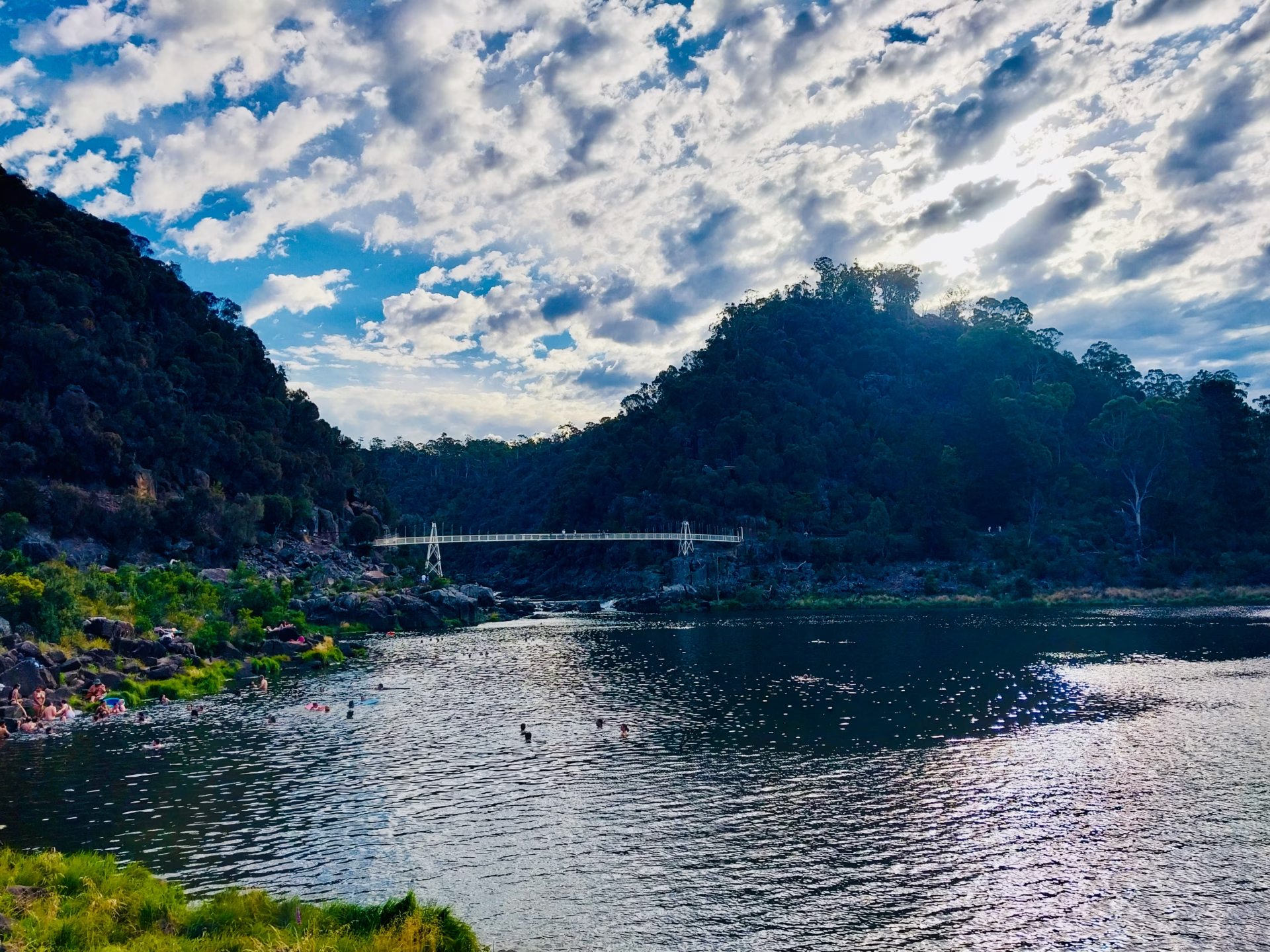
In short: Cataract Gorge is a free nature reserve on the edge of Launceston, about 15 minutes’ walk from the city centre. Give it 2 to 3 hours for the loop walk, the Alexandra Suspension Bridge and a swim (the First Basin pool usually opens from November to March), and ride the chairlift one way if you want the view from above.
I had just come back from a full day at Cradle Mountain. Most people would have called it a day. But it was only early evening, my hotel was in the Launceston CBD, and someone had mentioned that Cataract Gorge was walkable from the city centre. I had nothing but time and slightly tired legs, so I went.
That turned out to be one of the better decisions of the Tasmania trip.
Cataract Gorge is one of those places that defies expectations. You are walking through ordinary Launceston streets, past houses and parked cars and corner shops, and then suddenly the road ends and a deep, rocky gorge opens up in front of you. Rugged dolerite cliffs, a wide green lake, a packed swimming pool, peacocks, a suspension bridge with a waterfall dropping beneath it, and all of it free, all of it within walking distance of the city centre.
Here is everything you need to know before you visit.
Cataract Gorge, Launceston: Quick Summary
- Entry fee: Free
- Distance from Launceston CBD: About 15 minutes’ walk via Paterson St and Kings Bridge
- Swimming pool: Free; usually open November to March
- Chairlift hours: Daily from 9am; closes 4:30pm (winter), 5pm (spring and autumn), 5:30pm (summer)
- Chairlift price: About A$15 one way, A$20 return for adults (recent visitor reports; tickets at the office only)
- Alexandra Suspension Bridge: Free; maximum 60 people at a time
- Parking at First Basin: A$1 an hour or A$6 a day (9am to 5pm); gates lock at 10pm
- Buses: Metro buses are free statewide until 30 June 2027; the Tiger Bus gorge shuttle ended in October 2025
- How long to allow: 2 to 3 hours
- Best time to visit: Weekday mornings to avoid crowds
- Must bring: Towel and a spare set of clothes if swimming
Getting There: The Walk from Launceston CBD
The walk from central Launceston to Cataract Gorge takes about 15 minutes. The route follows Paterson Street, crosses Kings Bridge over the South Esk River, and leads directly into the gorge reserve. It is a pleasant walk: you pass through the city, then along the river, and the transition from urban streets to wilderness is surprisingly abrupt.
I noticed the road sign pointing to the gorge while still in the middle of town. At that point it still felt like I was in a city.

One thing to know: the walk is uphill on the way there and downhill on the return. It isn’t steep, but bear it in mind when you plan the day. After a long day at Cradle Mountain, the downhill walk back through the city felt like a reward.
If you’d rather not walk, note that the council’s free Tiger Bus, which used to stop at the gorge, ended in October 2025. Regular Metro buses are free across Tasmania until 30 June 2027 (you just hop on), but walking is still the easiest way from the city centre. You can also drive. There’s a car park at First Basin on Basin Road, though it fills quickly on weekends and summer afternoons.
Arriving at First Basin
The First Basin entrance is the main entry point for most visitors. The welcome sign makes the place feel properly set up: this is not a rough bushwalk, it is a well-maintained reserve with toilets, a kiosk, and proper facilities throughout.

Just inside the entrance is the Gorge Scenic Chairlift, and if you have not heard of it, the sign makes the claim plainly: world’s longest single chairlift span. The total length is 457 metres with a centre span of 308 metres. It runs from First Basin across to the Cliff Grounds on the far side of the gorge, giving you a bird’s eye view of the whole reserve.

I did not ride it on this visit: I had arrived in the evening and my focus was on the gorge itself. It runs every day from 9 am, closing at 4:30 pm in winter, 5 pm in spring and autumn and 5:30 pm in summer, and the ride takes about 10 minutes each way. Tickets are sold only at the ticket office, with no online booking; recent visitors report about A$15 one way and A$20 return for adults. The smart approach is to ride one way and walk back: you get the aerial view without paying for the return.
The swimming pool and the gorge
When you walk into First Basin, two things present themselves almost immediately: an artificial swimming pool on your left, and the natural gorge stretching out ahead of you.
The pool is large, well-maintained, and packed. On the evening I visited, it was surrounded by families, teenagers, people sunbathing on the grass, and what felt like half of Launceston. This is clearly the local go-to spot on a warm day, the equivalent of a city beach, but inside a gorge.

The pool is free and usually open from November to March, with lifeguards on duty every day in the Tasmanian school holidays and at weekends otherwise. Outside the swimming season, the gorge walk and the rest of the reserve are just as good.
But I skipped the pool. The natural gorge looked far more interesting.

The water in the gorge is cold. Properly cold. The South Esk River flows through here year-round and does not warm up much even in January. I jumped in anyway. The cold hit immediately, the kind of cold that clears your head completely and makes you wonder briefly why you made this decision, and then it felt extraordinary. I swam for a while, got out, and felt completely revived after a long day.
Important tip: bring a towel and a spare set of clothes. I had neither, which made for an interesting walk back to the hotel. Do not make the same mistake.
The Loop Walk: a Peacock, a Pademelon and the Bridge
After swimming I followed the path around the lake for the loop walk. This is where the gorge goes from impressive to special.
The path winds through native bushland along the edge of the water, with the dolerite cliffs rising on either side. It is an easy walk: mostly flat, well-surfaced, and suitable for most fitness levels. The full loop takes about an hour at a comfortable pace.

At one point I reached a directional signpost pointing left to Alexandra Suspension Bridge and right to the Band Rotunda and Restaurant. I was about to follow the sign when I noticed I was not alone on the path.

The peacocks at Cataract Gorge are residents: they live here and wander the reserve freely. Seeing one on the walking path, completely unbothered by people, was one of those unexpected moments that makes a place memorable.
Shortly after, I noticed movement in the undergrowth to the side of the track. My first instinct was baby kangaroo. Someone nearby gently corrected me: it was a Pademelon.

Pademelons are small marsupials, smaller and rounder than wallabies, with shorter tails. They are native to Tasmania and common in bushland areas, but this was my first sighting of the entire Australian trip. I had visited Cradle Mountain that same day and missed them there. They appeared at Cataract Gorge, in a city reserve, on an ordinary evening walk. Tasmania continues to surprise.
Alexandra Suspension Bridge
The path leads to the Alexandra Suspension Bridge, first built in 1904, with a maximum load of 60 people, and a sign at the entrance politely asking you not to swing it. The bridge spans the South Esk River at a point where the gorge narrows dramatically, and what you see from the middle of it stopped me completely.


Looking upstream from the bridge, the river drops over a natural weir in a wide curtain of white water, crashing down over the dark dolerite rocks below. The current beyond it looked powerful. And yet there were people swimming right beside it, perched on the rocks at the edge, sitting in the calmer pools just above the drop. That takes a particular kind of confidence in the water.
Looking back downstream from the bridge, the view opens out into the full panorama of First Basin.

This is the shot that captures the whole place in one frame: the wide dark lake, the cliffs on both sides, the green lawn, the swimming pool at the edge, and the forested hills above. It is a remarkable view for somewhere less than a kilometre from the centre of a city.
Best time to visit Cataract Gorge
Cataract Gorge is open year-round and good in every season, but the experience changes significantly depending on when you go.
- Summer (December to February): Warm and busy. Pool open. Gorge swimming possible. Best for: Swimming, full loop walk, families. Peak crowds: arrive early or go on weekdays.
- Autumn (March to May): Cooler, quieter. Pool closes end of March. Foliage colours in the gardens. Best for: Walking, photography, fewer crowds. Cliff Grounds garden at its best.
- Winter (June to August): Cold, sometimes misty. Pool closed. Gorge can flood after heavy rain. Best for: Atmospheric photography, solitude, dramatic water levels.
- Spring (September to November): Warming up. Pool reopens in November. Wildflowers in the gardens. Best for: Wildlife spotting: pademelons and wallabies most active. Chairlift less crowded.
For swimming, come between November and March: that is when the pool is open and the gorge water is at its most swimmable. I visited in January and the place was buzzing with energy, locals treating it exactly like a city beach.
For the walk without the crowds, a weekday morning is best regardless of season. By late afternoon in summer the car park is full and the pool fence is lined three deep.
Whatever time of year you visit, bring layers: the gorge itself is sheltered but the walk from the city can be exposed, and Tasmanian weather changes quickly.
The walk back through Launceston
The return walk retraced the route back through the gorge and up through the residential streets of West Launceston. Because the gorge sits slightly lower than the surrounding city, the walk out is uphill, but not demanding.
At the top of the hill, with the late evening light behind me, I stopped and looked back over Launceston.

The church spire, the rooftops, the mountains in the distance under a moody sky. It was a good moment at the end of a very full day: Cradle Mountain in the morning, Cataract Gorge in the evening, and a walk through the city connecting both.
What else is at Cataract Gorge
The reserve has more to it than the loop walk and the swimming. A few more things to know about:
Duck Reach Power Station: a walk of about 1.5 to 2 hours return upstream along the South Esk River leads to the historic Duck Reach Power Station, which opened in 1895 and is now an interpretive centre. It was one of Australia’s earliest hydroelectric power stations. A suspension bridge at the power station makes the walk into a loop.
Cataract Gorge Cruise: if you want to see the gorge from a completely different perspective, a 50-minute cruise takes you along the South Esk River and into the gorge by boat, looking up at the dolerite cliffs from the water rather than down from the walking track. A good option if you have done the loop walk and want to see the place from a different angle, or if walking is not practical.
Gorge Scenic Chairlift: daily from 9 am, closing between 4:30 pm and 5:30 pm depending on the season. Recent visitors report about A$15 one way and A$20 return for adults. The smart move is one way across, then walk back.
Kings Bridge: the iron arch bridge at the mouth of the gorge, first installed in 1867. Pause on the walk in to look at the structure and the view upstream.
Practical information
Entry: Free. The swimming pool usually opens from November to March.
Getting there on foot: 15-minute walk from the Launceston CBD via Paterson Street and Kings Bridge. The route is well-signposted from the city centre.
Getting there by bus: The council’s free Tiger Bus ended in October 2025. Regular Metro buses are free across Tasmania until 30 June 2027, but walking from the city centre is still the easiest option.
Getting there by car: Follow signs from York Street to Hillside Crescent and Basin Road. Parking at First Basin costs A$1 an hour or A$6 a day (charged 9 am to 5 pm), and the car park gates lock at 10 pm. Arrive early on summer weekends, as the car park fills up.
What to bring: Towel and spare clothes if you plan to swim. Comfortable shoes for the loop walk. Water. The Basin Café and the Gorge Kiosk at First Basin sell food and drinks.
How long to allow: The loop walk takes about an hour. Add 30 minutes for swimming, 30 minutes for the chairlift if you ride it, and more if you walk to Duck Reach. A comfortable visit covering the main highlights takes 2 to 3 hours.
Swimming: The First Basin pool is free and usually open from November to March, with lifeguards in the school holidays and at weekends. The natural gorge can be swum by strong swimmers when the current is gentle, so check conditions before you get in. The water is cold all year. Bring a towel, as there are none to hire.
Chairlift: About A$15 one way and A$20 return for adults, going by recent visitor reports; tickets are sold only at the ticket office. Open daily from 9 am, closing at 4:30 pm in winter, 5 pm in spring and autumn and 5:30 pm in summer. Closed in severe weather.
After the gorge: The walk back through West Launceston gives you a good view over the city from the higher streets. If you are staying centrally, the whole visit including the walk there and back can be done in an afternoon without a car.
Frequently asked questions
Is Cataract Gorge free?
Yes. The reserve, walking tracks, gardens, Alexandra Suspension Bridge and the First Basin pool are all free. The only costs are the chairlift and parking at First Basin (A$1 an hour or A$6 a day) if you drive.
Can you swim at Cataract Gorge?
Yes, in two ways. The First Basin pool is free and usually open from November to March, with lifeguards in the school holidays and at weekends. I swam in the natural gorge too: it’s cold all year and the current can be strong, so only swim there if you’re confident and conditions are calm.
How far is Cataract Gorge from Launceston city centre?
It took me about 15 minutes to walk to the gorge via Paterson Street and Kings Bridge, and First Basin is a little further. The free Tiger Bus shuttle ended in October 2025, though regular Metro buses are free across Tasmania until 30 June 2027.
How much is the Cataract Gorge chairlift?
Recent visitors report about A$15 one way and A$20 return for adults. Tickets are sold only at the ticket office. It runs daily from 9 am, closing at 4:30 pm in winter, 5 pm in spring and autumn and 5:30 pm in summer, and the ride takes about 10 minutes each way.
Is the Cataract Gorge pool open?
The First Basin pool usually opens from November to March, depending on the weather. Entry is free.
How long should you spend at Cataract Gorge?
Allow 2 to 3 hours. The main loop walk with the Alexandra Suspension Bridge took me about an hour; add time for a swim, the chairlift, or the walk to Duck Reach Power Station (about 1.5 to 2 hours return).
What animals can you see at Cataract Gorge?
Peacocks roam the reserve and often walk along the paths. I also saw a pademelon, a small native marsupial, in the bushland beside the track in the early evening.
Is Cataract Gorge worth visiting?
Yes. It’s one of the best free things to do in Launceston: dramatic gorge scenery, swimming, wildlife, a historic suspension bridge and bush walks, all within walking distance of the city centre.


Leave a reply